
Review · LISBON CITY TOURS
Lisbon Walking Tour – The Perfect Introduction to the City
Start in the riverfront, then history happens. This 2.5-hour Lisbon Walking Tour threads through Baixa and Chiado, pairing Santa Justa Elevator views with the story of the 1755 earthquake and how Lisbon rebuilt itself. I like that it gives you a downtown map in your head quickly, and I love that the listed stops have free admission, so your $1.25 ticket mostly pays for the guide.
One consideration: the route packs in 15 stops in about 2 hours 30 minutes, so the pace may feel quick if you want every detail at a relaxed speed.
Key highlights to know before you go
- A first-day orientation across Baixa and Chiado, starting at Praça do Comércio and ending around Praca Luis de Camoes
- Earthquake and revolution in real places, including Carmo Church ruins area at Largo do Carmo and the Carnation Revolution site
- Free-entry stops on the route, from Praça do Comércio to Bairro Alto
- A small group cap of 20 people, with a mobile ticket and an English-speaking guide
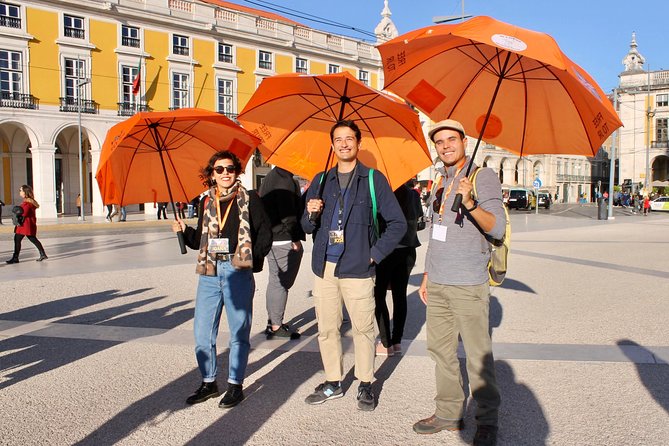
- Spot-the-guide simplicity, the guide uses an orange umbrella at the main meeting point
- Tip your guide at the end, pay whatever you see fit based on your experience
Meeting at Praça do Comércio, then walking Lisbon with an orange-umbrella guide
Your tour starts in Praça do Comércio, Lisbon’s big riverfront square. The meeting point is at Praça do Comércio, and the guide should be easy to spot: look for the orange umbrella between the big arch and the statue in the middle.
This is a smart place to begin. You start with the widest open space in the area, so it’s easier to orient yourself before your feet start turning toward narrower streets and tighter corners. It also sets the tone for the tour: you are not just collecting photos, you are learning how downtown Lisbon is laid out.
You can also read our reviews of more walking tours in Lisbon



Praça do Comércio and the Municipal Square, where the downtown center gets its structure
Stop 1 is the Statue Of D. Jose I at Praça do Comércio. Stop 2 is Praca do Comercio, described as the biggest square in Lisbon, with time built in for photos and context.
Then you move to Stop 3, the Municipal Square, where the city hall is located. Even if you do not plan to go inside buildings, these are the kinds of places where you can feel how public life and power sit at the heart of the city. In a short walking tour, that matters, because it gives your history lessons a real address.
Santa Justa Elevator sights, then Praca Dom Pedro IV and Rua Augusta
Stop 4 is Elevador de Santa Justa, one of the most famous landmarks in Europe. This is one of those Lisbon spots that looks dramatic even when you are only viewing it from the street, and it’s also a natural transition point, from open plaza space toward the busiest downtown streets.
Stop 5 is Praca Dom Pedro IV, noted as the oldest square in Lisbon. Stop 6 is Rua Augusta, described as Lisbon’s most important street. This is where the walk becomes more about movement, crowds, and atmosphere, because Rua Augusta is the kind of street you instantly recognize on postcards.
If you like tours that connect buildings and streets to the story of why they exist, this section is built for you. You get the landmark moments, then you get the street spine that links everything.
A 1506 memorial, Igreja de S Domingos, and the shift to Avenida da Liberdade
Stop 7 is a Memorial as Vitimas do Massacre Judaico de 1506, honoring the thousands of Jewish victims of the 1506 massacre. Stop 8 is Igreja De S Domingos, one of the most impressive churches in Europe.
That pairing is important. It keeps the tour from feeling like a greatest-hits photo walk. You are shown a painful chapter of Lisbon’s past, then you shift into major religious architecture, which helps you understand that the city’s story includes both violence and devotion.
Then you head to Stop 9, Avenida da Liberdade, Lisbon’s most fancy avenue. Stop 10 is Casa do Alentejo, described as one of the most charming houses in Lisbon. This is your visual reminder that downtown Lisbon does not stay in one style forever. You are moving from historic cores toward a more upscale, wide-avenue feel.
Largo do Carmo: Carmo Church ruins and the Carnation Revolution place
Stop 11 is Largo do Carmo, the place where the Carnation Revolution took place. This is one of the tour highlights because it anchors a major modern event to a specific street location you can stand on.
It also ties into the tour’s other big theme: the aftermath of disaster and the changes that followed. The experience is built around learning about the Great Lisbon Earthquake of 1755, and Carmo Church ruins are part of that story arc. Even if you only see ruins from the outside, they carry weight because they explain Lisbon’s rebuilding, not just Lisbon’s aesthetics.
When I think of this kind of stop, I like that you are not rushed through it. Largo do Carmo is given time, and you are positioned in the right spot to connect what you see with what the guide explains.
You can also read our reviews of more city tours in Lisbon





Estacao do Rossio and Igreja de Sao Roque, the earthquake survivor in plain sight
Stop 12 is Estacao Do Rossio, the old central station of Lisbon. Even though it is not a museum stop on this tour, the station gives you a sense of how people moved through the city, especially before the modern transit network fully took over.
Stop 13 is Igreja de Sao Roque, one of the only churches in Lisbon to survive the Earthquake in 1755. This is a key moment in the tour because it turns the earthquake from a headline into a visible fact. You can point to what stood, what did not, and why that difference matters.
In a short walk, that is a lot to pack into one section, but this is exactly the value of guided storytelling. You are not just seeing a church, you’re getting a reason it matters that you can carry with you as you continue exploring.
Praca Luis de Camoes and Bairro Alto, finishing with real next-step options

Stop 14 is Praca Luis de Camoes, one of the most iconic squares of Lisbon. The tour ends around Camões Square, and that is useful because it’s a natural springboard for your next hours.
Stop 15 is Bairro Alto, the famous nightlife area of Lisbon. You get the historical overview earlier, then you finish close to the area where many people end up when they want evenings with energy.
This is also a practical finish. Ending near an iconic square helps you feel like you have a base, not just a walking line that disappears into the distance.
Price and value: how $1.25 plus a tip can work out well
The price is listed as $1.25 per person for the Lisbon Walking Tour. That is strikingly low for a 2 hours 30 minutes guided walk through the core downtown area, especially when your route includes stops like Santa Justa and major squares.
The reason the value feels strong is that the listed stops are free to enter (the itinerary shows free admission for the stops on the route). So you are not spending your time queuing for tickets inside attractions. You’re spending your time walking, listening, and learning how the city connects.
One more value factor is that the tour is designed for a small group, with a maximum of 20 travelers. Smaller groups generally mean your guide can handle questions and keep the flow moving.
Just know the experience also includes guide payment at the end, in the form of pay-what-you-see-fit tipping. That can feel totally normal if you’ve done free walking tours before. If you prefer a fixed-price approach with no tip conversation at the end, plan your expectations ahead of time.
Pacing, rain gear, and how to get what you came for in 2.5 hours
This tour runs about 2 hours 30 minutes, and it covers 15 stops. That means you should treat it like an orientation walk, not like a slow museum visit. If you want more detail on one topic, make a note of it during the walk and circle back afterward on your own.
Comfort matters here. Wear comfortable shoes. Also, if rain is in the forecast, bring an umbrella or a rain poncho, because this kind of walk continues in wet weather.
Language is another practical point. The tour is offered in English, and the best results happen when you actively ask questions. If you ever miss something because the guide is moving at full speed, request repetition. This is one of those tours where a quick clarification can turn a blur into a clear story.
Who this tour fits best, and who may want a different style
I think this tour is ideal if:
- You are in Lisbon for the first time and you want the center of town explained in one morning or afternoon.
- You want a mix of major landmarks and real context, including the Great Lisbon Earthquake of 1755 and the Carnation Revolution.
- You like guides who share practical pointers, such as food and sightseeing recommendations. Guides on this route have a reputation for offering tips that help you move through Lisbon more easily.
It may be less ideal if:
- You strongly prefer fixed pricing with zero tip talk.
- You need long, unhurried stops to absorb details, because the route is compact and moves between squares.
- You have trouble following fast-paced explanations, since the tour’s format compresses a lot into one walk.
Should you book this Lisbon Walking Tour?
Yes, if you want a high-value, low-commitment way to get grounded fast in Lisbon’s downtown. For first-time visitors, the combination of Praça do Comércio, Santa Justa views, the earthquake story, and the Carnation Revolution location is exactly the kind of mental map you want early in the trip.
I’d especially book it on one of your first days. Not because you have to, but because the tips and the geography you learn make the rest of your Lisbon wandering far less confusing.
FAQ
How long is the Lisbon Walking Tour?
The tour lasts about 2 hours 30 minutes.
How much does the tour cost?
The price is $1.25 per person.
Is the tour offered in English?
Yes, the tour is offered in English.
Where do I meet the guide?
Meet at Praça do Comércio, Lisbon, Portugal. The guide should be at the arch area, between the big arch and the statue in the middle, and they use an orange umbrella.
Where does the tour end?
The tour ends around Praça Luís de Camões (Camões Square) in Lisbon.
Do I need a mobile ticket?
Yes, the tour uses a mobile ticket.
Are admission tickets needed for the stops on the route?
The stops listed on the itinerary show free admission.
How many people are in the group?
The tour has a maximum of 20 travelers.
What should I do about paying the guide?
At the end of the tour, pay your guide whatever you see fit.
Can I cancel and get a full refund?
Yes. You can cancel up to 24 hours in advance for a full refund. If you cancel less than 24 hours before the start time, the amount paid is not refunded. If the tour is canceled because a minimum traveler number is not met, you are offered a different date or a full refund.
More Walking Tours in Lisbon



More Tours in Lisbon




More Tour Reviews in Lisbon



Not for you? Here's more nearby things to do in Lisbon we have reviewed











Lisbon City Tours, side by side.
 ★ 5.0Lisbon City Center Tour – The Unmissable LisbonTickets from $322,234 traveller reviews
 ★ 4.7Sintra, Pena, Regaleira, Cabo da Roca & CascaisTickets from $2319,656 traveller reviews
 ★ 4.1Jerónimos Monastery Entrance TicketTickets from $2114,164 traveller reviews
 ★ 4.8History, Stories and Lifestyle Walking TourTickets from $2910,902 traveller reviews
 ★ 4.5Sunset Boat Party Cruise with DJ and Open BarTickets from $2710,378 traveller reviews
 ★ 4.7Pena Palace, Sintra, Cabo da Roca, & Cascais DaytripTickets from $919,981 traveller reviews
 ★ 4.6Oceanário de Lisboa Entrance TicketTickets from $299,943 traveller reviews
 ★ 5.0True 4Hour Private Tuk Tuk Tour: Discover Lisbon with a Local!Tickets from $1088,008 traveller reviews
More useful lists for this tour