
Review · HISTORICAL TOURS
Private Tour to Evora and Merida – World Heritage City of the Roman Empire
Roman ruins and a bone chapel in one day. This private route mixes Mérida’s Roman Art with Évora’s famously unsettling chapel of human remains, plus a stop at Badajoz’s fortress quarter. It is a packed day with big “wow” moments, built around Roman sights that are still standing.
I especially like how the tour hits both the art and the architecture: you get museum mosaics and sculptures in Mérida, then you step into the Roman Theater and see the Temple of Diana in the same rhythm. You also get the full Évora contrast, from medieval streets to the bone chapel, which is unforgettable. The one drawback is the time pressure, since the schedule moves from site to site with shorter stops, so you need to enjoy quick looks over deep study.
One more plus for comfort and flow: you get pickup and drop-off around Lisbon, Cascais, Sintra, and Almada, and you travel in an air-conditioned minivan with a guide. If your guide is Hugo, for example, you can expect clear explanations that connect dates, builders, and what you are seeing on the ground. Just note that the day runs about 10 hours, so plan for long drives and wear shoes you can walk in.
Key things to know before you go
A private day with Roman “must sees” across Spain and Portugal, not a quick coach hop.
Mérida’s museum-first stop sets context for what you see at the theater and temples.
The Roman circus details include the legions tied to the Cantabrian Wars.
Évora’s bone chapel is the emotional anchor of the day, with human remains as decoration.
Many admissions are listed as free on this route, which improves value for a full day out.
Why Badajoz, Mérida, and Évora fit together so well
This tour works because it treats the Roman Empire like a story you can walk through. You start in Badajoz at a cultural fortress area, then shift to Mérida for the heavy Roman lifting: mosaics, sculpture, theater, temples, circus, and aqueduct ruins. Finally, you end in Évora where the layers keep stacking, Roman foundations followed by Moorish fortifications, medieval streets, and the bone chapel that turns history into a real-life shock.
I like tours that give you context before you stare at stone. Here, Mérida’s museum stop is the setup, so the later ruins make more sense in your head. Then Évora provides the emotional reset, because the bone chapel is not just another view, it is a distinctive monument that makes you pause and look longer than you planned.
The realistic trade-off is that the itinerary is tight. Several stops are around 10 to 30 minutes, which means you will see the key parts but you will not “linger forever.” If you prefer slow wandering and long museum time, you may feel a little rushed. If you like a curated highlights route with interpretation, this day plan is a strong match.
You can also read our reviews of more city tours in Lisbon


Private minivan pickup in Lisbon, Cascais, Sintra, and Almada
Logistics can make or break a day trip, and this one removes the hardest part: getting everyone to the same start point. You arrange your pick-up and drop-off address in the Lisbon region, including Lisbon, Cascais, Sintra, and Almada. That means you can start your day without hunting for a meeting place.
The transport is an air-conditioned minivan, and the tour runs as a true private experience, so you are not waiting for a large group. That matters on an international route, since you are crossing from Portugal into Spain and back. A private pace also helps if someone in your group needs a bathroom stop along the way, or if you want a few extra minutes at a site before moving on.
One small thing to keep in mind: pickup details are based on the address you provide, so double-check that you give a correct address and not a landmark. Also, the tour notes that it is near public transportation, but it is designed around private pickup, so do not plan on hopping on and off independently.
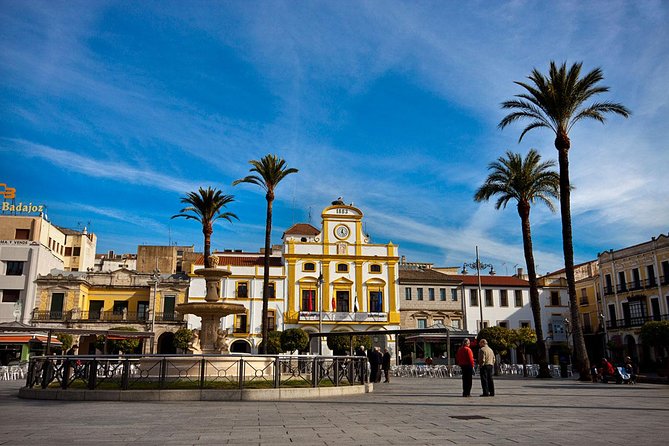
Stop in Badajoz at the Ayuntamiento area and the fortress culture zone
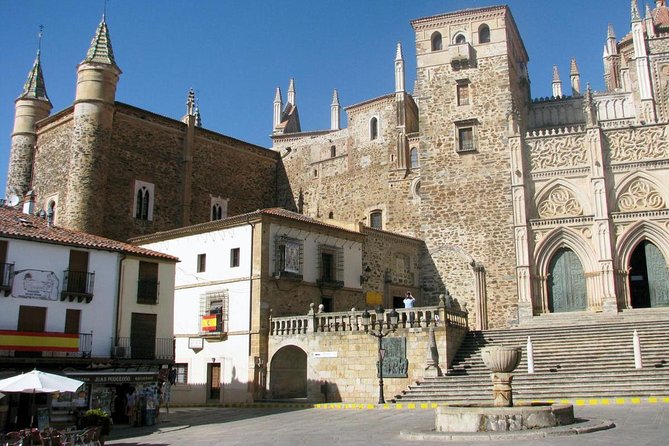
Your first real hit of history is in Badajoz, at the Ayuntamiento de Badajoz area. The tour frames this city as a fortress dedicated to art, with the Arab Alcazaba or fortress presiding over bastions and city walls. A lot of the fortified spaces have been restored, and that is why you get more than views of old stone. You also get a sense that the area is used for cultural institutions now.
Even though the time here is about 30 minutes, you can still get value if you focus on what you are seeing from the outside: the shape of the defensive system, how the walls and bastions define neighborhoods, and how restoration turns a military layout into a cultural one. The route specifically points out places like the MEIAC and museum spaces such as the Archaeological Museum and the Carnival Museum area.
This first stop is also a smart warm-up. It shifts your brain from Portuguese pacing into Iberian fortress-city thinking before you jump into Roman Mérida.
Mérida’s National Museum of Roman Art: mosaics that explain the ruins
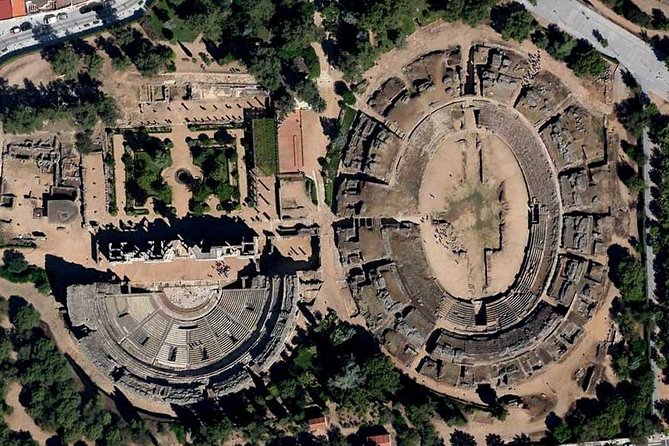
Mérida is where the day becomes Roman-focused in a big way. You start with the National Museum of Roman Art, given about one hour on this route. The key benefit of starting here is that the museum shows Roman mosaics, sculptures, and artifacts collected from nearby theater and amphitheater contexts.
If you have ever felt lost at a Roman site because the buildings are scattered, this museum-first approach fixes that. You can see the craftsmanship up close, then translate that into what you later spot outdoors. It also gives your imagination handles. Instead of only reading about decoration, you recognize motifs and materials, and you start noticing the kind of public spectacle these sites supported.
The tour lists this museum stop as admission ticket free. That matters for value. Museums can vary wildly in price across Spain and Portugal, so a free entry for a full hour of Roman art is a genuine win on a day that already includes several major monuments.
Roman Theater of Mérida: built by Marco Vipsanius Agrippa
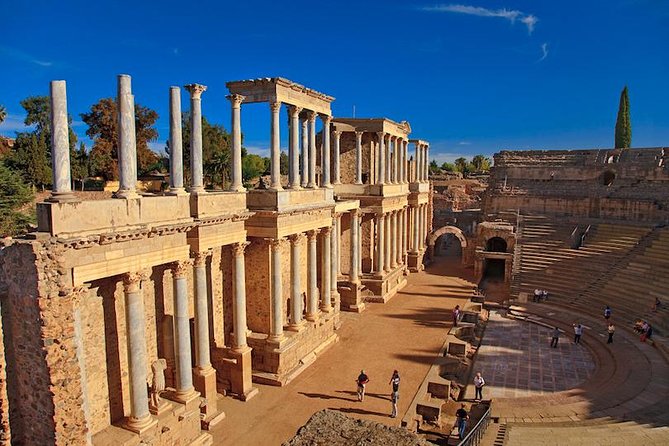
After the museum, the route steps into the Anfiteatro Romano de Mérida, which is tied to Roman theater time on the schedule. You get about one hour here, and the admission ticket is listed as included.
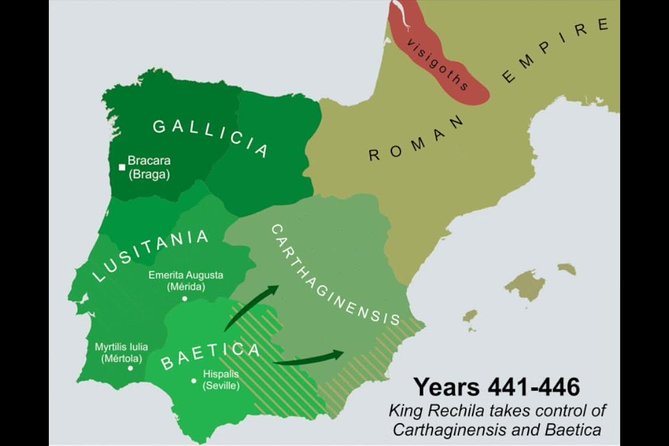
The guide information you are given for this stop is not vague. The Roman Theater of Mérida is attributed to consul Marco Vipsanius Agrippa, and it is noted that it was possibly opened between 16 to 15 AD. Those dates help you place the site in the broader Roman timeline, especially when you are seeing later Lusitania-era monuments on the same day.
Practical tip: Roman theaters and amphitheater complexes can be visually stunning from multiple angles. Try not to lock yourself into one photo position. Walk a little, look at the seating layout, then glance back toward the stage area to get a feel for how performance and civic life worked together.
Also, keep your expectations aligned with the time. You will not get a lecture on every architectural feature, but you will get a solid guided orientation plus enough time to appreciate scale.
You can also read our reviews of more private tours in Lisbon





Temple of Diana: a Roman stop that travels well
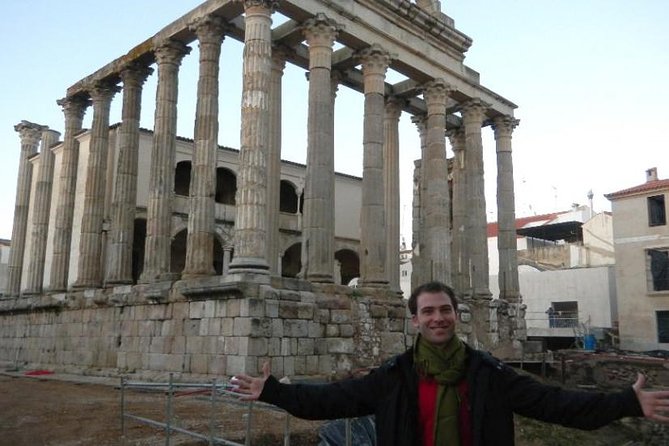
Next comes Templo De Diana, scheduled for about 30 minutes with admission listed as free. This is one of those sites that works even if you are tired, because the structure is easy to read quickly. You see the Roman temple built through the late 1st century BC at Emerita Augusta, and then the later role of Mérida as the capital of the Roman province of Lusitania, which helps explain why this city mattered.
The value here is contrast. The theater is about spectacle and crowd movement. The temple is about sacred space and city identity. Put together, they help you understand the Romans built for both public entertainment and public meaning.
If you like photo stops, this is a good one. If you dislike rushing, you will still be okay because the temple’s form is visually “complete” in a way that does not require a long checklist of details.
The Roman circus and Aqueduct de los Milagros: when scale hits
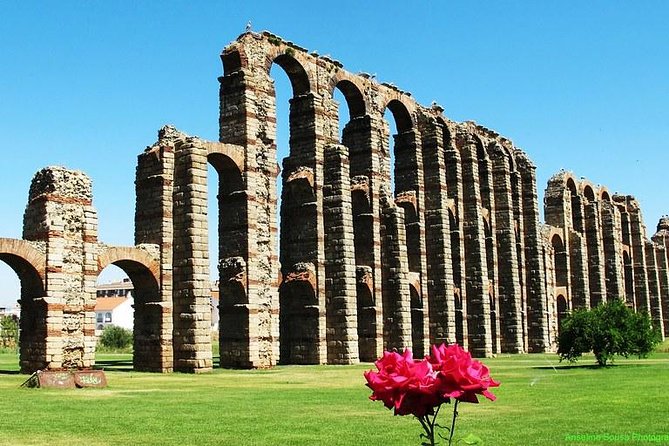
Two of the most distinctive outdoor stops are the Roman circus and the aqueduct ruins.
The Roman circus of Mérida is listed as about 30 minutes, with admission free. What I like about this stop is that the tour includes very specific context: Mérida was founded as Emerita Augusta in 25 BC by Augustus, and the circus was built for licensed Roman Army soldiers of two veteran legions from the Cantabrian Wars, Legio V Alaudae and Legio X Gemina. That kind of detail turns a pile of ancient structure into something more concrete.
Here is your practical takeaway. Stand where you can see the long, sweeping layout, then imagine how events were staged along the track. Even if you do not know the exact mechanics of Roman circus races, you can feel the purpose because the geometry is still there.
Then comes Acueducto de los Milagros, about 10 minutes on the schedule. The tour describes it as ruins of a Roman aqueduct bridge, part of the aqueduct that supplied water to the Roman colony of Augusta Emerita. Ten minutes sounds short, but aqueduct structures make a strong impression fast. If you can only do one quick “scale moment” in Mérida, this is often the one that sticks in your memory.
Évora in Portugal: Roman roots to the bone chapel shock
Évora is where the day turns from Roman science of power into Portuguese atmosphere and emotional punch. You get about two hours here, and the entry listed for this block is free.
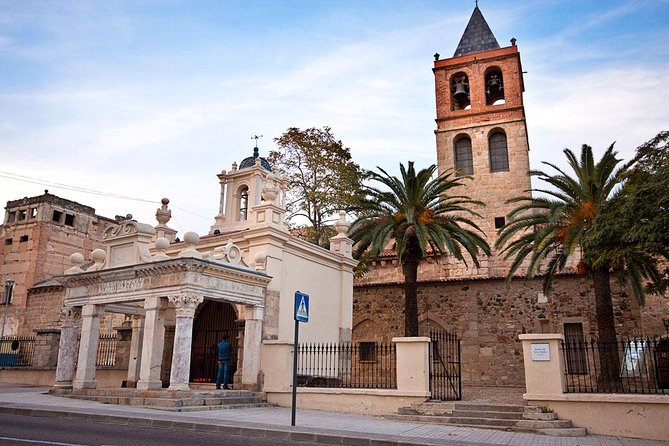
The route highlights Évora’s layered origin story: founded by Romans, later fortified by Moors, and flourishing during the 15th century. You will feel that mix in the way the town is laid out, and the stop gives you several anchor points so you are not just walking randomly.
Key places you can expect in this Évora portion include:
- The preserved Roman Diana Temple (another Diana reference, but in a Portuguese setting).
- Evora castle, adding that fortified look to your mental map of who held power.
- Praça do Giraldo, with 16th-century Gothic architecture nearby, a good place to regroup and get your bearings fast.
- The bone chapel, described as ghoulish and among the most memorable monuments in Portugal.
The bone chapel is the standout, even if you think you are prepared. Human remains arranged and decorated transforms the idea of a chapel from calm and solemn into something strange and unsettling. If you are sensitive to this kind of display, go in with a plan. Some people need a few minutes to process before they can enjoy the historic context.
If you want balance, do not rush out the door after the bone chapel. Use your time in Évora to take in the surrounding architecture and square space. That way the day ends with a sense of place, not only a jolt.
Timing, walking, and how to pace yourself in a 10-hour day
This is an all-day tour at about 10 hours. The schedule packs in Mérida’s major monuments plus a Portuguese city finale, with stops ranging from 10 minutes to two hours.
Here is how I’d pace it if you are trying to get the most without burning out:
- Wear comfortable shoes and keep water handy for the drive back.
- At shorter stops, focus on one or two photo angles plus one “what am I looking at” question in your head. The guide’s job is interpretation, so let the guide do the heavy lifting.
- In Évora, give yourself more breathing room after the bone chapel. Two hours sounds ample, but that chapel can take more mental energy than expected.
Also note that the tour mentions children must be accompanied by an adult and that most people can participate. Still, the day includes multiple outdoor sites. If someone in your group has limited mobility, ask yourself whether short structured stops will feel workable, since the schedule does not suggest long resting periods.
Price and value: what you get for $423.25 per person
At $423.25 per person, this is not a budget day trip. The value comes from four places that are explicitly built into the offering.
First, it is a private tour, so you are paying for a guide and driver dedicated to your group, plus private pickup and drop-off rather than a shared meeting point shuffle. Second, transport is included via an air-conditioned minivan, which matters when you are covering long distances and doing cross-border driving.
Third, the itinerary lists admission ticket free for multiple stops, and it lists the Roman Theater admission as included. Even if you assume some entries may vary in practice, the overall structure signals that you are not being hit with nonstop paid entrances.
Fourth, the tour includes all taxes, fees, and handling charges, so you can budget without guessing at extras.
If you are traveling with a small group, private pricing can still work out well compared to paying separately for guides or multiple tickets. If you are going solo or as a couple, it is more expensive per person, but you also gain flexibility and a personal pace. That is the trade.
Best fit: who this tour suits best
I think this tour fits you best if you like Roman sites and you want the highlights delivered in one day. You enjoy interpretation, not just seeing stones. If the idea of mosaics in a museum, then immediately walking into the outdoor theater setting sounds like fun, you will likely enjoy this format.
It also works if you want a clear “outline” for visiting Mérida and Évora. Many people struggle with what to prioritize in both places, because there is so much to see. This tour makes that choice for you.
If you are the kind of traveler who wants long stays, deep museum time, or unstructured wandering, you might feel the schedule tight. In that case, this tour is better as a first taste, then you can come back later for slower exploration.
Should you book this Roman-era Lisbon to Évora loop?
Book it if you want a guided, private day that connects Roman power centers across Spain and Portugal, and if you do not mind moving through sites in shorter bursts. The combination of Mérida’s museum and major monuments, plus Évora’s bone chapel and town squares, is a memorable mix that is hard to replicate on your own in a single day.
Think twice if you hate time pressure or need long “sit and read” moments. The day is full, and some stops are brief. Also, if you are highly sensitive to the bone chapel’s display of human remains, consider whether that specific element is worth it for you.
If you do book, plan to let the guide’s story do its work. The route’s strongest value is the way the sites fit together, from Agrippa-era context to Lusitania significance to Évora’s layered identity. When it clicks, it really clicks.
FAQ
What cities does the tour include?
The tour covers Badajoz, Mérida, and Évora.
How long is the private tour?
It runs about 10 hours.
Is this tour private or shared?
It is private. Only your group will participate.
Is pickup and drop-off included?
Yes. The tour includes hotel or port pickup and drop-off in the Lisbon region, including Lisbon, Cascais, Sintra, and Almada.
What language is the tour offered in?
The tour is offered in English.
Is there air-conditioned transportation?
Yes. The tour includes transport by air-conditioned minivan.
Are admission tickets included?
The schedule lists admission ticket free for several stops, and admission ticket included for the Roman Theater in Mérida.
Do I get a mobile ticket?
Yes. A mobile ticket is offered.
What COVID-19 safety measures are mentioned?
The operator notes a Clean & Safe hygiene certification, vehicle disinfection, and that hand sanitizer and masks are provided. It also notes private tour operation and pickup and drop-off only for your group.
Can children join?
Children must be accompanied by an adult.
Can I cancel for free?
Yes, you can cancel up to 24 hours in advance for a full refund.
More City Tours in Lisbon



More Tours in Lisbon




More Tour Reviews in Lisbon


Not for you? Here's more nearby things to do in Lisbon we have reviewed










Historical Tours, side by side.
 ★ 4.8History, Stories and Lifestyle Walking TourTickets from $2910,902 traveller reviews
 ★ 4.7Live Fado Show with Port Wine in Historic CenterTickets from $174,166 traveller reviews
 ★ 4.8Fado Show with Wine in a Historic VenueTickets from $191,294 traveller reviews
 ★ 5.0Explore Lisbon by Tuk Tuk: History and ViewpointsTickets from $19840 traveller reviews
 ★ 4.9Daytime or Sunset Boat Cruise with History and WineTickets from $45819 traveller reviews
 ★ 5.0Private Tuk Tuk Tour Through Lisbon’s Historical StreetsTickets from $27734 traveller reviews
 ★ 5.0Lisbon Sunset Sailing with Portuguese Wine and HistoryTickets from $54668 traveller reviews
 ★ 4.8Guided Tuk-Tuk Tour Along the Historic Tram Line 28Tickets from $147475 traveller reviews
More useful lists for this tour