
Review · BELEM TOURS
Tour in Lisbon (highlights), Cristo Rei and Belém.
Belém plus Cristo Rei is a Portugal speed course. You get Belém highlights on a guided route that keeps you moving, with smart stop lengths that work even if you only have half a day. It’s a practical way to hit the iconic sights without turning your trip into a scavenger hunt.
What I like most is the setup for comfort and control: an air-conditioned vehicle, a professional driver, and a local guide who can tailor the pacing to your preferences. I also like that it’s a private group up to 8, so you are not stuck in a giant herd. The main drawback to plan for is money for entry tickets, since several monuments on this route list tickets as not included.
Key things you will notice on this tour
- Belém monuments in manageable chunks, most stops around 20 minutes
- Christo Rei’s 133-meter elevation, with the Holy Redeemer facing Lisbon
- Lisbon orientation by design, Tagus river views, major squares, and viewpoints
- Real city landmarks, not just photo stops, like Panteão Nacional and Aqueduto das Aguas Livres
- Comfort-first logistics, pickup offered, bottled water included, and a mobile ticket
Why the Belém and Cristo Rei pairing makes sense

This route strings together two parts of Lisbon that tell different stories. Belém is the grand, ceremonial side, tied to Portugal’s Age of Discoveries and the Manueline era. Cristo Rei flips the viewpoint, literally, putting you above the Tagus so Lisbon can make sense as a city of hills, water, and long streets.
The best part for you is that the tour reads like a plan, not like a checklist. You’re not just hopping from one landmark to the next. Each stop is placed to help you build a mental map: where the river sits, where downtown opens up, and how the neighborhoods climb.
And since it is customizable, you can adjust the emphasis. If you care more about the big stone monuments, you can linger inside where tickets apply. If you prefer views and city atmosphere, you can keep things lighter where you are outside most of the time.
You can also read our reviews of more tours and experiences in Lisbon.



The pace and timing, 4 to 8 hours in a city that moves fast
The total tour time runs about 4 to 8 hours, and travel time is included. Many stops are set around 20 minutes, which is useful in Lisbon. It’s enough time to see the key features, take a few photos, and get oriented, without losing half your day waiting for people to catch up.
Two things to keep in mind. First, the order can vary depending on what you want. That matters because Belém and central Lisbon can feel very different at different times of day. Second, the tour asks for moderate physical fitness. This does not mean you need to be an athlete, but expect some walking, standing around viewpoints, and stairs or uneven surfaces at certain spots.
Belém blockbuster stops: Jerónimos, Torre de Belém, and the Discoveries Monument
Mosteiro dos Jerónimos, Portugal’s Manueline showpiece
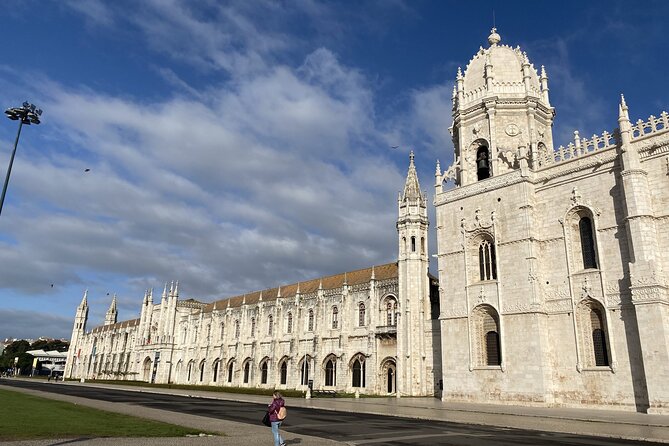
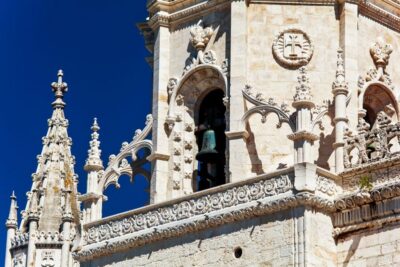
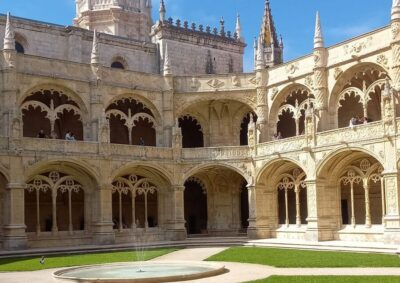
Most people come to Belém for this monastery, and the reason is simple. It was built at the end of the 15th century by King Manuel I and handed over to the Order of Saint Jerónimo. The building is famous for Manueline architecture, a Portuguese style that mixes elegance with maritime power symbols.
What you can do in the time you have is look for the details rather than trying to absorb everything at once. Focus on the main hall church feel, the stonework character, and the overall scale. This is one of those stops where your eyes do the work faster than your brain. If you pace yourself, 20 minutes can be enough to get the “why it matters” feeling, then you can decide if you want extra time once you are there.
Practical note: the monastery stop lists an admission ticket as not included, so plan for that extra cost if you want to go inside.
Torre de Belém, where medieval meets artillery-era Lisbon
Next up is Torre de Belém, a major architectural icon from the reign of D. Manuel I. The tower is described as a synthesis between a medieval keep tower tradition and a modern bastion style designed to hold artillery pieces.
That blend is the point. You are not looking at a tower that only tells one era. You are seeing Lisbon’s transition, where defense, empire, and sea traffic all share the same skyline.
This stop also lists tickets as not included, so factor that in if the tower interior is part of your plan.


Padrão dos Descobrimentos, Portugal’s Discoveries in concrete and stone
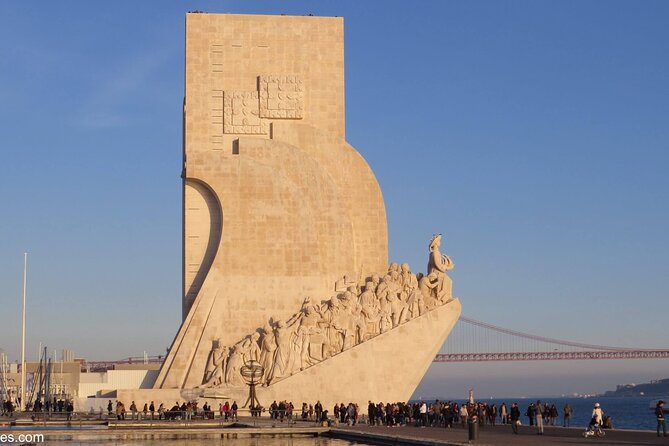
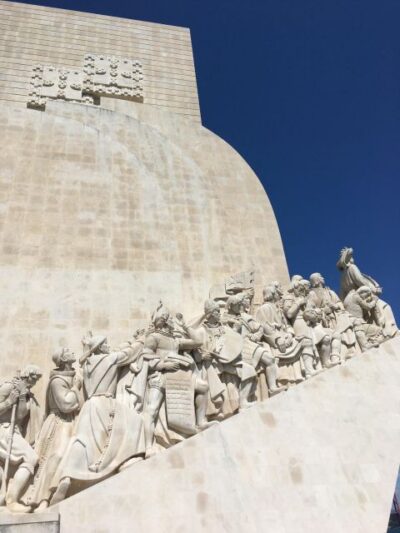
The Monument to the Discoveries, or Padrão dos Descobrimentos, sits prominently on the right bank of the Tagus. The original monument was erected in 1940 for the Portuguese World Exhibition and made from perishable materials. The current version is a replica made of concrete and stone, inaugurated in 1960.
In plain terms, it’s a great photo stop because you can see it from the river side context, not just as a standalone object. It also helps connect the dots between Belém’s monastery and Portugal’s overseas story.
This is listed as not requiring included admission tickets, so treat it as more of an exterior orientation and architecture moment.
Pastéis de Belém, what the famous stop is really about
Pastéis de Belém is not just a snack stop, it is a tradition stop with an origin story. Manufacture began in 1837 in Belém near the Jerónimos Monastery. The story ties back to closure of convents and monasteries in Portugal in the 1830s, and then the pastry operation starting in facilities attached to a refinery. The recipe is described as a secret passed among master pastry chefs and still made by hand in the Oficina do Segredo.
What I like for your planning is that the stop is timed, and it is practical. You do not need a monument entry ticket here, since it is listed as admission ticket free. That means you can focus on eating or just watching how the place works while you are already in the Belém area.
Two tips to make this work without stress:
- Have a quick decision ready. If you want the classic ones, grab them early so you do not waste your visit in a line.
- Bring a little room for sugar. This is a sweet stop that pairs well with the next river-facing sights.
Praça do Comércio to Marquês de Pombal, Lisbon’s biggest open-air orientation

Central Lisbon gets you from the riverfront to the city’s ceremonial center. Praça do Comércio, also called Terreiro do Paço, sits right by the Tagus and is one of the largest squares in Europe, about 36,000 square meters. It’s shaped by 79 arches, and the square is tied to the former palace of the kings of Portugal, which stood there for about two centuries.
If Belém is about monuments, this square is about space. Standing here helps you understand Lisbon’s geography fast. You can see how the river corridor opens up, and you get that sense of Lisbon’s scale in one shot.
Praça do Marquês de Pombal, a transit marker you will appreciate later
The tour also includes Praça do Marquês de Pombal, the Rotunda do Marquês de Pombal. The square sits between Avenida da Liberdade and Parque Eduardo VII, with the monument to Marquês de Pombal in the center. The monument opened in 1934.
Think of this stop as a city navigation anchor. If you return later on your own, you will know where you are because you learned it here during the guided drive.
Cristo Rei sanctuary: the 133-meter perspective shift
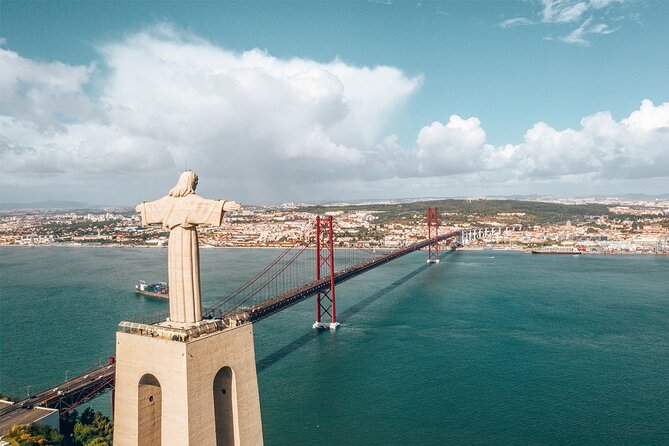
The National Sanctuary of Christ the King sits at an altitude of 133 meters above the level of the Tagus. The structure includes a 75-meter-high portico designed by architect António Lino, topped by the statue of the Holy Redeemer with open arms facing Lisbon, standing 28 meters tall.
This is the stop that changes your mental picture of Lisbon. From ground level, the city feels dense and built on slopes. From above, the city looks organized and readable, like layers stacked around viewpoints and river approaches.
Practical note: the sanctuary stop lists admission tickets as not included. If your goal is the full experience inside the sanctuary area, budget for entry.
Panteão Nacional and the Graça viewpoint, Lisbon’s memory and the view from the neighborhood

Panteão Nacional, Santa Engrácia’s big honor hall
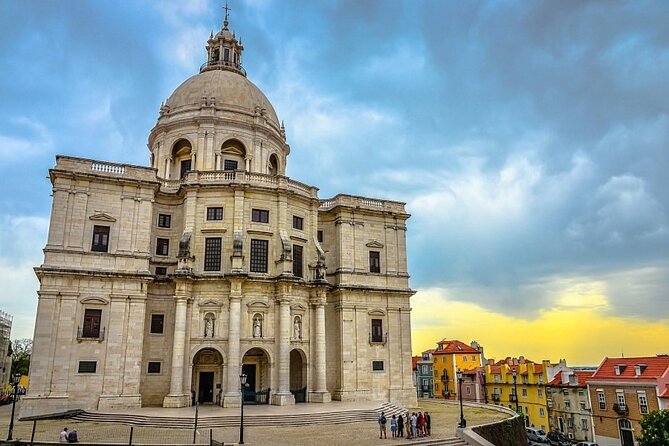
Panteão Nacional is installed in the Church of Santa Engrácia, since December 1, 1966. It was created by decree in September 26, 1836, with the purpose of honoring Portuguese citizens who distinguished themselves through public service, military services, cultural creation, science and art, or defense of human dignity and freedom.
Even if you are not spending tons of time reading every detail, the building’s mission gives context. It is not just a pretty church interior. It’s designed to turn national memory into something you can walk into.
Admission tickets here are listed as not included, so consider whether you want the inside portion.
Miradouro da Graça, a rooftop view with neighborhood texture
Miradouro da Graça, also known as the Sophia de Mello Breyner Andresen Viewpoint, sits in Largo da Graça next to the church in the Graça area. The viewpoint is positioned in an area connected to the old Convento da Graça churchyard.
The key detail I would use to help you decide: you can see rooftops and buildings, and the panorama is described as popular, even if the nearby Miradouro da Senhora do Monte can have an even more spectacular view. The Graça viewpoint is also tied to the Augustinian monastery founded in 1271 and rebuilt after the earthquake.
This is one of those stops where you are not only collecting a postcard. You are sensing how Lisbon’s neighborhoods sit on the hills. It makes your earlier river views click.
The stop lists admission ticket free, so you can enjoy the viewpoint without extra entry cost.
Santa Justa Elevator and Águas Livres Aqueduct, two clever engineering stops
Santa Justa Elevator, a downtown lift with neo-Gothic style
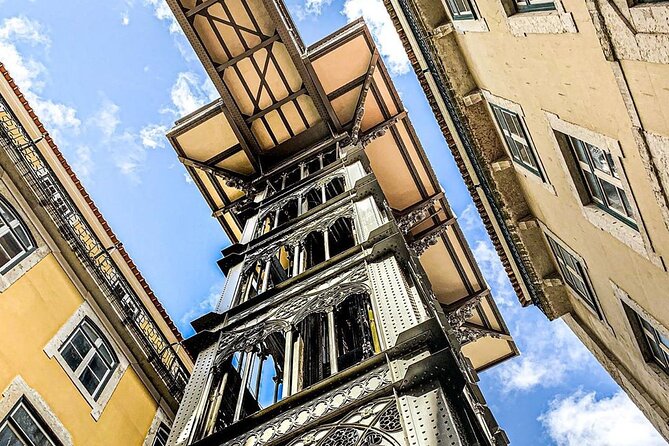
The Santa Justa Elevator is one of Lisbon’s most interesting transport monuments. It connects Rua do Ouro and Rua do Carmo to Largo do Carmo. The system uses a metal tower with two cabins that circulate, and a walkway that links the upper floor to the Carmo area.
The elevator structure is made of cast iron and follows a scheme inspired by neo-Gothic style, built under engineer Raoul Mesnier du Ponsard’s management.
What this means for you during the tour: it’s a compact, urban landmark that adds variety beyond churches and plazas. It also gives you a quick lesson in Lisbon’s engineering mindset, especially in a city built for hills and stairs.
Admission tickets are not included for this stop in the data you provided, so plan accordingly if you want to ride.
Aqueduto das Aguas Livres, Lisbon’s water infrastructure survived the 1755 quake
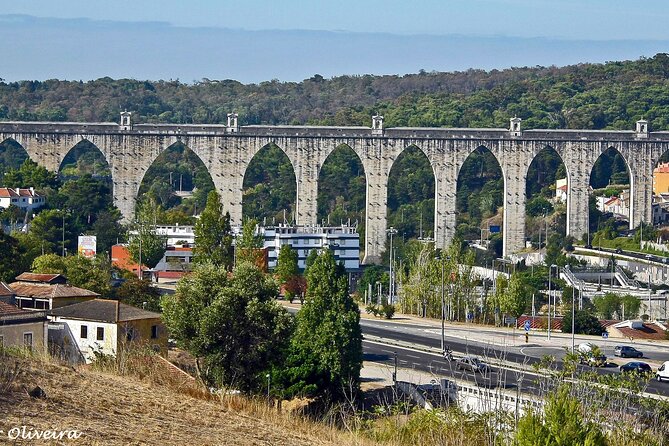
Águas Livres Aqueduct is a water system for Lisbon, with its most emblematic work being the grand stone archway rising over the Alcântara valley. The aqueduct was built by D. João V in the 18th century, starting from the Águas Livres spring in Belas, Sintra, and later reinforced and expanded through the 19th century.
The detail that makes this especially worth your attention is that it survived the 1755 Earthquake unscathed. That detail turns it from a pretty arch into a symbol of how Lisbon rebuilt and carried on.
Admission tickets are listed as not included, so you will likely treat it as a close-looking exterior stop unless you choose to pay for any specific access options available on site.
Price and logistics that affect real value
This tour is priced at $232.71 per group, up to 8 people. That pricing model can be a real win when you are traveling with friends or family because your guide and vehicle cost get shared. Also, it is typically booked about 8 days in advance, which suggests it is popular but not impossible to line up if you plan ahead.
What your price includes is the stuff that makes a half day actually work:
- Air-conditioned vehicle
- Bottled water
- Professional driver and local guide
- All fees and taxes
- Fully customizable tour
- Pickup offered
- Mobile ticket
- Private format, meaning only your group participates
What you should not ignore is what is not included: tickets for several major monuments. Jerónimos, Torre de Belém, Cristo Rei, Panteão Nacional, and the aqueduct stop all list admission tickets as not included. If you add up those entries, your total day cost will rise. Still, the guided route can be worth it because it saves time and keeps your pacing tight.
Who this tour fits best
This is a strong match if you:
- Want a guided highlights loop instead of figuring out transport between dispersed viewpoints
- Like structure but still want flexibility, since the tour is customizable
- Travel as a small group and want a private experience with a vehicle and guide
It may not be ideal if you are trying to do everything on zero-entry-ticket options. This tour includes several ticketed landmarks, so you’ll likely spend extra if you want full access.
Should you book this Lisbon Belém and Cristo Rei tour?
If you want to see the big Belém monuments and then switch to a high viewpoint like Cristo Rei, this tour is a smart way to do it without wasting your day. You get comfort, a private group setup, and a guide-focused route that prioritizes orientation as much as sightseeing.
I’d book it if your goal is “see the key places and understand them” rather than “collect every detail.” Skip it only if you are determined to avoid entry ticket costs and you want a purely do-it-yourself freeform day.
FAQ
What is the duration of the Lisbon Cristo Rei and Belém tour?
The tour runs about 4 to 8 hours, and the total time includes travel time between stops.
How many people are in a group?
This is a private tour, and the group size is up to 8 people.
Is pickup included?
Pickup is offered. The details of pickup are something you can clarify directly with the operator before you go.
Is the tour fully customizable?
Yes. It is described as fully customizable, and you can adapt the tour and the timing based on your preferences.
Do I need tickets for the monuments?
Tickets are not included for several monument stops listed as admission ticket not included. The ones named with tickets not included include Mosteiro dos Jerónimos, Torre de Belém, Padrão dos Descobrimentos, Santuario Nacional de Cristo Rei, Panteão Nacional, and Aqueduto das Aguas Livres. Pastéis de Belém is listed as admission ticket free.
Does it include bottled water and a vehicle?
Yes. Bottled water, an air-conditioned vehicle, and a professional driver are included, along with a local guide.
Is it a mobile ticket?
Yes. The tour includes a mobile ticket.
What if the weather is bad?
The experience requires good weather. If it is canceled due to poor weather, you will be offered a different date or a full refund.
Is there a cancellation policy?
Free cancellation is offered. You can cancel up to 24 hours in advance for a full refund, with the exact cut-off based on local time.
What physical level do I need?
The tour notes a moderate physical fitness level.
More Tours in Lisbon




More Tour Reviews in Lisbon
Not for you? Here's more nearby things to do in Lisbon we have reviewed











Belem Tours, side by side.
 ★ 4.1Jerónimos Monastery Entrance TicketTickets from $2114,164 traveller reviews
 ★ 5.0Private Lisbon Sightseeing Tuk-Tuk Tour: Alfama, Belém & MoreTickets from $524,277 traveller reviews
 ★ 5.0Age of Discoveries Walking Tour in BelémTickets from $31,513 traveller reviews
 ★ 5.0Bike Tours Lisbon – Center of Lisbon to BelémTickets from $19686 traveller reviews
 ★ 3.7Jerónimos Monastery E-Ticket and Audio GuideTickets from $33660 traveller reviews
 ★ 4.7Lisbon Bike Tour: Downhill Downtown Lisbon to BelémTickets from $45655 traveller reviews
 ★ 4.7Belem Walking Tour with Jeronimos Monastery TicketTickets from $61490 traveller reviews
 ★ 4.8Belem, Jeronimos Monastery, and Coach Museum TourTickets from $94478 traveller reviews
More useful lists for this tour