
Review · PRIVATE
Tour Évora and Alentejo in a private tour
A medieval city plus cork, in one day. This private Évora and Alentejo tour is interesting because it’s customizable and you start with a real cork factory lesson, not just window-shopping. One thing to plan for, though: the day runs long, with a serious Lisbon to Évora drive both ways.
I like how this feels like a true “you and your guide” outing. You get pickup, round-trip transport, and a guide who can tailor pacing if you want more photos or a slower lunch stop. The main drawback is that some of the big-ticket sights have extra entry fees, so you will want a small budget ready.
Below, I’ll break down the stops, what they’re really like, and who this tour fits best.
Key highlights worth your attention
- Corticarte cork factory first, with a hands-on look at cork harvesting and products
- UNESCO walled historic center with medieval streets, tiles, and time-worn stonework
- Chapel of Bones for a memorable, if unsettling, reality check on mortality
- Roman to Gothic architecture at the Temple of Diana and Évora Cathedral
- A private format where you can control pace and photo stops with your guide
- Pickup and air-conditioned transport so you are not wrestling with buses and transfers
Why this private Évora and Alentejo day trip works
Évora is one of those Portuguese places that feels like it has been sitting still for centuries. From Lisbon, the temptation is to cram in fast sightseeing. This tour resists that urge. It builds your day around a set route through Évora’s best-known monuments, then gives you enough flexibility to slow down where you care.
The other smart move is the cork factory stop. Most day trips to Évora rush from transport to churches. Here, you start with a craft and a material that is very Portuguese, then you carry that context into the city.
In the real world, that means you come away with more than postcard photos. You understand why cork matters here, and you connect it to Portuguese life, exports, and even wine culture. It’s also just fun to watch a process unfold, especially if you like practical, tangible stuff you can explain later.
You can also read our reviews of more private tours in Lisbon



Price and value for a full 9-hour private tour from Lisbon
At $169.31 per person, you are paying for three big things: a private guide, round-trip transport from Lisbon, and monument support throughout the day.
Is it “cheap”? No. But it is fair if you want a guided route without logistics headaches. You are also paying for time. Évora is far enough that you need efficient transport to make the day feel worth it. A 9-hour outing can sound tight, and it is, but the private format keeps the day from turning into a scramble.
Also note what you are not paying for. Lunch is not included, and some entrances cost extra. Based on what’s listed, you should budget for museum tickets at about €10 per person, plus any paid entries for specific monuments such as the Chapel of Bones and the cathedral.
If your travel style is “I want the highlights, but I want the pacing under control,” the value makes sense. If you want to wander totally on your own, you would probably get more freedom for less money by going independently.
Getting picked up, driving to Évora, and how the day is paced
The tour starts at 8:30 am. Pickup is offered at your hotel or apartment, and also from Porto de Cruzeiros. That matters in Lisbon, where getting to the right departure point can waste your morning.
Expect travel time to be a big part of the day. One review described roughly 90 minutes each way from Lisbon, which matches the feel of a full-day outing. Once you’re in Évora, time gets used efficiently on foot inside the walls.
You also get air-conditioned vehicle and WiFi on board, which is not glamorous but is practical on a long ride. The best use of that ride time is to prep mentally. Évora rewards curiosity. If you go in knowing you will see Roman, Renaissance, and medieval layers, the stops hit harder.
And yes, it’s private. Only your group participates. That usually makes the experience feel calmer than a busload day.
Stop 1: Corticarte – Arte em Cortica, the cork lesson that explains Portugal
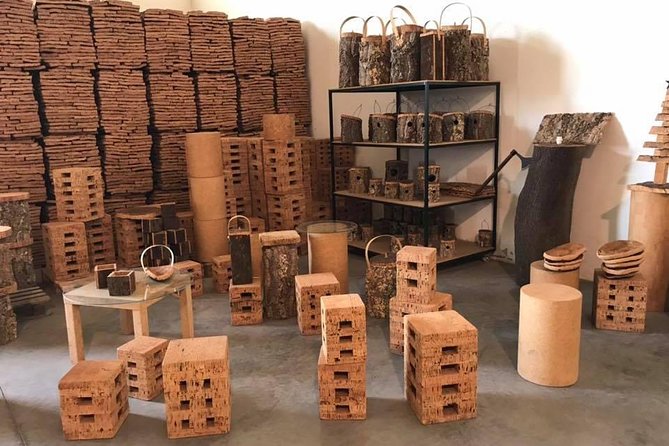
You start at Corticarte – Arte em Cortica, a traditional cork factory where you learn the process from the cork oak tree to the final product. This is the kind of stop that can either be a gimmick or a true highlight. Here, it’s built as the tour’s opening story.
You get the big cork facts:
- Cork comes from the cork oak bark.
- The bark grows back, and about every nine years it has to be removed.
- After removal, the bark can reach around 25 centimeters thick.
- Cork is naturally resistant to heat, cold, and fire.
Then you connect it to modern life. Portugal is responsible for 55% of world cork production, and cork shows up in more than just wine bottles. You might see uses like decorative wall and floor coverings, sports gear (including references such as baseball grains and fishing rods), and everyday products.
One detail I appreciated in how this is framed: cork’s role in wine aging. A wine cork allows tiny oxygen exchanges, so wine can mature while maintaining quality. That makes the cork story more than trivia. When you later think about Portuguese wine culture, the material makes sense.
Time at this stop is about 1 hour, and admission is listed as free. The practical tip here is simple: wear comfortable shoes. Factories mean uneven floors and lots to look at.
Stop 2: Historic Center of Évora, UNESCO walls and layered civilizations
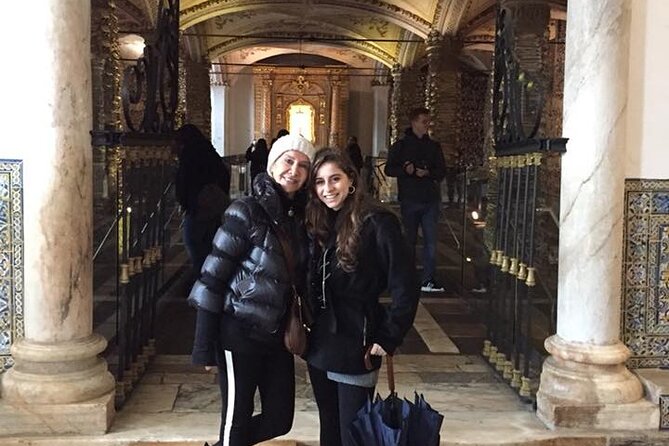
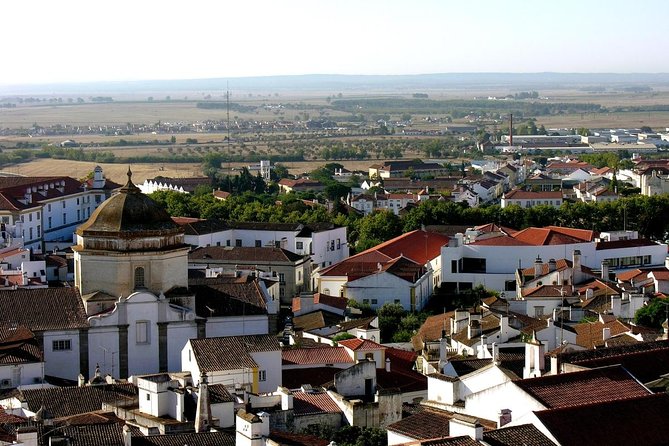
Next comes the Historic Center of Évora, a UNESCO World Heritage Site (since 1986). This part is your orientation in stone.
Here’s what makes it compelling:
- It is an intra-wall city-museum space, enclosed by the medieval walls.
- The walled area is about 107 hectares.
- The center keeps traces from multiple civilizations: Celts, Romans, Arabs, Jews, and Christians.
- Évora hit a golden age in the 15th century, when it became a residence for Portuguese kings.
- Many houses are white, often with tiles and wrought iron balconies from the 16th to 18th centuries.
When you walk these narrow streets and lanes, patios, and open squares, you start to understand why Évora is often described as a living museum. You are not just looking at one monument. You’re seeing how the city itself was built to hold different eras.
Admission for this stop is listed as free, and the time is about 45 minutes. That’s enough to get your bearings and focus on the monuments you’ll see next.



Stop 3: Aqueduct of Água de Prata, Renaissance engineering outside the city walls
Between the central landmarks, you also visit the Aqueduct of Água de Prata (Aqueduto da Água da Prata). This is Renaissance hydraulic engineering built to supply Évora with water.
Key details that help you appreciate what you’re seeing:
- It was inaugurated in 1537.
- It was built during the reign of King João III.
- The designer and builder is listed as royal architect Francisco de Arruda.
- It carries water from springs near Graça do Divor, linked to the São Bento de Castris Convent.
- The aqueduct covers about 18 km.
You might not feel impressed at first glance if you expect a dramatic ruin. But aqueducts are about function. When you pair this with what you see later at the Temple of Diana and its connection to water systems, the whole city reads differently. Évora was planned. It wasn’t random.
Stop 4: Chapel of Bones, the unsettling stop that people remember
Then comes the Chapel of Bones. This is the famous, eerie chapel where the walls and pillars are lined with human bones and skulls. It’s estimated to be more than 5,000 monks.
Time is about 30 minutes. Admission is not included.
There’s also a specific message at the entrance that frames the experience. It basically turns the horror into reflection about life and mortality. That doesn’t make it less strange, but it makes it easier to process. If you’re sensitive, you can choose to spend less time here. If you are curious, it’s one of the most memorable stops in all of Évora.
Stop 5: Igreja de São Francisco, Gothic-Manueline with maritime symbolism
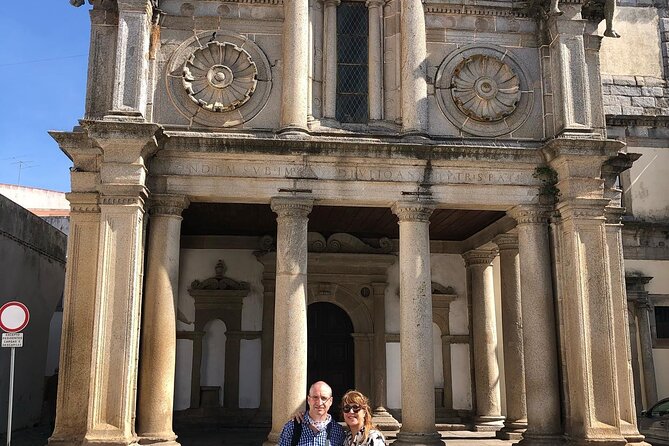
Next you visit Igreja de São Francisco. This church is known for Gothic-Manueline architecture, built between 1480 and 1510 by stone masters Martim Lourenço and Pero de Trilho. Royal painters named in the description include Francisco Henriques, Jorge Afonso, and Garcia Fernandes.
What makes it more than a pretty façade is the symbolism. It’s linked to Portugal’s maritime expansion era. You can look for details such as:
- The cross of the Order of Christ
- Emblems connected to kings D. João II and D. Manuel I
- The monumental nave and ogival vault design
Admission is listed as free. Time is about 20 minutes, so you will want to focus. Let your guide point out the standout elements rather than trying to read every carving yourself.
Stop 6: Praça do Giraldo, the city’s central stage
Your walk continues to Praça do Giraldo, a key square that has long functioned as the main crossroads of Évora. Construction is listed as 1571/1573.
This square honors Geraldo Geraldes, Sem Pavor, who conquered Évora from the Moors in 1167. After that feat, D. Afonso Henriques named him mayor of the city and frontier of the Alentejo.
Time is about 15 minutes and admission is listed as free. This is a breather stop, but it’s also where the city’s everyday rhythm hits you. You can think of it as a way to reset your eyes before the heavier monuments.
Stop 7: Church of Graça, Renaissance façade figures called Meninos da Graça
The tour also includes the Church of Graça, the convent of Nossa Senhora da Graça. This is Renaissance and very specific in its details.
From the description:
- It was founded in 1511
- Designed by architect Miguel de Arruda
- Owned by hermit monks of Saint Augustine
- Known for Atlantean figures called Meninos da Graça, on the façade
Time is not clearly stated for this stop, but it’s treated as another city highlight before the major Roman and cathedral visits.
This is one of those stops where the façade details matter. If it’s sunny, take a few slow minutes and look up. These kinds of carvings are easy to miss when you’re moving fast.
Stop 8: Templo Romano de Évora (Templo de Diana), Roman pride inside the city
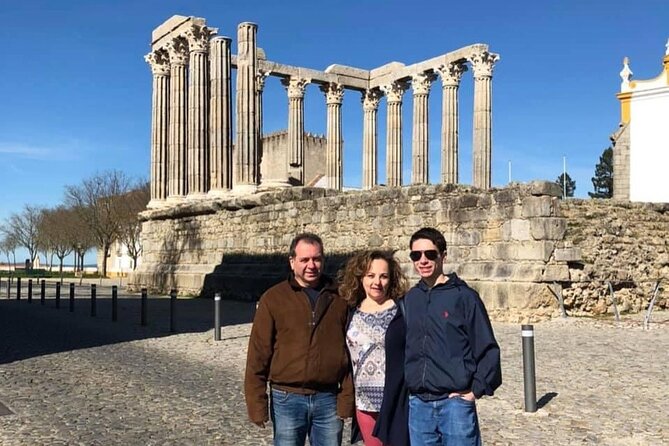
Now you hit one of the big names: the Templo Romano de Évora, also called the Temple of Diana.
You see it as part of Évora’s Roman legacy, next to the cathedral. There’s also an important water connection. You can see references to the aqueduct called Água de Prata, also described as water of the Silver, running outside the walls, with some arches visible inside the city built in the 16th century to transport water.
Time is around 15 minutes, and admission is listed as free.
Here’s how to make this stop land: don’t just look for the obvious columns. Let your guide connect the Roman presence, then the later water systems. Évora’s story is one of layers, not replacement after replacement.
Stop 9: Cathedral of Évora, granite grandeur and the shift from Romanesque to Gothic
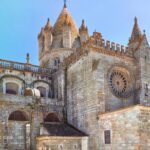
The final big monument in town is the Cathedral of Évora (Se Catedral de Evora).
This church matters for architecture:
- Construction started in 1186 and was consecrated in 1204
- Completed in 1250
- Built in granite
- Shows a transition from Romanesque to Gothic style
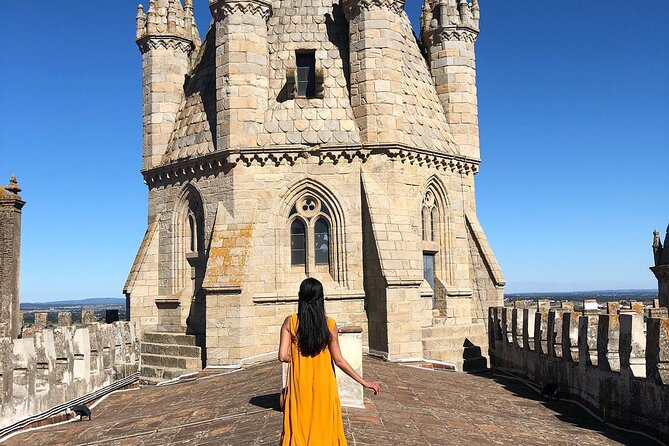
- Two medieval towers frame the façade, including a bell tower
- Sculptures of 14th century Apostles by Mestre Pêro
- The dome and lantern feature is described as crowned by a stone needle element, noted as an ex libris
Time here is about 45 minutes. Admission is not included.
Plan to spend your time smart. If you like architecture, focus on how the styles change. If you prefer atmosphere, focus on the scale and the feeling inside. Either way, this is one of the stops where your guide’s narrative really helps you connect details to a timeline.
Where you end your day: Diana’s Garden and getting your timing right
Near the cathedral area, the tour includes Diana’s Garden in the heart of Évora’s cultural center, extending from Largo do Conde de Villa Flor. It sits in harmony with the Roman Temple, so it’s a natural place to pause, take photos, and reset before your ride back.
Think of it as the tour’s closing frame. You’ve seen the bones chapel, the Roman temple, the cathedral, and the Renaissance façades. Diana’s Garden gives you an easier view of the whole setting at once.
Time for this stop is not listed as a separate duration, but it functions as the wrap-up. If you want one last shop stop, ask your guide when you can fit it in, because your pacing is adjustable.
Lunch and money planning, the part that decides if the day feels relaxed
Lunch is not included. Your best move is to treat lunch like your personal setting choice rather than something you rush.
In practice, the pacing gives you time to eat, and one reason people like this tour is that the day can be flexible. Some groups even adjust plans if they are not hungry for a sit-down meal. That flexibility is a real value because it reduces stress.
For budgeting:
- Expect museum and monument tickets around €10 per person as listed for tickets for museums
- Chapel of Bones and the cathedral have entries listed as not included
- Bring a little extra for drinks and snacks, especially if you drink coffee or want bottled water during hot weather
The guide makes the difference, and the best bet is a great human
This tour has guides who can explain both architecture and craft in plain language. Names that come up clearly here include João and Anastasiya, both praised for being punctual, patient, and engaging.
That matters more than people think. Évora can be overwhelming if you only know what the buildings look like. A strong guide helps you understand why each site is where it is, what it symbolizes, and how it connects to Portuguese history and Christianity.
If you are the type who asks questions during tours, this is a good fit. You will likely get thoughtful answers, and the day will feel like a conversation instead of a lecture.
Who should book this Évora and Alentejo private tour
This fits best if you want:
- A full-day highlights route without worrying about tickets and directions
- A balance of craft and city monuments (cork first, then history)
- A private experience where pacing can adapt
- A guided look at architecture from Roman to Gothic to Renaissance
It is also great for people staying in Lisbon who do not want to commit to an overnight just for Évora. You can get the main hits, and you’ll probably leave feeling that an overnight would be your next logical step.
You might choose something else if you:
- Hate long drives and prefer short trips
- Want fully independent wandering with no fixed timing
- Prefer only one type of attraction (for example only churches or only Roman ruins)
Should you book this private tour?
If you like guided highlights, a cork factory lesson, and a calm private day with pickup and transport, I would book this. The price makes sense because it pays for a guide plus the travel that you would otherwise have to manage.
What seals it is the combination. Évora is the payoff, but the cork stop is the story that makes the day feel more than a checklist. Just go in with a budget for paid entries and be ready for a full schedule.
If your goal is to understand Évora as a place shaped by water systems, Roman ambition, medieval power, and Portuguese craft, this is a smart way to do it in one day.
FAQ
Is lunch included on the Évora and Alentejo private tour?
No. Lunch is not included. The itinerary includes time in Évora for you to eat on your own.
What entrance fees should I expect?
Some stops are free, but not everything is included. Tickets for museums are listed at about €10 per person, and specific paid sites include the Chapel of Bones and the Cathedral of Évora.
How long is the tour, and what time does it start?
The duration is about 9 hours. The start time is 8:30 am.
Do you get pickup and drop-off?
Yes. Pickup and drop-off are included at your hotel or apartment, and also at Porto de Cruzeiros.
Is this a private tour?
Yes. It is described as a private tour/activity, meaning only your group participates.
Can I cancel for a full refund?
Yes, free cancellation is available up to 24 hours in advance for a full refund, based on the local time where the experience takes place.
More Private Tours in Lisbon


More Tours in Lisbon

More Tour Reviews in Lisbon
Not for you? Here's more nearby things to do in Lisbon we have reviewed









Private, side by side.
 ★ 5.0True 4Hour Private Tuk Tuk Tour: Discover Lisbon with a Local!Tickets from $1088,008 traveller reviews
 ★ 4.9Private Guided Tuk-Tuk Tour with Hotel PickupTickets from $1534,552 traveller reviews
 ★ 5.0Private Lisbon Sightseeing Tuk-Tuk Tour: Alfama, Belém & MoreTickets from $524,277 traveller reviews
 ★ 5.0Lisbon Highlights: Private Tuk Tuk Tour Adventure SightseeingTickets from $843,284 traveller reviews
 ★ 5.0Welcome Lisbon Tour with Local Guide in Private Eco Tuk TukTickets from $171,691 traveller reviews
 ★ 5.0Sintra Full-Day Private Tour – A Journey through WonderlandTickets from $1871,665 traveller reviews
 ★ 5.0Sintra Private Trip from Lisbon Customizable Dreamlike ExperienceTickets from $1631,414 traveller reviews
 ★ 5.0Airport Private Transfer to/from LisbonTickets from $271,284 traveller reviews
More useful lists for this tour