
Review · BELEM TOURS
Private Tour along the Discoveries route in Belém
Lisbon turns pink, then turns royal. This private 3-hour route strings together street scenes, major landmarks, and a few stops that move you fast into Lisbon’s Discoveries era, without turning your day into a scavenger hunt. I like the private group size (up to 6) because it keeps conversations easy and photo stops from feeling chaotic. I also love the built-in payoff at Pastéis de Belém, where you get both the story and the taste.
The main trade-off is timing: you will hit a lot of places, so some stops are short, mostly for photos or quick views. If you want to linger for long museum hours or sit for a slow lunch at every stop, you may feel slightly rushed.
Key highlights to watch for

- A tight Discoveries loop that connects Lisbon center to Belém in about 3 hours
- Calle Rosa de Lisboa photo time in the Cais do Sodré nightlife pocket
- Royal history at Museu Nacional dos Coches, with admission included
- Pastéis de Belém factory stop, with a tasting right after
- Iconic viewpoints at Torre de Belém, Ponte 25 de Abril, and the Monument to the Discoveries map
A Lisbon Discoveries route in 3 hours, from Cais do Sodré to Belém
This is a “see the essentials” kind of private tour, but it is not just a greatest-hits list. The route is laid out so you can understand how Lisbon’s story shifts from everyday neighborhoods to big imperial-era monuments along the Tagus River. In a short window, you get both mood and meaning.
You start on the Lisbon side where the city feels current and playful, then you work your way toward Belém’s monumental coast. Along the way, you pass a few places that are more about atmosphere than ticketed time, like the pink street and the bridge views. That mix is smart. It helps you get oriented quickly, especially if it’s your first time in Lisbon.
You can also read our reviews of more private tours in Lisbon



Your group setup and pace, up to 6 with quick stops
The tour runs about 3 hours, and it is priced at $355.21 per group (up to 6). That price makes the biggest difference if you are traveling as a small family or a couple plus friends. Split six ways, it can feel like a bargain compared with paying individual tickets plus separate transport. Split fewer ways, it still works well if you value a smooth, guided route over self-navigating public transport.
One practical win: pickup is offered, and you return back to the meeting point at the end. That matters in Lisbon, where walking can be lovely but hills and crowd flow can slow you down. The tour is in English, and you get a mobile ticket.
Just keep your expectations aligned with the structure. Some stops are 5 to 20 minutes. Others are longer. You are not doing one deep dive per site. You are getting a good “first contact,” then you can come back later if something really hooks you.
Calle Rosa de Lisboa and Time Out Market Lisboa, pink street energy plus food-market context
Your first stop is Calle Rosa de Lisboa in the Cais do Sodré neighborhood. This pedestrian strip is famous for its pink look and its night-life reputation, lined with clubs, bars, and terraces. Even if you are not there at midnight, the street still delivers. Daytime photos are perfect because the color reads clearly and the umbrellas add instant color.
In practical terms, take a quick walk and grab at least one photo with the umbrellas. You’ll appreciate it later, because it gives you a visual anchor for the rest of the route. Lisbon can feel like a patchwork of different eras, and this street is the “current city” mood-setter.
From there you pass Time Out Market Lisboa. The important detail here is how it fits into Lisbon’s evolution. The space was once a market that has been revitalized, and today you will see lots of small stalls and counters. The good part of a pass-by stop is that you get the context without losing tour time inside a crowd.
If your brain is already aiming at food, know this: this is one of those stops where you can decide to snack now or later. With a tasting coming later in Belém, you might want to keep it light here.
LX Factory and Ponte 25 de Abril, street art and an iconic “frame” for photos
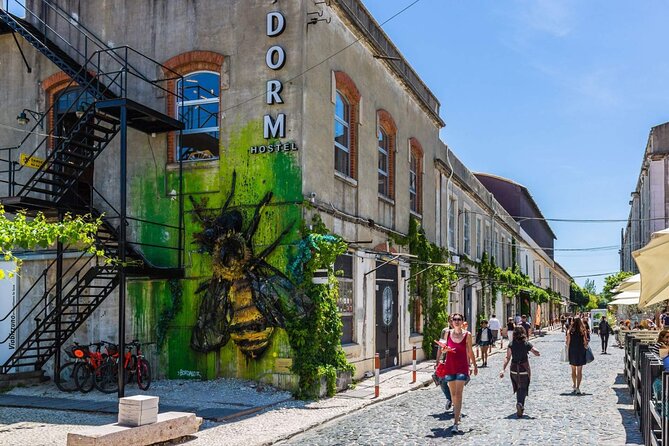
Next comes LX Factory, a creative complex with lots of shops and visible urban art. Even if you do not plan to shop, the value is the street-art layer. It helps explain Lisbon as a city that reuses industrial spaces and keeps making new culture in old walls.
You also get a view option here, including the rooftop outlook over the bridge. Rooftops in Lisbon can be windy, but even a short look is worth it if you love city geometry. This stop is about giving your eyes a new kind of Lisbon, one that feels self-aware and artsy.
Then you move to Ponte 25 de Abril, the long bridge connecting Lisbon to Almada. It opened in 1966, and it is packed with symbolic meaning because it was originally called Ponte de Salazar. Its current name ties directly to the Carnation Revolution, which is one of those details that gives you a reason to look beyond the “big bridge photo.”
Take the time to frame it. When the bridge is in the background, the picture reads as more than a landmark snapshot. It looks like a Lisbon story. Also, if you are sensitive to wind, bring a layer for the bridge area. It can feel sharper than you expect.
Museu Nacional dos Coches, Royal coaches in the former royal riding school
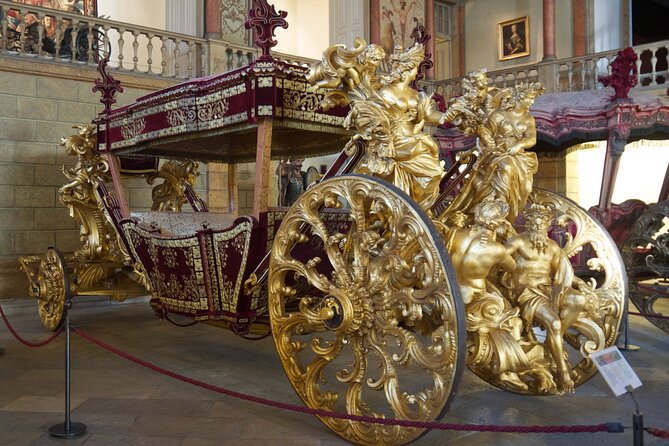
The tour’s ticketed museum stop is Museu Nacional dos Coches, the National Coach Museum. You spend about 30 minutes, and admission is included. This is one of the most satisfying stops on the route because it slows you down just enough to feel the craftsmanship.
The museum is housed in the refined environment of a former Royal Picadeiro. Translation: you get a sense of ceremony and scale, not just cars behind glass. The collection covers royal vehicles from the 17th century through the end of the 19th century. That span matters, because you can see how materials, design, and status messaging changed over time.
You’ll likely come away with a different idea of “transport.” In this museum, coaches are basically moving architecture, built to display power and refinement. If you’re the type who enjoys museums but gets bored by long lectures, this stop is a good fit. It is visual and story-driven without demanding a full afternoon.
If you are traveling with kids, this is also a more kid-friendly museum angle. Coaches look cool, and the royal theme gives it instant appeal.




Pastéis de Belém and Jerónimos Monastery, the sweet payoff and the monument that anchors it all
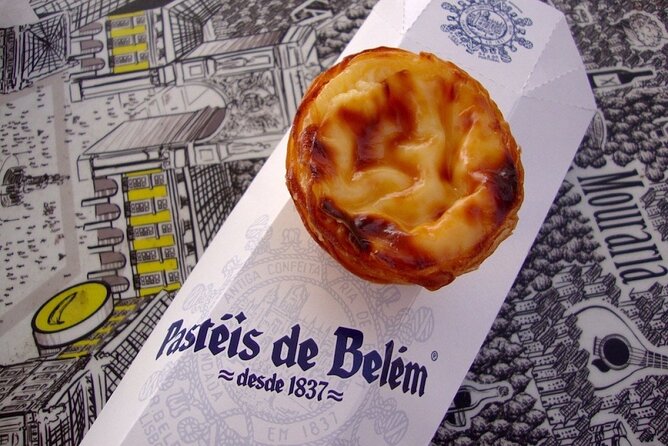
Next is Pastéis de Belém. The big reason this stop feels worth it is that it connects the iconic dessert to the craft behind it. Production began in 1837, based on a recipe associated with the Jerónimos Monastery. The pastries are made daily in the factory using artisanal processes, and you get time to learn how they’re made before you taste them.
That tasting part is key. You are not just buying a pastry and moving on. You get a quick understanding of why the method matters, then you eat while the explanation is still fresh in your mind. For many people, this is the moment that turns the tour from “nice landmarks” into “a Lisbon memory.”
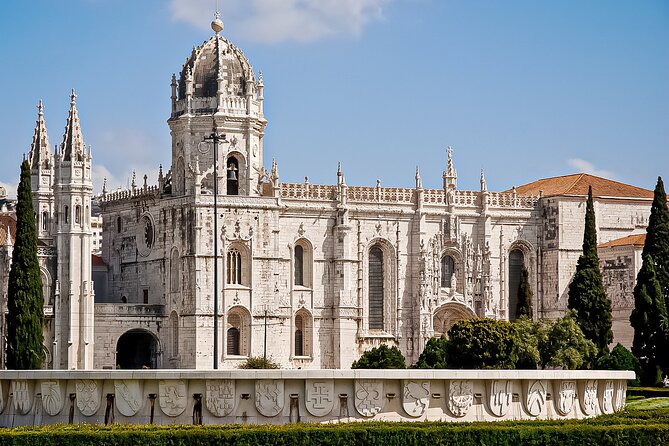
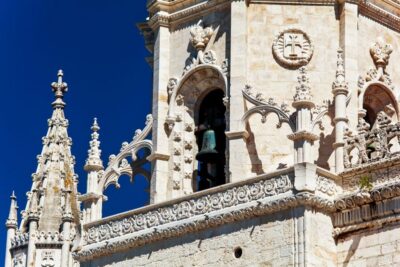
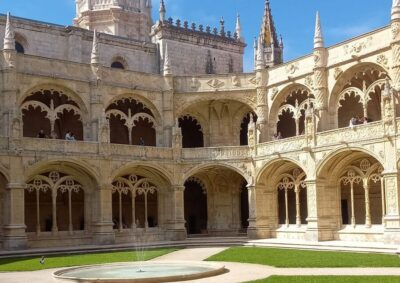
Right after, you stop at Jerónimos Monastery. The monastery dates to the late 15th century, built by King D. Manuel I and connected to the Order of Saint Jérónimo. Inside the church you will find the tombs of Pedro Alvares Cabral and Vasco da Gama, which makes this site feel like it is pointing toward the Age of Discoveries without needing extra interpretation.
The time here is brief, and that is normal for a route like this. Treat it as a front-of-building and quick viewing moment, then decide if you want to return later for longer exploration.
Torre de Belém and Padrão dos Descobrimentos, river defenses and the stone map idea
Then the tour shifts you back toward the river with Torre de Belém. This is a fortification on the right bank of the Tagus. Historically, the surroundings changed over the centuries, but the monument stayed central to the city’s coastal identity. Architecturally, it is linked to the reign of D. Manuel I and combines medieval keep-tower tradition with a modern bastion feel meant for artillery.
You get about 25 minutes, so you can see it up close and get a solid sense of the details. This stop works especially well if you like architecture because it is not just a silhouette. You can spot how the shape supports the “defense” story.
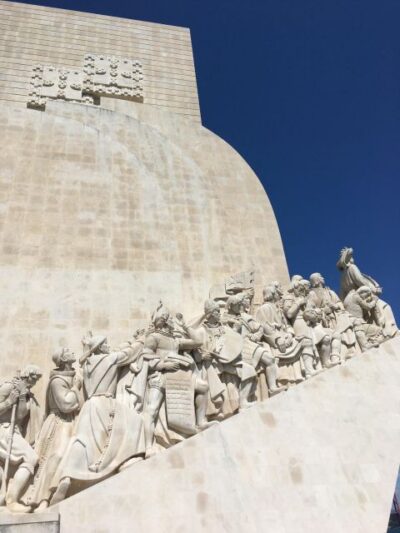
After that, you visit Padrão dos Descobrimentos, the Monument to the Discoveries. It was erected in 1940 for the Portuguese World Exhibition and later inaugurated in 1960 as the current replica. You also get a look at the map area, which represents how Portugal first passed in the 15th and 16th centuries.
This is a great pairing with Jerónimos. Together they help you connect the religious-political anchor of the monastery with the outward-looking, overseas-expansion theme of the monument.
MAAT’s modern shell, a contrast stop that makes the whole day click
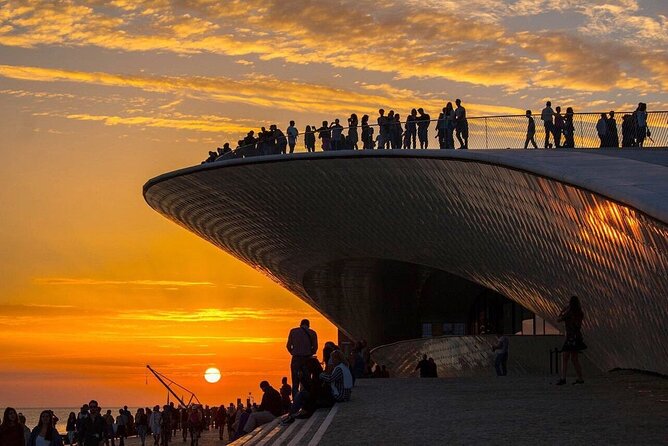
The last featured stop is MAAT (Museu de Arte, Arquitetura e Tecnologia). You only spend about 10 minutes, and admission is free for this stop. The point here is not deep museum time. The point is contrast.
MAAT opened in October 2016, and it sits within a broader cultural push supported by the EDP Foundation. Even from a short stop, you can appreciate why this museum is placed at the end of a Discoveries-focused route. It gives Lisbon a present-day voice after you’ve been surrounded by symbols of exploration and empire.
If you want something tangible to do with that short time, focus on the building’s architecture and how it sits near the river world of Belém. It helps the whole day feel connected instead of just “a list of separate places.”
What I’d watch for on the day, lines, closures, and how to keep it fun
Because this is a tight schedule, you should plan for real-world friction. Even when the tour is well organized, some sites can be affected by lines, closures, or crowding. In one shared experience, a pastry stop at Belém was a clear winner, even when other nearby highlights were impacted and a specific chapel area at Jerónimos saw a long wait.
So here’s the mindset that works best: treat the itinerary as a set of anchors, not a set of guarantees for long time inside every possible room. The payoff stops are built into the plan, like the coach museum with included admission and the Pastéis de Belém tasting. If one part runs long elsewhere, the rest of your highlights are still there.
Also consider timing for your own food choices. With a tasting coming in Belém, you do not need a huge meal earlier in the day. A snack approach helps you enjoy the factory pastries without feeling stuffed.
Finally, remember you are moving through multiple neighborhoods and bridges. Wear comfortable shoes and keep a light layer for wind. Lisbon often feels mild until you hit open spaces like the bridge and riverfront.
Should you book this private Discoveries tour?
I think this tour is a strong choice if you want a private, guided route that hits Belém’s main Discoveries symbols without making you coordinate transport and entry times yourself. It’s also a great match if you like a mix of styles, pink street fun, street art, royal museum visuals, then back to history-heavy monuments.
Book it if:
- you are traveling with up to five others and want the value of a group rate
- you want a smart Belém introduction, not a long museum marathon
- you care about the story behind Pastéis de Belém, not just buying one pastry
Skip it or consider a longer standalone visit if:
- you know you want long museum time at Jerónimos or the Torre area
- you hate quick stops and want a slow pace
- you prefer to explore at your own speed without photo timing
If you want to save energy and still get the essentials, this private Discoveries route is a practical way to make Lisbon feel clear fast.
FAQ
How long is the private Discoveries tour in Lisbon?
The tour lasts about 3 hours.
How much does the tour cost, and how many people are included?
It costs $355.21 per group, for up to 6 people.
Is pickup available?
Yes, pickup is offered. You meet outside the hotel in vehicles identified with the company logo.
What language is the tour offered in?
The tour is offered in English.
Is there a mobile ticket?
Yes, the tour includes a mobile ticket.
Are any admissions included, or are all stops free?
Most stops are free. Admission is included for Museu Nacional dos Coches, while Pastéis de Belém and the other listed stops have free admission tickets noted as included at the stop.
Does the tour visit multiple neighborhoods and landmarks?
Yes. The route includes stops such as Calle Rosa de Lisboa, Time Out Market Lisboa, LX Factory, Ponte 25 de Abril, Museu Nacional dos Coches, Pastéis de Belém, Jerónimos Monastery, Torre de Belém, Padrão dos Descobrimentos, and MAAT.
What is the cancellation policy?
You can cancel for a full refund up to 24 hours in advance of the experience start time. Free cancellation is available, and any changes within 24 hours of the start time are not accepted.
More Private Tours in Lisbon


More Tours in Lisbon



More Tour Reviews in Lisbon
Not for you? Here's more nearby things to do in Lisbon we have reviewed











Belem Tours, side by side.
 ★ 4.1Jerónimos Monastery Entrance TicketTickets from $2114,164 traveller reviews
 ★ 5.0Private Lisbon Sightseeing Tuk-Tuk Tour: Alfama, Belém & MoreTickets from $524,277 traveller reviews
 ★ 5.0Age of Discoveries Walking Tour in BelémTickets from $31,513 traveller reviews
 ★ 5.0Bike Tours Lisbon – Center of Lisbon to BelémTickets from $19686 traveller reviews
 ★ 3.7Jerónimos Monastery E-Ticket and Audio GuideTickets from $33660 traveller reviews
 ★ 4.7Lisbon Bike Tour: Downhill Downtown Lisbon to BelémTickets from $45655 traveller reviews
 ★ 4.7Belem Walking Tour with Jeronimos Monastery TicketTickets from $61490 traveller reviews
 ★ 4.8Belem, Jeronimos Monastery, and Coach Museum TourTickets from $94478 traveller reviews
More useful lists for this tour