
Review · LISBON CITY TOURS
Lisbon Street Art – Private Guided Tour in a Electric Tuk Tuk
Street art, by tuk-tuk, in Lisbon’s hills. This private electric tuk-tuk tour threads together Lisbon neighborhoods and artist-focused stories, with stops timed for both photos and short, clear explanations. I love that it is not just a ride from wall to wall, it is a guided walk-by the art, with names like Vhils, Bordalo II, and Shepard Fairey worked into the route.
I also like the practical pacing. You get multiple murals and graffiti moments, then you finish at a viewpoint where the city makes sense in one wide look. One thing to consider: the stops are short, often around 10 to 30 minutes, so if you want to linger like a museum visit, short photo stops might feel a bit fast.
Key Things That Make This Tuk-Tuk Street Art Tour Worth Your Time
- Electric tuk-tuk rides save your legs on Lisbon hills and uneven cobblestones
- Private group format keeps the guide’s attention on your questions
- Named artists and specific works show up in the route, like Vhils, Bordalo II, and Shepard Fairey
- Viewpoints are built in, including Miradouro da Graça and Portas do Sol
- Your itinerary can be customized, so you are not forced into a generic checklist
- Most stop entrances are free, so you can focus on the art and the walking time between moments
Electric Tuk-Tuk Meets Lisbon Street Art: Why the 2-Hour Format Works
Lisbon’s street art is everywhere, but it is also scattered across neighborhoods that climb, curve, and sometimes turn into a cobblestone obstacle course. This is exactly where an electric tuk-tuk earns its keep. You spend more time seeing street-level murals up close, and less time stuck in the logistics of getting from one hilltop corner to the next.
The ride is about 2 hours, so think of it as a guided highlight reel that teaches you how to look. The guide talks as you arrive, so you understand what you are seeing while the mural is still right in front of you, not back in your hotel room when it is hard to remember details.
Because it is private, you also get a cleaner experience. If you are more into portraits, stencils, or environment-focused street art, you can steer what the guide emphasizes. That customization matters more than you might think, since street art tastes vary a lot person to person.
You can also read our reviews of more guided tours in Lisbon



Price and Value: Is $101.97 a Fair Deal for This Much Art?
At $101.97 per person for a 2-hour private electric tuk-tuk tour, the price can look steep if you are comparing it to a quick sightseeing bus. But the value is in three things that add up fast in Lisbon.
First, transportation is doing real work for you. The route hits Graça and São Vicente type terrain, where narrow streets and cobblestones slow walking. The tuk-tuk helps you cover ground that would take much longer on foot.
Second, you are not just collecting images. The tour focuses on named pieces and artists, and the guide provides commentary at the stops. That turns the art into something you can interpret, not just photograph.
Third, the route includes free-access moments at multiple stops. Several locations are listed as admission ticket free, which keeps the total cost from creeping upward with entrances.
If you want the quickest way to get oriented to Lisbon street art without losing half a day to wandering, this format is priced like a shortcut, and it usually feels like a good one.
Route Plan From Chiado: What You Will Actually See and Why It Adds Up
Your tour starts in Chiado, with the option for hotel pickup. That is a big practical win because Chiado is a natural launch point for heading toward the steep lanes of older Lisbon neighborhoods.
From there, the route flows toward the Graça and São Vicente areas and finishes at a viewpoint stop. You are combining three things that help you understand the city:
1) street-level artwork,
2) neighborhood context,
3) a panoramic view that lets you map what you just saw.
The stops are deliberately varied. Some are more about a single, standout piece. Others are short bursts of multiple works packed into an area. Then you get a viewpoint at the end to reset your perspective.
This mix is one reason the tour works well even for first-timers. You get highlights, plus just enough context to know where to go back later on your own.
Stop 1, Miradouro da Graça: Sophia de Mello Breyner Andresen by Daniel Eime
You begin at Miradouro da Graça, tied to a mural of Sophia de Mello Breyner Andresen, with the work credited to Portuguese street artist Daniel Eime. The mural is a portrait, and it matters because the poet is strongly associated with the Graça area. Even if you are not a Portugal-literature expert, you will recognize that the mural is doing more than decoration.
In practical terms, this is your orientation stop. You get viewpoint energy first, then street art right where people live and gather. The timed visit is around 10 minutes, so you are not expected to read everything like a scholar. Instead, it is a fast, guided introduction that helps you notice details when you move on.
Bonus for photos: because it is a viewpoint area, you can frame the mural with Lisbon’s slopes in mind. That helps you later when you spot other art pieces and start connecting them to the neighborhood setting.
Stop 2, Shepard Fairey Peace Guard: When Two Artists Collide on One Wall
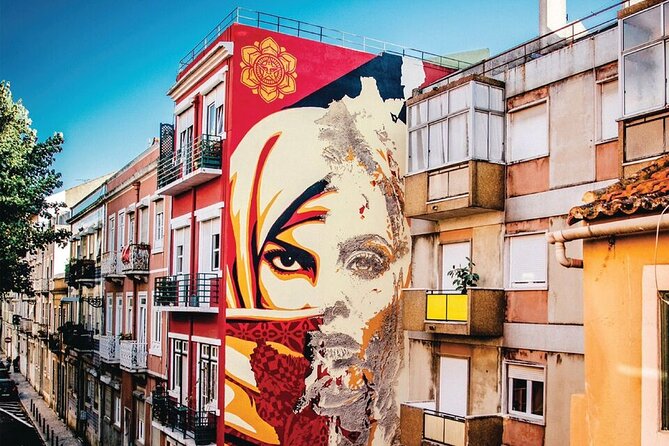
This is the marquee moment. The tour includes a collaboration-focused stop linked to Shepard Fairey, also known as Obey Giant, and Vhils. The stop is built around an iconic mural called Peace Guard, and the guide gives you a key tip: turn around and position yourself so you have a clear view.
If you only remember one thing from this tour, make it that. Peace Guard is presented as the closest thing in the route to a street-art landmark, a piece that people actively orient around.
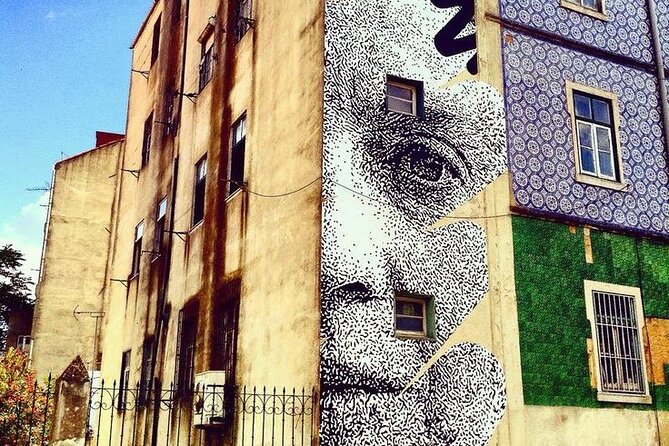
You will also see that this tour connects Fairey and Vhils thematically. Earlier, the route references another Fairey work made in collaboration with Vhils. That makes the second stop feel less random. You are seeing a relationship between artists, not just isolated murals.
Timing is longer here, around 30 minutes. Use that extra time. Take a few steps to find your best angle, then let the guide’s commentary finish before you speed off to the next stop. This is one of those murals that rewards patience by revealing layers when you look again.
You can also read our reviews of more private tours in Lisbon





Stop 3, Graça and São Vicente Murals: Oze Arv and Andre Saraiva
After the big icon stop, the tour shifts into neighborhood variety. In Graça and São Vicente, you get shorter, around 10-minute bursts at multiple works.
One stop highlights Oze Arv, with the piece titled alegria de um caos constante. Another spot focuses on Andre Saraiva and a mural azuleijo. Azulejo-style work is a big part of Portuguese visual culture, so seeing it in a street-art context is a nice reminder that the city’s aesthetics are not locked in museums. They show up on walls, too.
These short visits are where you learn how to spot styles quickly. You will likely notice differences in materials and shapes. The guide’s job here is to help you link those visual cues to the artist and the intention behind the piece, so it does not all look like the same kind of graffiti from a distance.
A practical tip: if you care about one artist more than the others, this is the moment to ask for a little extra time at that style before moving on. Because the tour is private, the guide can usually adjust.
Stop 4, R. São Tomé 76: Bordalo II’s Panda and Vhils’s Amália
This stop is one of the most distinctive on the route because it mixes playful characters with cultural tribute.
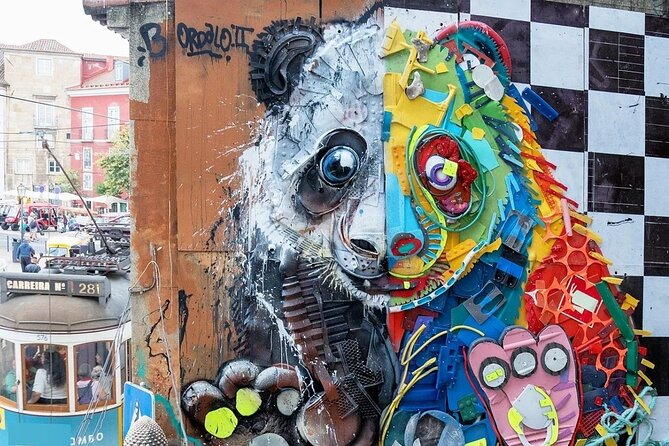
First up: Bordalo II’s panda, created in the context of an exhibition called Evilution. The information provided connects it to environmental and sustainability themes, using a neologism tied to ongoing commitment. The panda concept is charming, but the point is serious enough to make it feel more than a cute street figure.
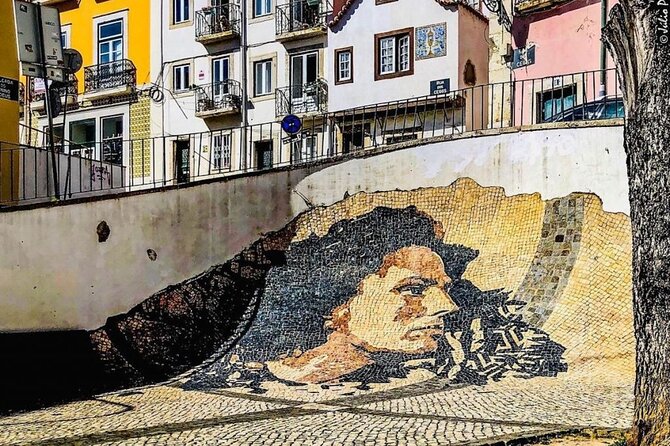
Then you move to Vhils – Amalia, described as a unique piece made in Portuguese traditional-style pavement. It pays tribute to Amália Rodrigues, the late Fado diva. This is the kind of detail that makes the tour feel more than a highlight list, because it shows street art taking different forms, not only painted walls.
Timing here is around 15 minutes. That is enough time to notice the “pavement” aspect and to understand why the tribute connects to Lisbon’s music identity.
If you like street art that mixes humor with message, this is a top stop. If you prefer art that feels tightly rooted in local culture, the Amália tribute is likely to hit hardest.
Stop 5, Miradouro das Portas do Sol: The Archway and Lisbon’s History
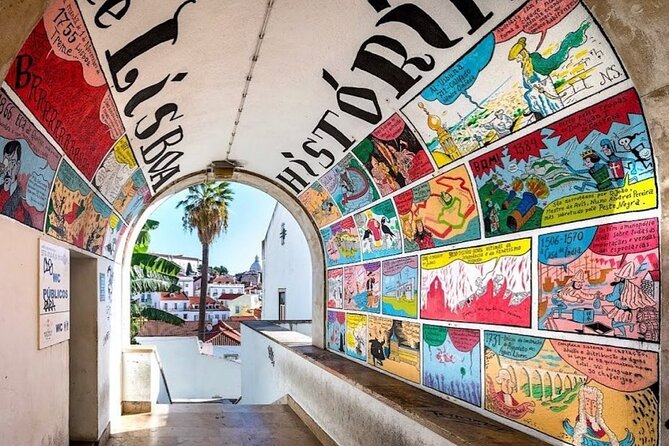
You end with another viewpoint stop at Miradouro das Portas do Sol. Underneath it, there is an archway with Lisbon history painted on. This final moment is a clever close: after focusing on individual pieces, you get to see the city as a whole again.
The visit is around 10 minutes. It is short, but it is a good way to wrap your understanding. You have just seen murals mapped to neighborhoods and cultural references. Now you can look at the slopes, streets, and viewpoints and imagine how those walls fit into daily life.
If you are planning to explore after the tour, this stop helps you pick direction. You will get your bearings faster because you have already been guided to the places where Lisbon’s angles matter.
How the Guides Actually Improve Your Street-Art Experience
The biggest consistent theme behind great experiences in this tour style is the guide. In this case, you may encounter guides like David, Andre, Susana, or Tiago, and they bring a friendly, adaptable approach.
The practical payoff shows up in two ways.
1) The guide helps you read the art in the moment. Instead of wondering what you are looking at, you get context for each piece right where it is located.
2) The guide can adjust the route toward your interests. If you are obsessed with one artist name on the wall, you can often get more time on that flavor.
A nice detail from real experiences is that the tour still works in rain. Lisbon weather can switch quickly. When it does, the value of a tuk-tuk plus guided stops becomes even more obvious, since it reduces time standing around and keeps you moving.
One more real-world benefit mentioned often is that you cover more street-art installations than you could comfortably do alone. Narrow streets plus hills can slow even motivated walkers. Here, the tuk-tuk helps you keep the pace without turning it into a sprint.
Who This Tour Suits Best (And Who Might Prefer a Longer Day)
This tour is ideal if you want:
- a fast, guided introduction to Lisbon street art,
- named artists and specific murals, not just general wandering,
- a way to handle hills and uneven pavement without tiring out your day,
- private attention so you can ask questions and tweak the focus.
You might consider a different approach if you already know the exact murals you want, and you prefer a long self-guided art walk where you can spend 40 minutes at a single wall. This experience is built around short stop bursts, so the emphasis is coverage and context, not slow art immersion.
That said, the “2 hours” format can also be a smart first step. You leave with names and locations in your head, then you can return later with a more patient plan.
Should You Book This Lisbon Street Art Electric Tuk-Tuk Tour?
Yes, I would book it if you want a high-quality street-art orientation that saves time and effort. The electric tuk-tuk solves Lisbon’s biggest practical problem for this kind of outing: getting between neighborhoods efficiently while dealing with narrow streets and hilly, uneven pavement.
It also earns its price through guide commentary and a route that mixes standout icons like Peace Guard with additional works by Vhils and Bordalo II. The viewpoint finish at Portas do Sol is a strong bonus because it helps you connect what you saw on the walls to the actual geography of the city.
If you are the type who likes your travel with a plan but still wants flexibility, the private format and customizable itinerary are a good match. You get structure, plus room to steer toward the art you care about most.
FAQ
How long is the Lisbon street art private guided tour in an electric tuk-tuk?
It lasts about 2 hours.
Is this tour private or will I be with other groups?
This is a private tour/activity. Only your group participates.
Do you offer hotel pickup?
Yes, pickup is offered at your hotel.
What language is the tour offered in?
The tour is offered in English.
Is there a mobile ticket?
Yes, a mobile ticket is provided.
Are there admission fees for the street art stops?
The listed stops show admission ticket free.
What are the tour operating hours?
Monday to Sunday, 9:30 AM to 7:00 PM, during 06/02/2025 to 06/01/2026.
Can I get a full refund if I cancel?
Yes. Free cancellation is available up to 24 hours in advance for a full refund.
More Guided Tours in Lisbon


More Tours in Lisbon





More Tour Reviews in Lisbon



Not for you? Here's more nearby things to do in Lisbon we have reviewed










Lisbon City Tours, side by side.
 ★ 5.0Lisbon City Center Tour – The Unmissable LisbonTickets from $322,234 traveller reviews
 ★ 4.7Sintra, Pena, Regaleira, Cabo da Roca & CascaisTickets from $2319,656 traveller reviews
 ★ 4.1Jerónimos Monastery Entrance TicketTickets from $2114,164 traveller reviews
 ★ 4.8History, Stories and Lifestyle Walking TourTickets from $2910,902 traveller reviews
 ★ 4.5Sunset Boat Party Cruise with DJ and Open BarTickets from $2710,378 traveller reviews
 ★ 4.7Pena Palace, Sintra, Cabo da Roca, & Cascais DaytripTickets from $919,981 traveller reviews
 ★ 4.6Oceanário de Lisboa Entrance TicketTickets from $299,943 traveller reviews
 ★ 5.0True 4Hour Private Tuk Tuk Tour: Discover Lisbon with a Local!Tickets from $1088,008 traveller reviews
More useful lists for this tour