

Review · ALFAMA TOURS
Alfama tour
Lisbon’s hills never feel so easy. This Alfama tour strings together top viewpoints and key monuments fast, using a tuktuk route so you spend less energy climbing and more time taking photos. I especially like the way the stops are stacked for easy sightseeing, and how the tour includes time at places you would normally reach only by wandering steep streets. One thing to consider, the tour depends on decent weather, and you will still do a bit of walking inside and around the stops.
I also like the human side of it. Guides like Otoni and Marlon get called out for being friendly, funny, and willing to give extra time when possible, which makes the whole loop feel personal instead of rushed. The only drawback is pacing: each viewpoint stop is about 10 minutes, so if you want long sitting-and-staring time, you may feel a little time-pressure at the highest miradouros.
If you are the type who wants to get your bearings in Alfama quickly, this is a strong fit. It starts in the morning at Praça da Figueira and ends back at the same meeting point, so you do not have to figure out how to hop between spots on your own.
Key things to know before you go
- Tuktuk transport for steep Alfama angles, without turning the day into a workout
- A tight viewpoint lineup across Alfama, the Tagus River, and São Jorge Castle
- Most admission tickets included, with one notable exception at the Pantheon stop
- A fado-focused museum stop plus a short Alfama stroll and ginjinha tasting
- Private tour for your group, plus pickup offered for the start of the loop
- Weather matters, since the route is built around outdoor viewpoints
Why this Alfama tuktuk route works in 1 hour 30 minutes

This tour is priced at $55.85 per person and runs about 1 hour 30 minutes. In Lisbon, that time window is actually a sweet spot. You get a guided push through the parts that make Alfama feel like Alfama, without losing half your day to stairs, winding lanes, and getting turned around.
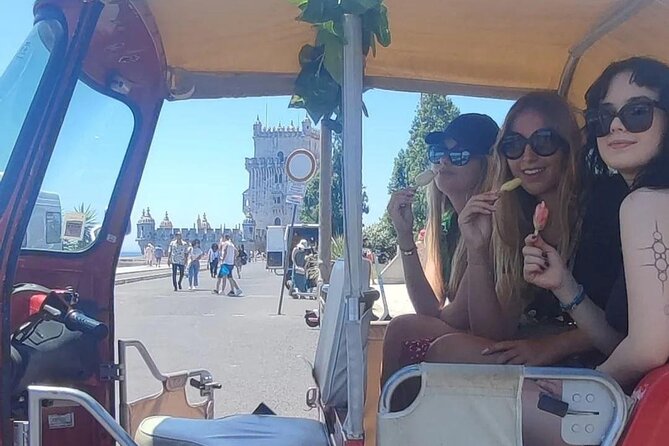
What makes the format feel good is the way it reduces friction. Instead of you hiring taxis or calculating bus routes while you bounce between lookouts, you get a direct, planned route that hits major points and photo angles in a logical order. The tuktuk also changes the experience. You move through the neighborhood differently, with a guide telling stories as you pass monuments and viewpoints you might otherwise miss.
The value angle is the admission mix. Many of the stops include admission tickets (Lisbon Cathedral, the miradouros’ guided entries, Mosteiro de São Vicente de Fora, and the Museu do Fado). One stop is explicitly not included, the Panteão Nacional. Still, for a tour that already includes a guided circuit, you can think of the included admissions as part of the price rather than as add-ons you discover later.
You can also read our reviews of more tours and experiences in Lisbon.
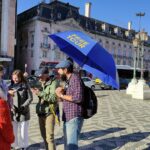
Meeting at Praça da Figueira and getting started on the right foot
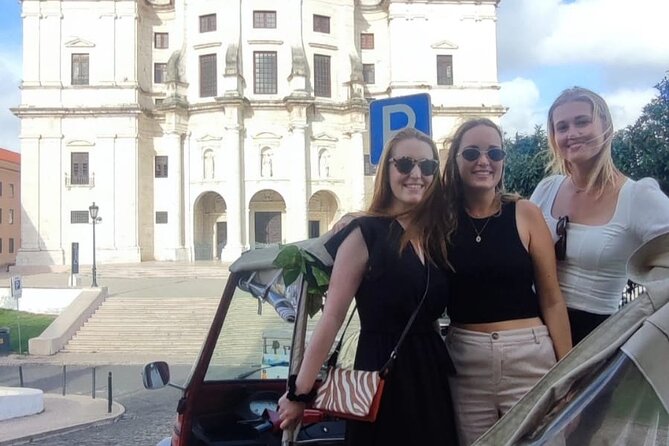
You meet at Praça da Figueira, 1100-241 Lisboa, and the tour starts at 9:00 am. The tour ends back at the same meeting point, so it behaves like a closed loop.
I like closed-loop tours for neighborhoods like Alfama. You can focus on what you see, not on the logistics of returning. Since pickup is offered, you might be able to start with less walking at the beginning too, which matters in Lisbon where distances can feel longer than they look.
A practical tip: wear shoes you can stand in comfortably. Even with tuktuk transport, you will be going in and out of viewpoints and making short walks around the monuments. Also bring something for sun and light rain. The tour requires good weather, and viewpoints are outdoors.
Lisbon Cathedral: a Romanesque start and a true oldest-church moment
Your first stop is Lisbon Cathedral, a Romanesque-style building whose construction began in 1147 and was completed in the early decades of the 13th century. You get about 10 minutes there, with admission included, and you are visiting inside what the tour describes as the oldest church in Lisbon.
This is a smart opener. It gives your day a historical anchor before the miradouros start stacking up. Cathedral visits can be hit-or-miss on tours if the timing is too short, but 10 minutes is enough to look closely, get oriented, and take a few interior photos without feeling you missed the whole point.
One consideration: since the visit is brief, focus on what you can actually see. Watch for architectural details, lighting, and the overall feel of the space rather than trying to read every plaque in a sprint.
Santa Luzia and Portas do Sol: Alfama viewpoints made for photos

Next come two classic Alfama lookouts: Miradouro de Santa Luzia and Miradouro das Portas do Sol, each with about 10 minutes on-site and admission included.
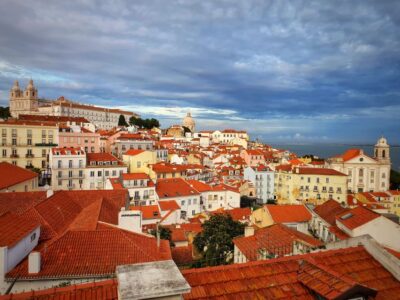
At Santa Luzia, the viewpoint gives a wide view over Alfama and the Tagus River. It is one of those spots where your brain clicks into place. Alfama is not just lanes and buildings, it is also a whole layered view down toward the river.
Portas do Sol is described as balcony-like, with a magnificent view covering the eastern part of Lisbon plus the Tagus. This is the kind of stop that helps you understand how the neighborhood sits within the city, not just how it looks in one direction.
Here is how I’d use your time at these miradouros:
- Take one photo from the widest angle first, so you capture context.
- Then do a second round for details, like how rooftops stack and where the streets thread downward.
- If it is crowded, do not fight for the perfect spot. Aim for a clean horizon line and move on.
Miradouro da Graça and Senhora do Monte: castle views and higher vantage points

After those river-and-neighborhood angles, the route climbs to Miradouro da Graça (named after Sophia de Mello Breyner Andresen) and Miradouro da Senhora do Monte. Both stops are about 10 minutes and include admission.
Miradouro da Graça sits in Largo da Graça, next to the church, and it is described as a terrace with one of the most beautiful views, especially toward São Jorge Castle. The castle is a key visual landmark in Lisbon, and getting it in frame is a big payoff for photo-heavy visitors.
Then you head to Senhora do Monte, at the highest point in Bairro da Graça. The viewpoint is in the churchyard of a small hermitage that was remodeled twice in the 20th century. The tour notes that this is one of the best panoramic viewpoints, particularly over Mouraria and Castelo de São Jorge.
Why this pairing is worth it: you are not just getting two similar photos. You are getting two slightly different elevations and perspectives on the same big story, Alfama’s relationship to São Jorge, the inner city, and the surrounding districts.
A small reality check: higher viewpoints mean more exposure. If the day is bright and windy, you might want sunglasses and an extra layer you can put away quickly.


Mosteiro de São Vicente de Fora: a quiet pause from viewpoints
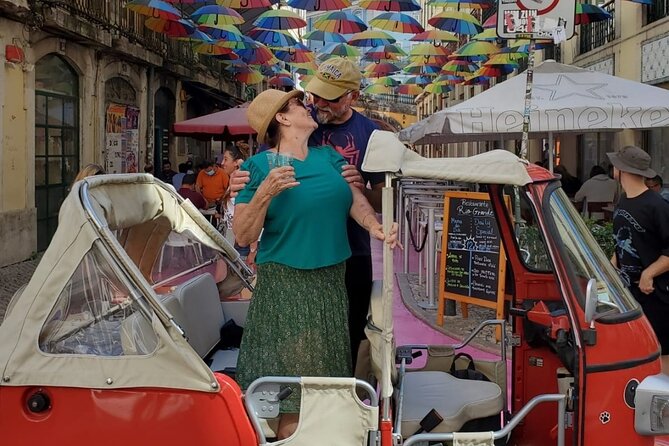
Stop 6 is Mosteiro de São Vicente de Fora. You get about 10 minutes, with admission included. The tour describes a church begun in 1582, in an area that reflects the medieval surroundings of Lisbon in the 16th century.
This stop is a nice change of pace. After a string of outdoor lookouts, a monument like a monastery works as a reset. It is also a chance to slow down and look at the building itself, not just the view it frames.
One practical consideration: because you only have a short window, go with one goal. Either focus on the architecture you can see quickly, or pick one angle you want to photograph. Trying to do everything in 10 minutes usually ends with no clear takeaway.
Panteão Nacional: what the stop is, and why it costs extra
Then comes Panteão Nacional. This is the National Pantheon, intended to honor and preserve the memory of Portuguese citizens recognized for services in public positions, military service, cultural expansion, literary, scientific, or artistic creation, defense of civilization values, and the cause of human dignity and freedom.
You spend about 10 minutes at this stop, but admission is not included. That means if you want to enter fully, you should be prepared that you may need to pay separately.
I actually like having one explicit extra-cost stop on a sightseeing tour, because it gives you choice. If you care deeply about the pantheon, you can decide you are willing to pay to go in. If your priority is mainly the viewpoints and fado, you can use the time for photos and context without stressing about ticketing surprises.
Museu do Fado and an Alfama mini-walk: the culture payoff

The final featured stop is Museu do Fado, about 10 minutes with admission included. The museum opened on September 25, 1998, and it is dedicated to the world of fado and guitar.
This is a smart closer, because it ties the tour back to the emotional side of Lisbon, not just the scenic side. Alfama is tied to fado as a cultural thread, and a museum stop helps you understand what you are hearing later.
After the museum, the tour includes a brief walk inside Alfama. You get a chance to discover alleys, local restaurants, and traditional shops. Then there is a ginjinha test, a cherry liqueur tasting included in the tour.
This combination is one of the most praised parts of the experience vibe. It gives you a small, guided taste of neighborhood life right when the tour ends, which helps you keep momentum after the tuktuk ride.
If you are the type who usually skips food and drink on tours, do not. Ginjinha is simple, local, and fast. Even if you only take a small taste, it gives you a souvenir that is not just an image.
Guides and timing: why the experience can feel better than the clock
Your guide is the difference between seeing Lisbon and understanding it. The tour is described as friendly and story-filled, and the names Otoni and Marlon came up in the most positive feedback I saw, with people praising gentleness, helpfulness, humor, and the feeling that the guide makes you feel comfortable.
One detail I really like: in at least one reported experience, the guide gave almost triple the time that was agreed. That is not a guarantee, but it highlights the kind of flexibility that matters. When a guide slows down for a question, adds a bit of extra orientation, or makes sure you get the photos you actually care about, the tour can feel more like a shared walk than a checklist.
Keep your own expectations practical though. Each viewpoint stop is roughly 10 minutes, so you should still plan to be efficient with your photos and questions. Think of it like a guided highlight reel, not a slow museum marathon.
Price and value: what $55.85 buys you in real terms
At $55.85 per person for about 1 hour 30 minutes, the math works best if you compare it to what you would otherwise spend on transportation plus timed admissions.
Here is what you can count on based on the tour description:
- Tuktuk transport through multiple key areas of Alfama
- A guided circuit with stops at major monuments and viewpoints
- Admission included at several stops, including Lisbon Cathedral and Museu do Fado
- Admission not included at Panteão Nacional
- Short Alfama walking time plus a ginjinha tasting
If you were to plan this yourself, you would likely spend time figuring out routes, paying for transport between elevations, and paying for museum and church entries on your own. The tour packages those moving parts into one schedule.
One more small value point: the tour is private for your group. Private tours usually cost more, so getting a private format in this price range signals that the operator is trying to focus on value, not only flexibility.
As a booking reality check, it is commonly booked about 15 days in advance on average. If you have a specific day in mind, do not wait until the last minute, especially during better weather weeks.
Should you book the Alfama tour by tuktuk?
I think this is a great choice if you want a fast, guided introduction to Alfama’s signature viewpoint circuit, plus a real culture anchor at the Museu do Fado. It is also a solid option if you want to avoid turning your day into a stair workout. The route is built for photo stops, and the museum and ginjinha tasting give you a memorable ending.
Skip or reconsider if your ideal tour is slow and unstructured. Because most stops are around 10 minutes, you will not have hours to linger at one viewpoint. Also, the experience requires good weather, so keep an eye on forecasts and be ready for rescheduling if conditions are poor.
FAQ
How long is the Alfama tour?
The tour duration is approximately 1 hour 30 minutes.
Where is the meeting point, and what time does it start?
You meet at Praça da Figueira, 1100-241 Lisboa, Portugal, and the start time is 9:00 am. The tour ends back at the meeting point.
Is pickup offered?
Yes, pickup is offered.
Is this tour private?
Yes. Only your group participates.
Does the tour include admission tickets?
Most stops include admission tickets, but the Pantheon stop (Panteão Nacional) does not include admission.
Is a mobile ticket used?
Yes, you receive a mobile ticket.
Are service animals allowed?
Service animals are allowed.
What if the weather is bad?
This experience requires good weather. If it is canceled due to poor weather, you will be offered a different date or a full refund.
More Tours in Lisbon



More Tour Reviews in Lisbon
Not for you? Here's more nearby things to do in Lisbon we have reviewed








Alfama Tours, side by side.
 ★ 5.0Alfama Tour in Lisbon Old TownTickets from $34,936 traveller reviews
 ★ 5.0Private Lisbon Sightseeing Tuk-Tuk Tour: Alfama, Belém & MoreTickets from $524,277 traveller reviews
 ★ 4.8Hills, Alfama, and Mouraria Tour by Electric BikeTickets from $253,438 traveller reviews
 ★ 4.9Best of Lisbon Walking Tour: Rossio, Chiado & AlfamaTickets from $232,700 traveller reviews
 ★ 5.0Lisbon Small-Group Food Tour with 18 Tastings in Alfama DistrictTickets from $1261,967 traveller reviews
 ★ 4.5Lisbon E-Bike Tour Commerce Square, Mouraria and AlfamaTickets from $301,688 traveller reviews
 ★ 5.0Old Town TukTuk Tour and Scenic Viewpoints in AlfamaTickets from $35974 traveller reviews
 ★ 4.4Alfama Tour and Live Fado with Traditional DinnerTickets from $58970 traveller reviews
More useful lists for this tour