
Lisbon tastes better when you walk it. This 3.5-hour tour strings together Alfama and Miradouro de Santa Luzia for hilltop photos, then breaks up the walk with Portugal’s classic nibbles. My only heads-up is that the streets include some steep stretches, so solid shoes matter.
I like how the route keeps you moving through Chiado and Baixa, with a guide (Ricardo and Eduardo have been leads recently) explaining what you’re seeing instead of dumping facts. The tastings feel like part of the neighborhood, especially the stop for pastel de nata and the small tavern style meal moments.
For $63, you get a live guide plus a full set of drinks and food, including coffee or juice, a ginjinha shot, and a beer or green wine, with optional extra food for solo travelers who opt in. If you hate eating on the move, plan for those breaks.
Key things you will notice on this tour
- Alfama first with narrow winding streets, cobblestones, and azulejo-covered facades
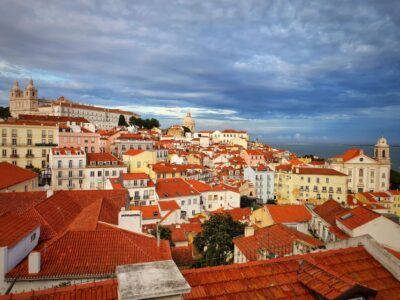
- Miradouro de Santa Luzia panoramic photo time without having to plan it yourself
- Chiado + Baixa as two different Lisbon moods, art and literature then classic plazas
- Manteigaria pastéis de nata tasting plus a built-in rhythm of food stops
- Ginjinha and a real sandwich (bifana) make it more than a quick snack tour
- Steep streets but moderate overall effort, great for walkers, not for mobility limits
Starting at Merendinha and getting your bearings
The tour begins at Merendinha, R. Nova do Almada 45a. That matters because you are not guessing where to start or how to thread through the neighborhoods. You get a live guide, and the group stays together long enough to connect the dots between Lisbon’s old streets and its showpiece squares.
This is a 3.5-hour walk, so I treat it like an efficient “see the city’s layout first” session. You will cover Alfama, Chiado, and Baixa in one go, with short stops that give you context instead of just passing landmarks. The pacing also includes food and drink moments, which keeps energy up on a day that can otherwise feel like straight sightseeing.
Before you go, plan for real walking. You will want comfortable shoes and water, because Lisbon’s famous hilly lanes can slow you down if you are in sandals. Bring a camera if you care about viewpoints, since the tour includes multiple miradouros where Lisbon opens up in every direction.
One more practical point: you might hear different guide styles depending on who leads. Ricardo is described as engaging and friendly in recent tours, while Eduardo also gets praised for keeping things entertaining. Either way, expect the guide to steer the day with a mix of street-level observations and city history tied to what you are seeing.
You can also read our reviews of more walking tours in Lisbon



Alfama first: narrow streets, azulejos, and Santa Luzia views
Alfama is Lisbon’s oldest district, and starting here sets the tone fast. You begin in the narrow, winding streets with cobblestones underfoot, which immediately changes your pace and your posture. You also see azulejo-covered facades, and those blue-and-white tiles are the kind of detail you only notice when you are walking close to the buildings.
One of my favorite parts of this segment is how the guide connects the geography to the sights. Alfama is not laid out like a grid, so your route naturally bends with the hills. That means the viewpoints matter, and you do not have to wander until you stumble into a great angle.
The tour includes panoramic city views from Miradouro de Santa Luzia. This is where you get the “okay, now I understand Lisbon” moment. If you are arriving in town and you want your photos to look like Lisbon, not like your hotel street, this is the time to prioritize your camera and take a breath.
You will also hear about the neighborhoods through small experiences, including family-owned taverns and the kind of everyday spots where locals eat. That is one of the most praised aspects of the tour, and I agree with the value: when you sample food inside a lived-in setting, the district feels less like an Instagram stage and more like a real place.
The drawback to plan for: steep streets. Even though the overall level is described as moderate, there are some climbs and uneven cobblestones. If you have tight calves or knee issues, you should consider whether 3.5 hours of hillside walking fits your day.
Pink Street to Baixa de Lisboa: following the city’s tempo

After Alfama, you transition into areas that feel more open and structured. You pass The Pink Street early on, then head into Baixa de Lisboa for guided walking. This shift is useful because it shows you how Lisbon changes from hillside neighborhoods to the more straight-line, plaza-focused center.
Baixa is where Lisbon’s modern “moving through the city” energy lives. The tour’s description highlights grand plazas and architecture here, which is exactly what you want after the compact maze of Alfama. Your guide helps you understand what you are seeing rather than just naming it, and that keeps you from feeling like you are sightseeing on autopilot.
This part of the walk is also where you can reset mentally. You get a clearer sense of direction. You will have more space to slow down and take photos that include wider views of streets and buildings.
If you want more time in Chiado and Baixa later, this early pacing is a good trade-off. The walking tempo stays steady, and the tastings help break up the day so you do not burn out before the best viewpoints.
Commerce Square and the Roman Theater Museum stop

You move through key central areas like Commerce Square with guided context. From a traveler’s perspective, squares like this are practical anchors. They are also where Lisbon’s “big city” side shows up, after the narrow lanes of Alfama.
The route then includes a stop for the Museum of Lisbon – Roman Theater, which is a visit. Even if you do not plan to read every label, museum stops act like mental rest breaks. They give your legs a breather and your mind a chance to connect Lisbon’s timeline to the physical city.
What I like about this kind of stop is that it prevents the tour from being only food and photo moments. The day includes cultural references, so the “why this city looks like this” question gets at least some answers before you leave.
One caution: entrance fees to attractions are not included. If you expect every stop to be fully covered, you will want to check what is included in your specific booking day. For the stops listed as visits, you can still expect the guide to point you in the right direction, but you may pay extra if an entrance is required.
Casa dos Bicos, Trindade, Chafariz d’El-Rei, and Aurea Museum
This middle stretch is built around short, guided touchpoints. You will have a guided stop at Casa dos Bicos, then visits at Trindade and Chafariz d’El-Rei, followed by a visit at Áurea Museum. Even without spending a long time inside each place, this sequence helps you understand Lisbon as a city of layers.
Chafariz d’El-Rei in particular is the kind of stop that works well for photos and quick curiosity. It also gives you a natural pause, which is a big deal on a walking tour with hills. The same goes for museum time: a short visit refreshes your attention, so you do not end up staring through the day.
I also appreciate that the guide keeps these stops from feeling random. The route threads them through the neighborhoods you already crossed, so the day has a shape. You are not just hopping from one landmark to another. You are seeing how different Lisbon styles sit next to each other.
The only drawback here is time. Because the tour is only 3.5 hours, some stops may feel brief. If you want long museum sessions, you will need a separate plan later. Think of these as orientation stops, not full day culture immersion.



Rossio Square to Chiado: art and literature on foot
You reach Rossio Square, then continue toward Chiado, guided along the way. Chiado is described as an elegant hub of art and literature, with iconic cafés, boutiques, and shops. That description is spot on for how Chiado feels in motion: calmer than Alfama’s maze, but still full of personality.
What I like about this segment is how it balances atmosphere with sightseeing. You can look around and feel the vibe without needing to know every detail. The guide points out what matters, so you get something beyond strolling.
Chiado also gives you a shopping and café window, even if you only plan to take a coffee break. You get enough time to notice street life, and the route keeps moving so you are not stuck in one place.
One note from real feedback: some people felt the tasting breaks reduced how much time they wanted in Chiado and Baixa. If you love wandering slowly without stopping to eat, you might find the food schedule a bit firm. The trade-off is that you do not have to hunt for classic Lisbon tastes on your own.
Then again, the tour includes well-known stops later, so even with the tastings, you still end up seeing the key viewpoints and major landmarks that make Lisbon memorable.
Igreja de São Roque, Carmo Convent, and the Santa Justa Lift area
As you keep going, you include several important stops like Igreja de Sao Roque (visit), Carmo Convent (guided tour), Casa do Alentejo (guided tour), and Church of St. Dominic (visit). These names are dense, but the value is in how the guide uses them as wayfinding points.
You also get Santa Justa Lift (guided tour). Even if you do not ride it, this is a classic Lisbon reference point. It helps you understand why the city’s hills feel so connected. Lisbon often looks like it should be hard to navigate, but landmarks like this give you a mental map.
I like this area because it feels like the transition between sightseeing and the city’s everyday life. You walk past spaces that are tied to local routine, not just tourist checklists. The guide’s job is to keep the flow logical, so you do not feel like you are marching through random stops.
And yes, there are still viewpoints and more tastings coming. This section works as a bridge. It gives you cultural stops, then keeps you ready for the big “look down and see the whole city” moments.
Miradouros, Castle Quarter, and Lisbon Cathedral viewpoints
Later, you reach Miradouro das Portas do Sol, then continue into the Castle Quarter area, with guided time. You also visit Lisbon Cathedral. This is where the tour leans into Lisbon’s big strength: seeing the city from above.
Miradouros are not just for photos. They teach you how the city is built. From higher ground, you notice patterns you would miss at street level. And because the tour includes specific viewpoint stops, you avoid the frustration of guessing where the best angles are.
This segment is ideal if you are the kind of traveler who wants to understand a place fast. Alfama’s streets feel confusing at first, but once you get elevation, you start to see why everything works the way it does.
The hills do mean more effort. Your shoes will take the brunt of it. If you have any mobility concerns, this is where you should slow down and keep water handy.
Still, the overall route is described as moderate. That means it is doable if you walk at a steady pace, take breaks when the group stops, and do not try to sprint between viewpoints.
Santa Engracia and São Vicente de Fora: stone, time, and guided context

The itinerary includes National Pantheon of Santa Engracia (guided tour) and Monastery of São Vicente de Fora (guided tour). These are major landmark names, but what matters on this tour is the guided context. You get a sense of why these sites exist in Lisbon’s story, not just where they are.
I like pairing these stops with the rest of the day because they keep the walking tour from turning into a pure food-and-photo loop. You are moving through neighborhoods, eating classic dishes, then getting structured cultural anchors that help everything click.
The guide’s role here is especially important. Without someone connecting the dots, it is easy to walk past big institutions and miss what makes them relevant. With a guide, the day feels like a single story moving forward.
Again, plan for time constraints. If you want to linger and read everything, you will likely need to come back later. But for a first pass through Lisbon, these stops give you more than just a quick exterior glance.
Manteigaria pastéis de nata tasting and the food stops that matter
Now for the part that people talk about most: the tastings. This tour includes Portuguese custard tart, specifically pastel de nata, plus a drink. You can also expect coffee and water or juice.
You also get a ginjinha chocolate shot, described as a local cherry licor served as a shot. That is one of those Lisbon items you either seek out or you miss entirely, so it is a smart inclusion.
Then there is a beer or green wine glass, plus bifana. Bifana is a traditional Portuguese sandwich, and having it on a walking tour is perfect because it actually fills you up. One of the standout compliments from recent experiences is that the tastings are delicious and feel like they belong to the neighborhoods you walked through.
A specific later stop is Manteigaria – Pastéis de Nata Factory for food tasting. If you care about where the tart comes from, this gives you a defined moment for it rather than a random pastry purchase.
Solo traveler note: there is an option for solo travelers to pay for 2 and get extra food options on this product. If that sounds like a good deal for you, it is the easiest way to increase the variety without having to coordinate with others.
Extra option: there is also an Açaí + juice option for an additional 10€, paid at the meeting point. If you prefer something lighter than sweets all the time, this can be a helpful swap, but it is not required.
What you should watch for
The only recurring consideration is pacing around food. Some people felt they expected more walking in Chiado and Baixa, while the tastings take time. I think that comes down to your style. If you love eating and want a set menu of local staples, you will likely feel satisfied. If you want maximum street time with minimal stops, you may feel the tour is more snack-forward than you expected.
Price and value for a 3.5-hour walking tour
The price is $63 per person for about 3.5 hours. On paper, that sounds like a city tour cost. In practice, it covers a lot of tangible items: a local guide, pastel de nata, a drink (coffee and water or juice), ginjinha shot, a beer or green wine, and a bifana sandwich.
That value equation matters if you would otherwise spend your day piecing meals together. Lisbon food can add up quickly if you keep buying individual items. Here, many classics show up in a structured way, so you leave with both neighborhood context and actual eating.
Entrance fees are not included, so you might pay extra if a visit requires admission on your day. Also note that the tour is not built for museum deep dives. It is designed for walking, viewpoints, and a guided hit of culture plus tastings.
I also like that it runs with multiple language options: English, Spanish, Italian, German, and Portuguese. That makes it easier to match with your comfort level when you book.
If you want the best value, treat it as a first or mid-trip orientation. You get a guided route, plus a few “must-eat” items that you would normally hunt down later.
Who should book, and who should pass
This tour fits best if you:
- want a first-time Lisbon walk that covers Alfama, Chiado, and Baixa in one afternoon
- like guided context while you stroll, not a self-guided plan
- care about Lisbon classics like pastel de nata, ginjinha, and bifana
It may not fit you if you:
- use a wheelchair or need mobility accommodations, since it is not suitable for people with mobility impairments or wheelchair users
- hate steep streets entirely, even though the level is described as moderate
- prefer long, uninterrupted time in Chiado and Baixa without food stops
It is also a good option if you are traveling with someone who wants the city story and the food story in one package. For solo travelers, the extra food option can help you get more variety, especially if you do not want to limit yourself to just one sampling moment.
Should you book this Alfama-Chiado-Baixa walking tour?
If you want an efficient, neighborhood-focused Lisbon introduction with viewpoints and classic eats, I think this is a strong booking. The big wins are the Alfama streets and azulejos, the Miradouro de Santa Luzia panoramic payoff, and the set of tastings that actually include a meal-sized item like bifana plus sweets and drinks.
I would only hesitate if your top priority is unbroken wandering with no tastings, or if you know hills and cobblestones will slow you down more than you can handle. For most walkers, though, this is an easy way to get oriented and leave with both memories and snacks you can name.
Book it with the mindset of a guided street walk plus a well-paced food plan, not a long museum day. Do that, and you will likely finish this 3.5-hour route feeling like you understand Lisbon better than you did at the start.
FAQ
How long is the tour?
The tour lasts 3.5 hours.
Where do I meet the guide?
Meet your guide at Merendinha, R. Nova do Almada 45a. The tour also returns you to Merendinha.
What food and drinks are included?
Included items are Portuguese custard tart (Pastel de Nata), a drink (coffee plus water or juice), a ginjinha chocolate shot (local cherry licor), 1 beer or green wine, and 1 bifana (traditional Portuguese sandwich).
Are entrance fees included?
No. Entrance fees to attractions are not included.
What languages is the guide available in?
The live tour guide is available in English, Spanish, Italian, German, and Portuguese.
Can I reserve now and pay later?
Yes. The experience offers reserve now & pay later, meaning you can book your spot and pay nothing today.
What should I bring for the walk?
Bring comfortable shoes, a camera, and water.
Is this tour suitable for wheelchair users or limited mobility?
No. It is not suitable for people with mobility impairments or wheelchair users.
More Walking Tours in Lisbon



More Tours in Lisbon



More Tour Reviews in Lisbon
Not for you? Here's more nearby things to do in Lisbon we have reviewed

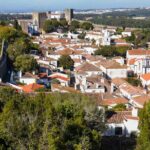

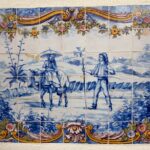






Alfama Tours, side by side.
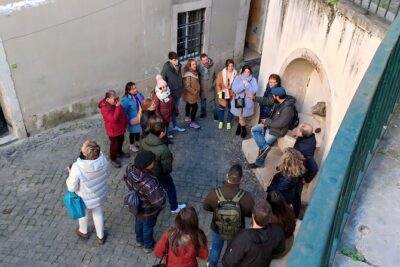 ★ 5.0Alfama Tour in Lisbon Old TownTickets from $34,936 traveller reviews
 ★ 5.0Private Lisbon Sightseeing Tuk-Tuk Tour: Alfama, Belém & MoreTickets from $524,277 traveller reviews
 ★ 4.8Hills, Alfama, and Mouraria Tour by Electric BikeTickets from $253,438 traveller reviews
 ★ 4.9Best of Lisbon Walking Tour: Rossio, Chiado & AlfamaTickets from $232,700 traveller reviews
 ★ 5.0Lisbon Small-Group Food Tour with 18 Tastings in Alfama DistrictTickets from $1261,967 traveller reviews
 ★ 4.5Lisbon E-Bike Tour Commerce Square, Mouraria and AlfamaTickets from $301,688 traveller reviews
 ★ 5.0Old Town TukTuk Tour and Scenic Viewpoints in AlfamaTickets from $35974 traveller reviews
 ★ 4.4Alfama Tour and Live Fado with Traditional DinnerTickets from $58970 traveller reviews
More useful lists for this tour