

Review · LISBON CITY TOURS
Sailing tour to the sunset in Lisbon
Sunset on the Tagus is a cheat code for Lisbon. This 2-hour sunset sailing tour lets you watch major sights roll by from the water while a multilingual crew shares what you are seeing, in a calm, no-rush way.
I like two things most: the small group size (max 12) keeps it relaxed, and the onboard vibe is friendly, with guides like Pedro described as especially attentive. One consideration, though, is that it is a sail and you will not be dining or going inside monuments, plus it runs only with good weather.
Key highlights to catch
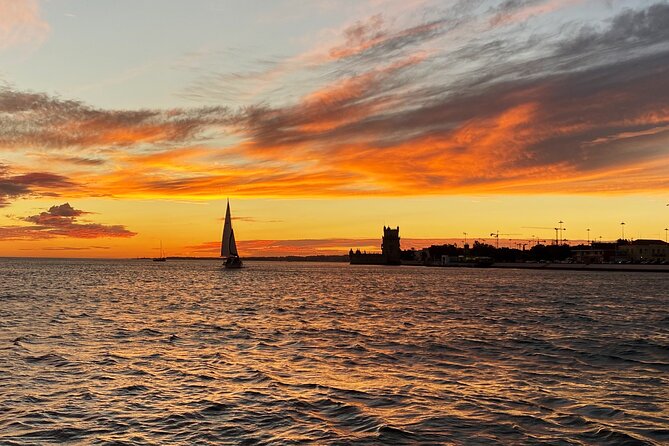
- Small group, big comfort: up to 12 travelers, so the boat does not feel crowded
- You get more than views: a crew with local context and Portuguese plus other languages
- Sunset timing on the Tagus: ideal light as you pass Belém, the bridge, and downtown
- Snack and drink included: welcome drink and light snacks like peanuts, cashews, and fried corn
- They adjust if dolphins show up: one guide may slow down to watch them
- Top Lisbon landmarks from one route: Discoveries monument, Belém industrial sites, Jerónimos area, 25 de Abril, Praça do Comércio, Sé, Alfama, and Cristo Rei
Price and what you actually get for it
At $45.66 per person for about two hours, this is priced like a value-oriented Lisbon experience. You are paying for a real sail on the Tagus, not just a quick photo stop, and the inclusions matter: fuel, crew, a welcome drink, light snacks, and all fees and taxes are covered. That means fewer little add-ons once you arrive.
Meals are not included, so I treat this as a “ride first, eat later” outing. If you are hungry, plan dinner after the sail. The snack mix is meant to keep you comfortable while the sun drops, not replace a proper meal.
You can also read our reviews of more boat tours in Lisbon



Meeting at Doca do Bom Sucesso, and getting on fast
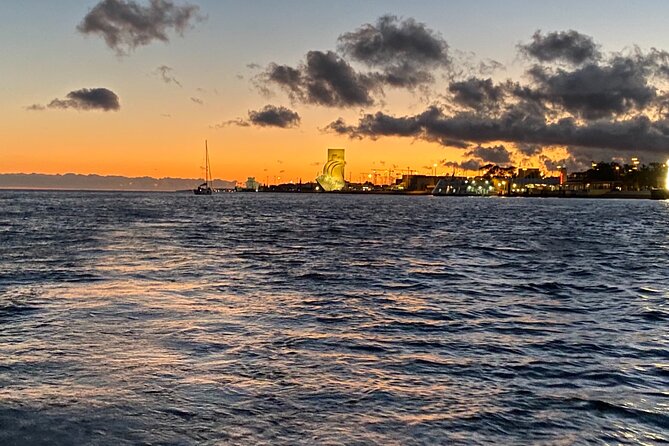
This tour starts at Bloo Boat Charter at Doca do Bom Sucesso, gate 3 (1400-038 Lisboa). The key practical point is to arrive with enough buffer to get settled before departure, especially because sunset timing can be tight.
You will get a mobile ticket, and the tour ends back at the meeting point, so you are not stuck figuring out a new route home. Also note it is near public transportation, which is handy if you want to combine it with a neighborhood walk before or after.
The “two hours on the water” rhythm
A short Lisbon sail works for real life. Two hours is long enough to feel like a proper outing, and short enough that you do not have to restructure your whole day around it.
From the feel of this experience, the flow is simple:
- you leave the dock
- you cruise past major landmarks along the Tagus
- the crew talks and points out what is relevant
- you return with sunset memories in the pocket
That rhythm is why it fits so many schedules, from a first trip to a repeat visit where you just want a calmer angle on the city.
From Belém to the Discoveries monument, the story begins
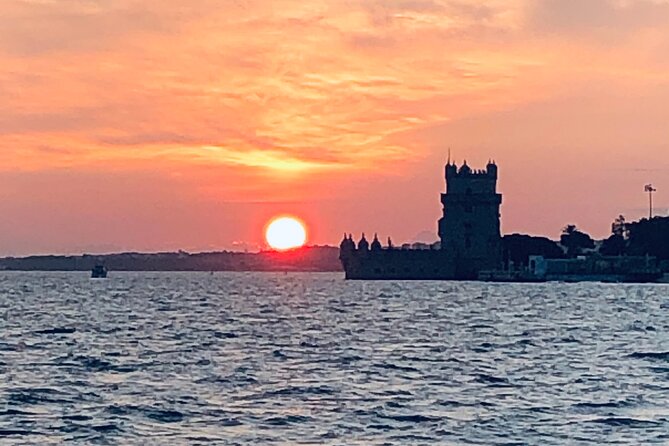
One of the first big sights you will run into is the National Monument associated with the Age of Discoveries. The design is credited to Cottinelli Telmo, and the sculptures to Leopoldo de Almeida. The main figure is Infante Dom Henrique (the Navigator), holding a model of a caravel.
What I like about seeing this from the water is scale. Up close on land, statues can feel like details you have to work for. From a moving boat, the monument reads as a whole, and the shiplike theme feels more natural because the Tagus is literally the setting for Portugal’s maritime identity.
Also, look for the set of figures on the ramps. There are 32 figures tied to the history of the discoveries, so you are not just seeing one icon, you are seeing a whole cast of ideas about exploration.
A rocky waterfront chapter: the old artillery ship story
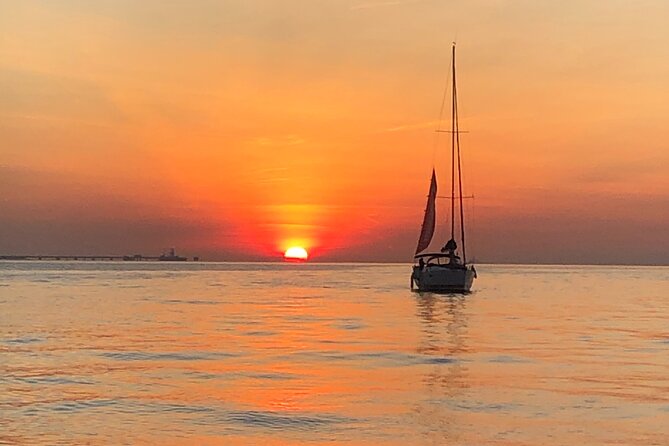
Another stop described along the waterfront is a monument that was meant to replace an older artillery ship. It sat on a rocky outcrop in the Tagus opposite the old beach of Belém.
The reason this matters is that it connects the architecture to movement and departure. The description links that spot to where fleets departed for the Indies. It also names Diogo Boitaca as the person in charge of the works, and notes that he also directed advanced works for the neighboring Jerónimos Monastery.
If you like the “why is it here” angle, this part of the route gives you a tangible reason for the setting, not just a pretty view.
You can also read our reviews of more evening experiences in Lisbon




Central Tejo and MAAT: industrial Lisbon before the art
As your sail continues toward Belém’s stretch, you will pass the Central Tejo complex, also called Central Tagus. It was built between 1908 and 1951, functioning as an old thermoelectric power station that supplied electricity to Lisbon and the region.
A lot of Lisbon sights are medieval or royal. Central Tejo is different. It is a major piece of industrial architecture from the first half of the 20th century in Portugal, and it changes how you see the river: this is not only a historic shipping corridor, it is also a power and industry corridor.
Right near it is MAAT, the contemporary art museum. The building is classified as a Property of Public Interest, and it is described as having two “poles”: the old Central Tagus and the New Building.
From a boat, you do not need to rush to a museum to get the point. You get the form, the contrast, and the idea that Lisbon is not stuck in one era.
Jerónimos Monastery from the Tagus: the Manuel I factor
The Jerónimos Monastery is one of those places that defines Lisbon for many people. It was built at the end of the 15th century by King Manuel I. It has been classified as a National Monument since 1907, and in 1983 it became part of UNESCO World Heritage together with the Tower of Belém.
It was also elected as one of the seven wonders of Portugal on July 7, 2007. Even if you do not plan to enter buildings during the sail, having the monastery in your line of sight is powerful. You get the sense of Portugal at its peak of craftsmanship and ambition, and the Tagus frames it like a stage.
One practical note: because this is a sailing tour, you will generally be viewing from the water rather than exploring inside. If your goal is to see cloisters, tombs, and details up close, plan a separate land visit.
The 25 de Abril Bridge: a dramatic mid-sail landmark

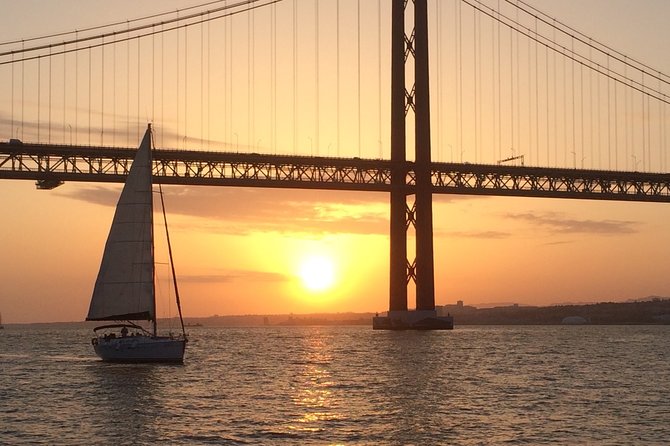
Few things in Lisbon are as instantly recognizable from a distance as the 25 de Abril Bridge. This is a road-rail suspension bridge over the Tagus River connecting Lisbon (north bank) to Almada (south bank).
The tour info adds a useful layer of context: until 1974, the bridge was called Ponte Salazar. The new name, 25 de Abril, references the revolution of April 25, 1974.
You also get the construction timeline: works began on November 5, 1962, and it was inaugurated on August 6, 1966.
From the water, the bridge often becomes the visual anchor of the cruise. It is also a great mental marker. Once you see it, you start to anticipate the next phase of the route, the move from Belém energy toward central Lisbon and the riverfront.
Praça do Comércio: where Lisbon greets you from the river
As the sail heads toward downtown, you will pass Praça do Comércio, still known by its former name, Terreiro do Paço. This is a huge square by European standards and, historically, it served as the palace area for Portuguese kings for about two centuries.
I like this stop because it tells you how Lisbon organizes itself. The square is described as the city’s grand entrance, and specifically, that prominent figures arrived and were received on the marble steps of Cais das Colunas.
At the center of Praça do Comércio you can see an equestrian statue of D. José, erected in 1775 by Joaquim Machado de Castro. On the north side is the Triumphal Arch of Rua Augusta, the entrance to Baixa.
Again, you are not walking through all of this during a sail, but you can read the geometry quickly. The riverfront and the square form a natural “arrival point” that helps first-time visitors understand the city layout fast.
Lisbon Cathedral and Sé area: changing styles in one view
Near the center of Lisbon, the sail references the Cathedral of Lisbon, also called Church of Santa Maria Maior and seat of the Patriarchate of Lisbon.
Construction began in the second half of the 12th century after Lisbon was conquered from the Moors by D. Afonso Henriques. Today it is described as a mix of architectural styles, with National Monument status since 1910.
From a sunset sail angle, you might not catch every detail, but you will understand the scale and the mix of eras. If you are the kind of traveler who likes to decode a city, this is one of the moments when Lisbon starts showing its layered identity.
Alfama: the oldest streets, shown with a slower pace
Next up is Alfama, described as Lisbon’s oldest and one of its most typical neighborhoods. The name is tied to the Arabic al-hamma, meaning fountain of warm waters, good waters.
Alfama is known for restaurants and fado houses, and it is closely linked with festivities for Santos Populares, especially the night of Santo António from June 12 to June 13.
What you should know is that this is a “neighborhood energy” stop. From the boat, you get the sense of place, not the full experience of narrow lanes and doorways. Still, it is useful because it helps you decide how to spend your evening after the sail.
If you want fado, this is where you start looking, and if you want quieter wandering, you may want to plan that too. Alfama is small in area compared to other neighborhoods, so it can feel concentrated, for better and for worse.
Cristo Rei at the end of the cruise: looking up, then watching the city glow
As the sunset shifts, the tour info highlights the National Sanctuary of Cristo Rei. It sits at an altitude of 133 meters above the Tagus. The structure includes a 75 meter high portico designed by architect António Lino, topped by a statue of the Holy Redeemer with open arms facing Lisbon.
The statue is described as 28 meters high, designed by Portuguese sculptor Francisco Franco de Sousa.
This is where a sunset sail really earns its keep. A viewpoint like Cristo Rei works best with the contrast of sky and city lights. From the water, you see the city as a system, not a list of monuments. Cristo Rei becomes a visual conclusion to the cruise story: maritime Lisbon in the distance, then a spiritual landmark above the river.
The crew, the vibe, and the small details that make it feel worth it
The experience is powered by the crew. The feedback points again and again to friendly skippers and a guide who actually explains what you are seeing.
One example: the guide Pedro is specifically noted for being attentive, including care for an older passenger. That is more than a nice touch. It signals a boat culture that pays attention to comfort and pacing.
Another highlight: if dolphins appear, the crew may slow down or take extra time to watch them. That tells you the captain is not stuck chasing a rigid schedule at the expense of nature.
And you get the simple comforts included in the price: a welcome drink and light snacks such as peanuts, cashews, and fried corn. It is not a meal, but it keeps you from getting that “sunset hunger crash” halfway through.
Who should book this sunset sail, and who should not
This sail is a strong fit if:
- you want a relaxed way to see big Lisbon landmarks without tiring yourself on foot
- you like learning as you go, with explanations from a multilingual crew
- you value included basics like drink and snacks
- you are traveling with older family members and want a calmer pace
It might not be the best fit if:
- you want to enter churches, museums, or monuments during the ride (this is a viewing experience)
- you are very food-focused and expect a full meal onboard
- you have limited flexibility because the tour requires good weather
If your plan is to combine sunset sailing with dinner in Alfama or Baixa, you are thinking in the right direction.
Should you book this Lisbon sunset sailing tour?
I would book it if you want a smart, low-stress way to experience Lisbon at golden hour. For the price, the best value comes from the combo of short duration, small group size, and included snacks plus a welcome drink. The route also hits multiple “first-trip must sees,” from the Discoveries monument and Jerónimos Monastery area to the 25 de Abril Bridge, Praça do Comércio, and Cristo Rei.
I would not book it if you are set on a full guided walking tour with lots of indoor time. This is about the river, the skyline, and the stories behind what you are passing.
If you do book, keep your expectations realistic. Bring a jacket if the evening feels cool, and plan dinner separately. Then sit back, watch the Tagus do its thing, and let the landmarks roll by in the right light.
FAQ
How long is the Lisbon sunset sailing tour?
It is about 2 hours.
Where does the tour start?
The start point is Bloo Boat Charter at Doca do Bom Sucesso, gate 3, 1400-038 Lisboa, Portugal.
Does the tour end back at the same place?
Yes, the activity ends back at the meeting point.
Is a mobile ticket provided?
Yes, the tour uses a mobile ticket.
What languages is the tour offered in?
The crew speaks Portuguese, English, French, and Spanish, and the tour is offered in English.
What is included in the price?
Included are the safe sailing experience, crew, fuel, a welcome drink, light snacks, and all fees and taxes.
Are meals included?
No, meals are not included.
What light snacks are provided?
Light snacks listed include peanuts, cashews, and fried corn.
How many travelers are on the boat?
The tour has a maximum of 12 travelers.
What if weather is poor?
The experience requires good weather. If it is canceled due to poor weather, you will be offered a different date or a full refund.
Can I cancel for a full refund?
Yes. You can cancel up to 24 hours in advance for a full refund.
More Boat Tours & Cruises in Lisbon

More Tours in Lisbon






More Tour Reviews in Lisbon

Not for you? Here's more nearby things to do in Lisbon we have reviewed









Lisbon City Tours, side by side.
 ★ 5.0Lisbon City Center Tour – The Unmissable LisbonTickets from $322,234 traveller reviews
 ★ 4.7Sintra, Pena, Regaleira, Cabo da Roca & CascaisTickets from $2319,656 traveller reviews
 ★ 4.1Jerónimos Monastery Entrance TicketTickets from $2114,164 traveller reviews
 ★ 4.8History, Stories and Lifestyle Walking TourTickets from $2910,902 traveller reviews
 ★ 4.5Sunset Boat Party Cruise with DJ and Open BarTickets from $2710,378 traveller reviews
 ★ 4.7Pena Palace, Sintra, Cabo da Roca, & Cascais DaytripTickets from $919,981 traveller reviews
 ★ 4.6Oceanário de Lisboa Entrance TicketTickets from $299,943 traveller reviews
 ★ 5.0True 4Hour Private Tuk Tuk Tour: Discover Lisbon with a Local!Tickets from $1088,008 traveller reviews
More useful lists for this tour