
Review · LISBON CITY TOURS
Highlights and Secrets of Lisbon Private Walking Tour
Lisbon turns every corner into a story. I like how this private walking tour mixes big-name sites with local food stops, and I love the way your guide connects details you would totally miss on your own. One consideration: a couple key add-ons cost extra, including the Santa Justa elevator and the Fado Museum.
In about 3 hours, you get a guided hit of landmarks plus the smaller places that make Lisbon feel lived-in. You’ll also taste classic pastéis de nata, strong local coffee, and ginjinha, which is a fun way to slow down and notice the city. I especially appreciated the focus on viewpoints and church interiors, not just street views.
The route starts at Praça Luís de Camoes and ends near the Fado Museum in Alfama. You’ll want comfy shoes, and you should plan to keep an eye on timing at the start point, since good guides depend on quick contact if you run late.
Key highlights I’d plan around
- Pastéis de nata and classic coffee at Rua do Loreto 4, the kind of stop you can actually taste and remember
- Carmo Convent and the Carmo Archaeological Museum with skip-the-line access and earthquake history built into the ruins
- Trindade brewery palace and azulejos with masonic symbology for a different side of Lisbon’s layers
- Miradouro de Santo Estevao for sweeping views plus a ginjinha taste tied to Alfama
- Lisbon Cathedral’s mixed styles, Romanesque outside, Gothic and neo-Gothic inside
- Santa Justa and Fado Museum are optional paid add-ons, so you control what you spend
Why this Lisbon private walk feels efficient for a first visit
Lisbon can be a choose-your-own-adventure city. You can spend half a day in one neighborhood and still feel like you barely touched it. This tour helps you get bearings fast by stitching together a run of places that make sense in one route, with time to stop, look up, and ask questions.
I like that it’s private, meaning it’s only your group with your guide. That matters, because the guide can adjust pace for your comfort level, answer questions on the spot, and steer you toward what is most worth your time. It also makes the food stops feel less like a rushed snack line and more like part of the experience.
At $79.52 per person for a 3-hour walk, it’s not trying to be the cheapest option. The value comes from mixing included sights with a guide who can explain what you are seeing as you see it, plus tastings that add real Lisbon flavor.
You can also read our reviews of more walking tours in Lisbon



Meeting at Praça Luís de Camoes, ending near Alfama and the Fado Museum
Your day begins at Praça Luís de Camoes (Largo Luís de Camoes, 1200-243 Lisboa). That’s a solid starting zone because it’s central and easy to reach via public transport. You’ll end near Alfama, at Largo do Chafariz de Dentro 1, close to the Fado Museum.
That end point is smart. Alfama is the neighborhood people picture when they think of Lisbon. Finishing there means you can keep going afterward on your own terms, especially if you want to wander narrow lanes or follow up on the Fado Museum stop, which is available but not included.
This tour also uses a mobile ticket, which is convenient on a phone and cuts down on fuss with paper tickets. One more practical note: departure times run online with precision to within half an hour, so you can pick a time that fits your morning or afternoon plans.
The food stops that set the tone: pastéis de nata, coffee, and ginjinha
If you care about eating well in Lisbon, this is a big win. You do not just pass by food. You pause at places that are part of the city’s routine.
Rua do Loreto 4 for pastéis de nata and coffee
One stop centers on the classic Portuguese pastry and a strong coffee pairing. At Rua do Loreto 4, you’ll get time to try the typical pastéis de nata and one of the most traditional coffee setups in Lisbon. You’re there long enough to taste, then reset before moving on.
Why I love this approach: pastry and coffee become part of how you learn the city. After you taste, the rest of Lisbon feels more tangible. You also get a rhythm that makes a 3-hour walk feel doable instead of like a nonstop checklist.
Miradouro de Santo Estevao for ginjinha with views
Later, you shift from sweets to something stronger. At Miradouro de Santo Estevao, you taste ginjinha liqueur made by the ladies of Alfama. This is one of those “small moment, big memory” stops because it happens while you are looking out at the city.
The viewpoint angle helps, too. When you taste something local at a place that locals use for the view, you start to understand why the neighborhood layout matters, and why Lisbon feels like it’s built on hills.
You can also read our reviews of more private tours in Lisbon





Igreja de São Roque vibes, Saint Roch’s wood and gold, and why it matters
Church stops can be hit-or-miss on walking tours. Here, the Church of Saint Roch is worth the pause.
You spend about 10 minutes there, visiting one of Lisbon’s important churches and the religious temple of the Brotherhood of Misericordia. The key detail is the interior focus: precious works in wood and gold tied to the brotherhood’s power. Even if you are not a church architecture fanatic, it helps to have someone explain what you’re seeing, because the decoration is not random. It’s part of how religion and civic life historically intersected in Lisbon.
A drawback to note: if you prefer only open-air sights, church interiors take discipline. Plan to slow down, and keep your phone away unless you are sure photos are allowed.
Trindade brewery palace and azulejos with masonic symbology
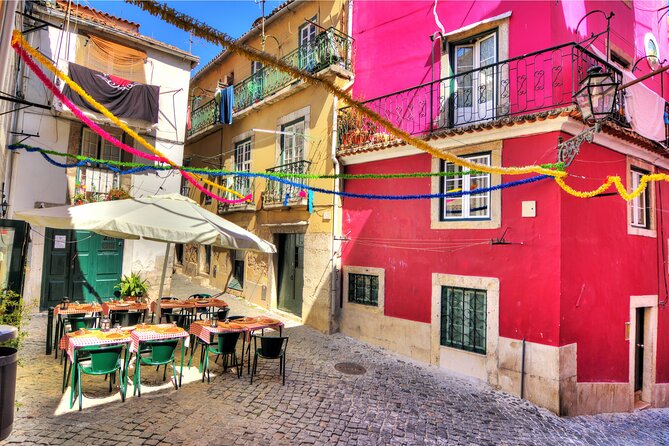
Trindade is where this tour gets interesting in a way that feels different from the usual “big church, big view, next stop” pattern.
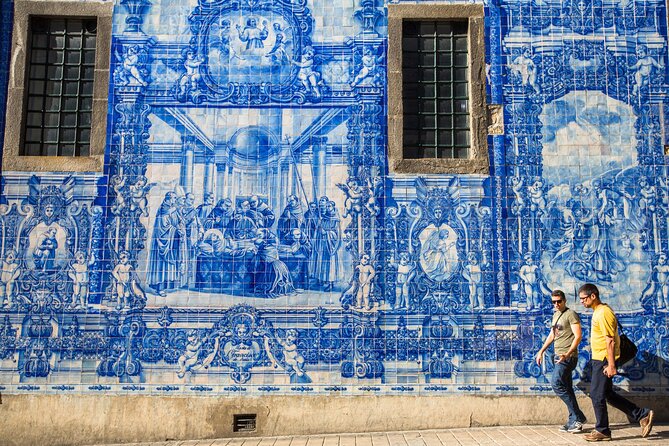
You visit Trindade and the oldest brewery in Lisbon, including the palace that housed the brewery. The standout visual angle is the azulejos, especially the ones with masonic symbology. Even for people who think they do not care about tiles, this is the kind of detail that rewards looking closely, because the patterns and meanings add another layer to how Lisbon developed.
Time here is about 10 minutes. That’s enough to see what you came for, then move on without losing your day.
Convento do Carmo and the Carmo Archaeological Museum, with skip-the-line time

Carmo Convent is one of those Lisbon locations where you can feel history physically. You walk through the site connecting ancient history and contemporary history, including its role connected to the Carnation Revolution.
Then you head to the Carmo Archaeological Museum, where you get a skip-the-line ticket. The museum highlights the gothic temple in ruins after the 1755 earthquake, which is one of Lisbon’s defining historical events. Ruins are not just dramatic. They also act like evidence, showing how the city was reshaped.
About 25 minutes is built in. That’s a comfortable window to look at the structure, read enough to understand the story, and still have energy left for the later viewpoints.
One practical note: ruins and older stone spaces can be cooler or uneven. If you have mobility issues, wear supportive shoes.
Santa Justa Elevator: an optional engineering stop with huge payoff
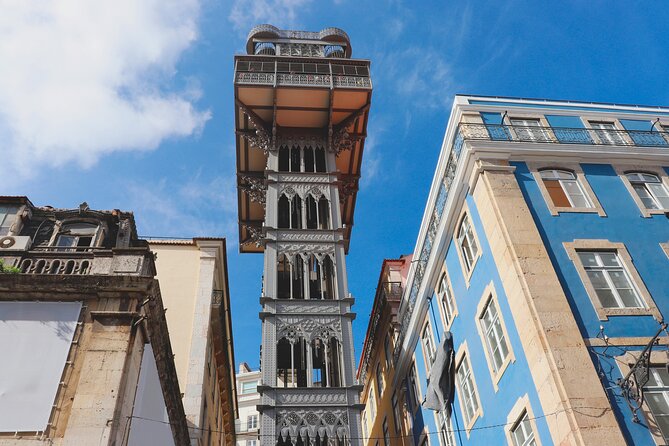
The Elevador de Santa Justa is an iconic Lisbon feature, and it makes perfect sense that it is part of this walk. You’ll get a look at the engineering work from the early 1900s.
This is also your panoramic moment. It overlooks Baixa Pombalina, the hill of Alfama, and the Castle of São Jorge. That view is often what people chase when they say they love Lisbon.
But here’s the consideration: the elevator admission is not included. You can still enjoy the exterior and viewpoint as part of the guide’s plan, but if you want the full ride, you should budget extra and decide on the spot whether it’s worth it for your energy level.
Praça do Comércio and the rebuilt city gate after 1755
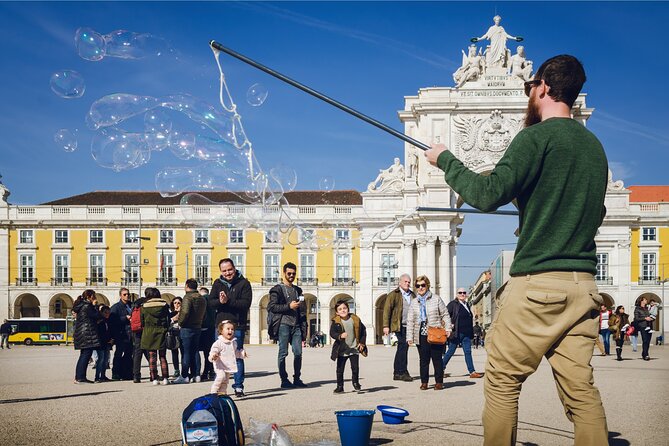
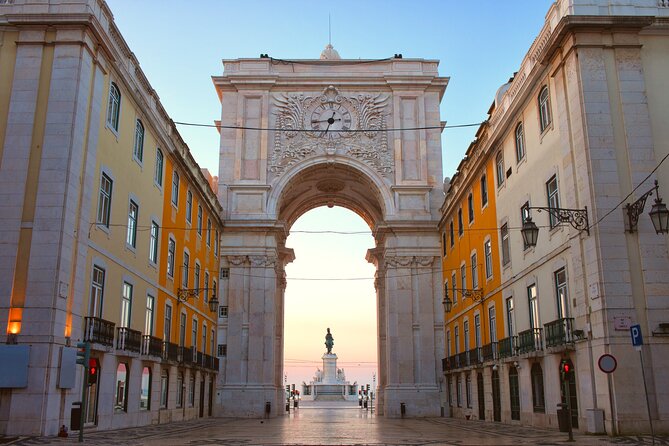
After church and ruins, the tour moves into the wide, open geometry of the Baixa area. You stroll along Rua Garrett and finish toward Baixa Pombalina, then walk through Rua Augusta and its monumental arch.
The big highlight is Praça do Comércio, the elegant entrance gate to the city. It was rebuilt after the devastating earthquake of 1755, and the design includes masonic symbols. You also get to see the Cais das Colunas, where a marble walkway served to welcome kings, queens, and presidents.
This part of Lisbon is useful because it shifts your perspective. After the tight streets and hills, the open square makes the whole city layout click. Even if you do not go into museums, the architecture tells you how Lisbon planned to recover and rebuild.
Nossa Senhora da Conceição Velha and the Manuelino facade you can’t ignore
Next you visit Church Nossa Senhora da Conceição Velha. This church is known for surviving the earthquake, and it has a facade in the Manuelino style, which is Portuguese baroque.
You also hear about fascinating history related to women. The exact focus depends on what your guide emphasizes, but the reason this matters is simple: it reminds you that the story of Lisbon is not only kings, wars, and monuments. People and social roles shaped daily life too.
This is a quick stop at about 10 minutes, so it works well even on hot or crowded days.
Casa dos Bicos for Jose Saramago and the Lisbon Cathedral from mosque to church
Two stops near each other bring Lisbon’s past and cultural identity into sharper focus.
Museu de Lisboa – Casa dos Bicos
At Casa dos Bicos, you see the palace that belonged to the first governor of the Indies. The modern purpose is what makes it feel current: it now hosts the foundation dedicated to Jose Saramago, the only Portuguese writer who won the Nobel Prize.
This is where the city stops feeling like only travel postcards. The setting matters, but so does the fact that Lisbon keeps creating culture here.
Lisbon Cathedral’s layered styles
Lisbon Cathedral is another “look closer” moment. You learn it was obtained from a former mosque. The facade is Romanesque, while inside you find Gothic and neo-Gothic styles.
If you like architecture, this is a great payoff because you can literally see the layers of different eras. If architecture is not your thing, still go in with the mindset of “how did this place change?” That question gives the interior meaning quickly.
Miradouro de Santo Estevao, Alfama ginjinha, and how the route ends gracefully
The Miradouro de Santo Estevao viewpoint is one of the tour’s big atmosphere builders. It’s where you get a classic Lisbon panorama, then taste ginjinha.
You also get time to stroll through the old quarter while you still have that ginjinha taste in your memory. That final stretch is important because it helps you transition from tour mode to wandering mode.
If your goal is to see Lisbon and then keep exploring on your own, ending here is a smart design. You are in the neighborhood that rewards slow walking and small detours.
The Fado Museum: learn the music background, without paying extra if you skip it
The tour ends near the Fado Museum. The museum itself is not included, but it’s presented as part of the route.
Since it’s available but ticketed separately, you can decide based on your interests. If you want the context behind the music, it’s an easy follow-up. If you’re already planning a Fado show later, you can use this time to keep walking instead.
The key is that you are not locked into it. The guide helps you land in the right area to choose.
Who should book this tour, and when it is the smart value
This tour fits best if you want three things at once:
- a private guide who can explain what you see
- a tight route that links food, churches, ruins, viewpoints, and major squares
- tastings that make Lisbon feel real, not just photographed
It also works well for couples, friends, or small groups who prefer a guided pace rather than trying to coordinate transit, tickets, and timing on your own.
Is it a great value at $79.52 per person? For Lisbon, it can be. You have included admission at the Carmo Archaeological Museum with skip-the-line, plus a run of free admission stops and tastings. That blend adds up. If you were planning to pay for the big-ticket attractions anyway, this tour can reduce planning stress by handling the flow.
When I would think twice: if you are trying to avoid any paid add-ons, because Santa Justa elevator and the Fado Museum are listed as not included. Also, if you hate walking uphill or uneven ground, a 3-hour walk through central Lisbon may feel like more than you want.
A note on guide timing, based on the real-world experience you should plan for
One booking reported waiting about 45 minutes because the guide was late. The response from the provider said the guide tried calling multiple times and sent proof of being at the meeting location. That tells me one thing about how to protect your trip: keep your phone handy at the start time and be ready to message or call if the guide is delayed.
This kind of hiccup is uncommon in a well-run local tour, but Lisbon is a city where meeting points can get tricky if one person is stuck indoors or caught by a detour. I suggest you take a screenshot of the exact meeting address and arrive a few minutes early.
Also, one highly positive experience named Rodrigo as the guide, describing him as excellent, knowledgeable, and fun. Another positive experience praised an exceptional guide who was attentive and responsive. That pattern matters. The guide is where the tour turns from sightseeing into understanding.
Quick tips so you get the most from your guide
- Wear shoes made for stone sidewalks and hills, because the route mixes steep streets and museum-style entrances.
- Bring a light layer. Older churches and shaded viewpoints can feel cooler even in good weather.
- Ask your guide what to do next after the walk ends near Alfama. They can point you toward the easiest wins for food and local wandering.
- Budget for add-ons you choose, especially Santa Justa and the Fado Museum, since they are not included.
Should you book this Lisbon Private Walking Tour?
Book it if you want a guided route that makes Lisbon make sense quickly, with tastings, major landmarks, and viewpoint stops all handled in about 3 hours. It’s especially good for first-timers who like history but also want the food-and-street feel that makes Lisbon memorable.
Skip or rethink it if you prefer everything fully included and worry about extra ticket costs, or if you want a longer, slower day in one neighborhood rather than a cross-city sampler.
If you book, do the small things that protect the day: arrive early at Praça Luís de Camoes, keep your phone active for contact, and go in with the mindset of asking questions. With the right guide in place, this kind of walk is one of the fastest ways to understand Lisbon’s layers.
FAQ
How long is the Lisbon private walking tour?
The tour is about 3 hours.
What is the price per person?
It costs $79.52 per person.
Is this tour private or group-based?
It is private. Only your group participates.
Where does the tour start and end?
It starts at Praça Luís de Camões (Largo Luís de Camoes, 1200-243 Lisboa) and ends near the Fado Museum in Alfama (Largo do Chafariz de Dentro 1, 1100-139 Lisboa).
Is the ticket mobile?
Yes, it uses a mobile ticket.
Which major admissions are included or not included?
Carmo Archaeological Museum is included with a skip-the-line ticket. Elevador de Santa Justa is not included, and the Fado Museum is also not included.
Are there places to eat on the tour?
Yes. The tour includes a stop at Rua do Loreto 4 for pastéis de nata and coffee, plus ginjinha tasting at Miradouro de Santo Estevao.
Is it easy to reach the meeting point with public transport?
The meeting point is near public transportation.
When will I get confirmation for my booking?
You will receive confirmation at the time of booking.
Is free cancellation available?
Yes. Free cancellation is available if you cancel at least 24 hours before the experience starts for a full refund.
More Walking Tours in Lisbon



More Tours in Lisbon




More Tour Reviews in Lisbon



Not for you? Here's more nearby things to do in Lisbon we have reviewed











Lisbon City Tours, side by side.
 ★ 5.0Lisbon City Center Tour – The Unmissable LisbonTickets from $322,234 traveller reviews
 ★ 4.7Sintra, Pena, Regaleira, Cabo da Roca & CascaisTickets from $2319,656 traveller reviews
 ★ 4.1Jerónimos Monastery Entrance TicketTickets from $2114,164 traveller reviews
 ★ 4.8History, Stories and Lifestyle Walking TourTickets from $2910,902 traveller reviews
 ★ 4.5Sunset Boat Party Cruise with DJ and Open BarTickets from $2710,378 traveller reviews
 ★ 4.7Pena Palace, Sintra, Cabo da Roca, & Cascais DaytripTickets from $919,981 traveller reviews
 ★ 4.6Oceanário de Lisboa Entrance TicketTickets from $299,943 traveller reviews
 ★ 5.0True 4Hour Private Tuk Tuk Tour: Discover Lisbon with a Local!Tickets from $1088,008 traveller reviews
More useful lists for this tour