
Review · LISBON CITY TOURS
Expert Plus Lisbon Tour with Local Guide in Private Eco Tuk Tuk
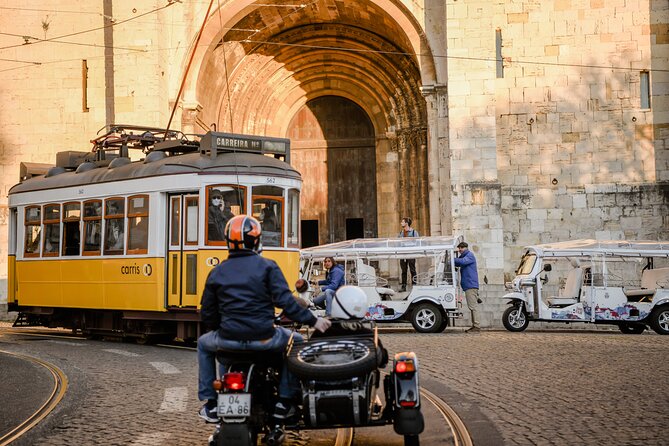
Lisbon without the uphill grind. This private electric eco tuk tuk tour strings together the Tagus River views, Belém’s big UNESCO sites, and classic central neighborhoods with preset photo stops. It is built for people who want the highlights without spending the whole day sweating up hills.
I especially like the limited walking plan. You get close to the sights, then you roll on fast, using the city’s steep streets instead of fighting them. And I really like the built-in stop for Pastéis de Belém, where you skip the long line at the original custard tart shop.
One thing to consider: the route is fixed for a good reason, and the stops cannot be swapped. If you want lots of time inside museums and churches, this may feel a bit “see it, then go,” rather than “wander for hours.”
Key highlights of the Eco Tuk Tuk Lisbon Tour
- Private tuk tuk for your group, with up to 4 passengers per tuk tuk
- 1 to 4 hour options, so you can match it to your schedule
- Skip the long line for Pastéis de Belém at the original shop
- UNESCO hits near Belém, including Jerónimos Monastery and Belém Tower area
- Rain and wind gear (blankets and protective covers) so the tour keeps going
- Guides with strong English and storytelling, including Lionel, Dimiz, Sylvia, Vitor, Eliana, Diniz, Ariana, and Arthur in the guide line-up
Electric eco tuk tuk comfort: less walking, more seeing
Lisbon is gorgeous, but it is also steep. That is the whole point of this tour. The private electric tuk tuk lets you cover big distances quickly while still getting the drama of Lisbon streets and viewpoints. I like that you are not trapped in a slow bus line, either. You are moving with your guide’s pace, stopping when it makes sense.
The ride setup is designed for real people, not just perfect fitness types. If you are a senior or you need help getting on, the driver assists. There are also blankets and protective covers for wind and rain, which matters because Lisbon weather can change fast and you still want to keep your day moving.
One more practical point: the stops are arranged so you can see key places without constant backtracking. You do not need to puzzle out transport between neighborhoods, and you do not need to time buses and trams. You just follow the route, take the photos, and spend your energy on the parts you care about most.
You can also read our reviews of more guided tours in Lisbon



Tagus River orientation and the 25 de Abril Bridge viewpoint
The tour starts with a ride along the Tagus River, because orientation is half the battle in Lisbon. From here you get a clear sense of where the city sits and how the waterfront stretches out behind the famous landmarks.
Then comes the 25 de Abril Bridge view. It is often compared to the Golden Gate Bridge because both are suspension bridges in a similar color tone. Even if you already know the nickname, the real value is practical: it helps you understand the geography. After this first scenic moment, Belém and the river neighborhoods start making sense as a connected story instead of random attractions.
This early stop is short, but it is useful. It sets your “mental map,” so later viewpoints feel less like you are hunting for them and more like you are arriving.
Pastéis de Belém: the skip-line custard tart moment
Pastéis de Belém is one of those food stops that turns a sightseeing day into a memory. This is the original custard tart shop, operating since 1837, and it is tied to the Hieronymites Monastery tradition. The story goes that monks invented the custard tart style, and from that original recipe, the family of custard tarts you see across Portugal evolved.
I like how this tour handles the one thing that can ruin a great food stop: waiting. You skip the long line and go straight into enjoying the moment. You do not need to guess which place is the real deal, either, because you are going to the trademark location.
Expect this to be a brief stop. The tour is about moving, not lingering all day. So if you want to slow down and try multiple items, plan to add that on later. But as a first-timer move, the “skip-line, sample the classic” approach is excellent value for time.
Jerónimos Monastery and Belém Tower area: UNESCO without the hassle
This is the core of the Belém stretch. Jerónimos Monastery (Mosteiro dos Jerónimos) is a Manueline-style masterpiece linked to the Age of Discovery. Construction began in 1501 and wrapped up about a century later. The site is UNESCO World Heritage, classified in 1983.
Here’s why this stop is worth doing on a tour like this: the architecture is detailed, and without context you can miss what makes it special. Your guide helps connect the design style to Portugal’s historic maritime power, so the stonework stops being just pretty and starts meaning something. Even with limited time, you leave with a better sense of what you are looking at.
Next you head toward the Belém Tower area. Belém Tower is a 16th-century fortification that served as fortress and ceremonial gateway to Lisbon. Like Jerónimos, it also carries UNESCO recognition, and it fits the broader “Portugal sending ships outward” theme that runs through this route.
Important practical note: the Jerónimos and Belém Tower admission tickets are not included. You do not need to worry about that on the day of the tour until you get there, but you should budget for it. Pastéis de Belém is different. The tour is set up so you skip the long line, and the stop itself is positioned to be easy on your schedule.
If you hate crowds and long museum lines, this tour fits well because the plan is meant to keep your time efficient. If you want a slow, in-depth interior visit with no pressure, you might add a separate return visit later.
Monument to the Discoveries and the museum frontage along the river
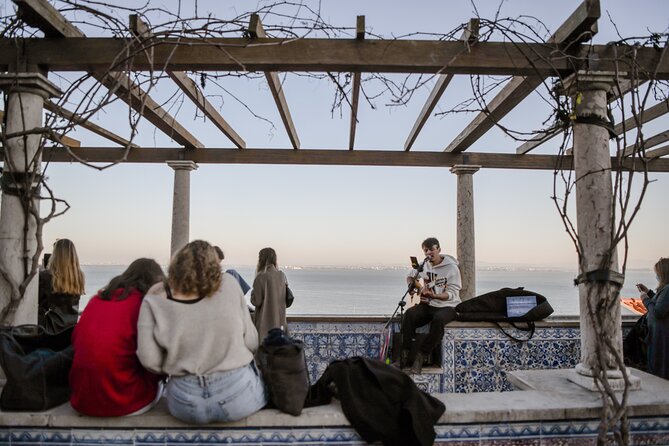
This leg continues the Age of Discovery story on the riverfront. The Monument to the Discoveries celebrates Portuguese exploration during the 15th and 16th centuries, including voyages tied to India and the Orient. It was built between November 1958 and January 1960 to mark the fifth centennial anniversary of Infante Henry the Navigator’s death.
This is a quick stop, but I find it helpful because it connects the dots. You just saw the religious and architectural center of Belém. Now you see the outward-looking monument that frames that era as action, shipping routes, and trade.
The route also passes the Museum of Art, Architecture and Technology frontage area, with a modern feel that contrasts nicely with the older stonework elsewhere. The museum opened in 2016, and the nearby thermoelectric power station adds another layer to how Belém looks today, not just how it looked centuries ago. Even if you do not go inside, the framing helps you understand that Belém is not only old history, it is also a living part of Lisbon.
You can also read our reviews of more private tours in Lisbon





Cais do Sodré, Chiado, and Bairro Alto: food, fado, and hillside neighborhoods

After Belém, the tour pivots toward central Lisbon. One of my favorite parts is the mix of “big-name sights” with neighborhoods that feel lived-in.
First is Cais do Sodré, a riverside district known for nightlife and restaurants. The Ribeira Market, a 19th-century landmark, is a key hub where you find a food court and plenty of choices. If you like the idea of tasting Lisbon later, this stop gives you the right area to remember.
Then you move into Pink Street territory, which is tied to bars and fado listening. Even if you do not stop for a performance, this helps you plan your evening. You now know where to go when you want that traditional music experience without guessing.
Next comes Chiado, the elegant neighborhood between Baixa and Bairro Alto. It is known for cafés, bookstores, theaters, and shops, including Café A Brasileira and Livraria Bertrand, often described as the world’s oldest operating bookstore. You also pass the São Carlos Theater area. The vibe here is less about sprinting and more about strolling, which is a nice contrast after the Belém segment.
Finally, you reach Bairro Alto, a neighborhood of narrow cobblestone streets and nightlife energy. By day, it is calmer with antique shops, art galleries, and cozy cafés. As evening approaches, it becomes the fado and bar corridor. This tour gives you the layout and the feeling, so you can decide how much to lean into the nightlife later.
Baixa and Praça do Comércio: the downtown rebuilt after 1755

Downtown Lisbon is where you feel the “plan” of the city. Baixa is the commercial and architectural heart, famous for neoclassical buildings and a grid-like layout created after the 1755 earthquake. The rebuilding led by the Marquis of Pombal turned much of the area into a structured street system that is still a major landmark today.
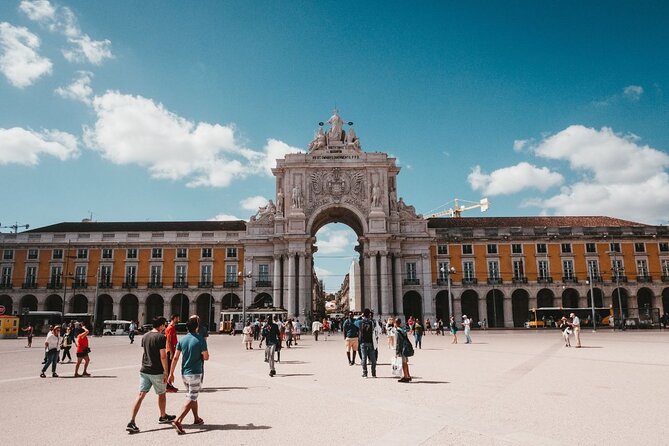
This tour steers you toward the right squares, including Praça do Comércio, once called Terreiro do Paço. It is next to the Tagus River and was the palace grounds for Portuguese kings for about two centuries. The square is huge, with large open space and arches framing the waterfront. Even a short stop here helps you understand why Lisbon’s riverfront feels so ceremonial.
You also pass the Arco da Rua Augusta, the monumental arch leading toward the river. It is one of those “you can see it from a distance” landmarks that makes navigation easier later. Another icon you will hear about around Baixa is the Santa Justa Lift, which signals how the city solves its hills with clever infrastructure.
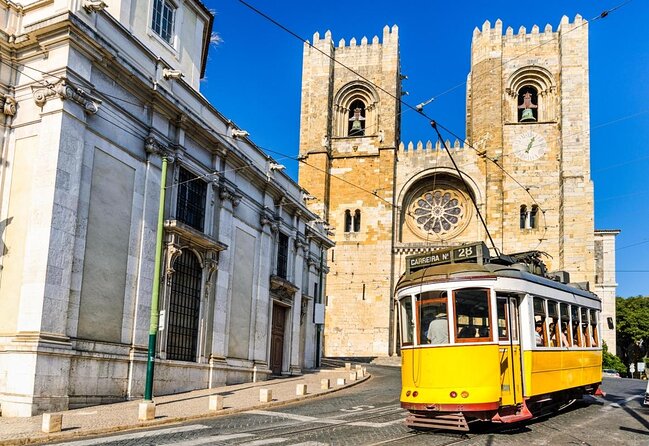
The tour also includes the Sé de Lisboa cathedral area. Construction began in 1148, one year after Afonso Enriques conquered Lisbon, and it is regarded as the oldest church in Lisbon. Again, this is not a long interior deep dive, but the exterior and location give you context for Lisbon’s layers of time.
Alfama viewpoints and Graça’s hilltop views: the postcard factor
Lisbon viewpoints are not optional. That is where the city’s geography turns into art. You get multiple elevated viewpoints on this route, and that is a big reason it works.
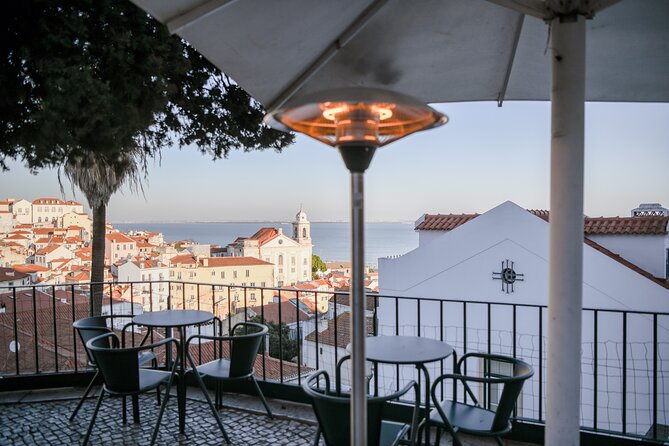
One key square is Largo das Portas do Sol, in Alfama, famous for views over the Tagus River, the Baixa Pombalina area, and the Castelo de São Jorge. If you want a quick “wow” from ground level, this is it.
Then comes Miradouro da Senhora do Monte in Graça. This is one of Lisbon’s iconic viewpoint stops, with broad panoramic views across the city and the river. The stop time is brief, but you get enough to look, take photos, and feel how Lisbon spreads out in waves over the hills.
Graça itself is described as traditional, with narrow cobbled streets and lots of miradouros, plus landmarks like Graça Church and the National Pantheon area nearby. I like ending up here because it feels less like a tourist corridor and more like a neighborhood. It is a good place to see everyday Lisbon life while still getting that sweeping city panorama.
São Vicente de Fora, Santa Engrácia, and Chafariz de El-Rei: history in the details
This part of the tour fills in the “what are these buildings and statues for?” question that most quick tours gloss over. You visit the Monastery of São Vicente de Fora, located on high ground where Graça and Alfama meet. It is called de fora because, historically, the parish was outside the city walls and not under the same jurisdiction as the bishop at the time.
Nearby you reach the National Pantheon of Portugal in the Church of Santa Engrácia area. The current building stands on a site where a church already existed, with an earlier structure dating back to 1568, ordered by Infanta Maria. That adds a lot of clarity if you notice how Lisbon religious architecture keeps reinventing itself across centuries.
Then you see the Chafariz de El-Rei, described as Lisbon’s first public ornamental fountain, built in the 13th century during Afonso III and Denis I. The fountain connects to the idea of Lisbon’s groundwater and how everyday city life depended on water sources long before modern systems.
Stops like these are short, but they are the reason I consider this tour more than a “drive-by” highlights package. You come away understanding the function of places, not just their looks.
The tour wraps back through central areas, including Praça do Comércio again, so you finish with the riverfront anchor point in your mind.
Price and logistics: what $17.24 gets you, and what to watch for
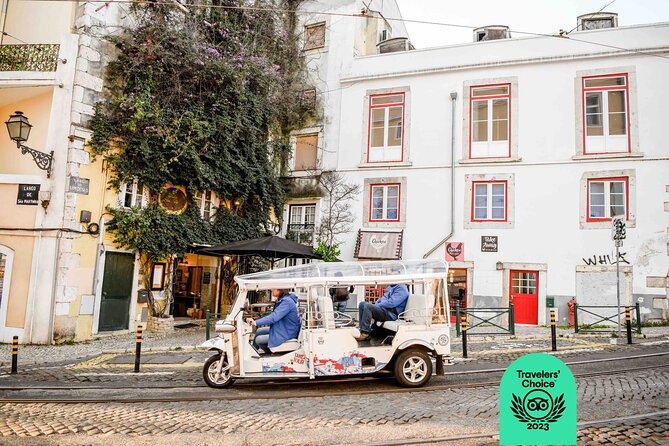
At $17.24 per person, the value is mostly about time. For a sightseeing day, you are paying for efficiency plus a private setup. You are not getting a shared group bus ride. You are getting a private vehicle for your group only, 100 percent electric, with photo stops planned and rain protection included.
You also get an “avoid the stress” approach. The tour starts without queues or waiting times, and Pastéis de Belém includes the skip-line advantage. In practical terms, that means you spend less time stuck and more time seeing.
What you should watch for is also simple. Jerónimos and Belém Tower admission tickets are not included, and the route cannot be modified. The photo stops are preset, and your schedule is built around those fixed moments. That can be perfect if you want a reliable outline. It can be annoying if you arrive with a very specific list and you want total control.
Also note the tour is offered in English, which is great for clarity. If you are traveling with kids, families, or a mixed group including seniors, the tuk tuk format helps. People in the guide line-up, including Lionel, Dimiz, Diniz, Sylvia, Vitor, Eliana, and Ariana, are praised for speaking clearly and keeping the pace appropriate. It can feel less like a checklist and more like a shared exploration.
Finally, the tour is conducted in rain or heat and only cancels under extreme conditions. So pack accordingly, and do not plan your day assuming sunshine is guaranteed.
Should you book this Lisbon eco tuk tuk tour?
I think this is a smart booking if you have limited time and you want the highest-impact Lisbon highlights connected into one story. It is especially good for first-timers who want fast orientation, scenic viewpoints, and Belém’s big UNESCO areas without spending the whole day walking uphill.
Book it if you fit one of these profiles:
- You want minimal walking but still want real sights
- You care about Pastéis de Belém and want to avoid the long line
- You want a private eco tuk tuk day that feels efficient and guided
- You like viewpoints as part of your sightseeing plan
Skip it or add a separate plan if:
- You want long, slow interior visits with lots of flexibility to change your route
- You have a very specific agenda for museums and churches beyond the preset photo and stop plan
- You do not mind that tickets for Jerónimos and Belém Tower are extra
If you want a day that makes Lisbon feel navigable, not chaotic, this is the kind of tour that delivers.
FAQ
How long is the Eco Tuk Tuk Lisbon tour?
The tour offers options from 1 to 4 hours, approximately. You can choose the length that matches how much time you have.
Are entrance tickets included for Jerónimos Monastery and Belém Tower?
No. Admission tickets for Jerónimos Monastery and Belém Tower are not included.
Do you skip the line at Pastéis de Belém?
Yes. This tour includes a stop at Pastéis de Belém and you skip the long line.
Does the tour include hotel pickup and drop-off?
No. Pick-up and drop-off at the hotel is not included. The tour ends back at the meeting point.
Is there cruise port pickup for the longer tours?
Yes. For the 3- and 4-hour options, you can be picked up at the Lisbon Cruise Port (Jardim do Tabaco Quay). You choose between Time Out Market or the cruise port pickup point the day before your tour.
Where does the tour start?
The meeting point is Tv. do Carvalho 25, 1200-058 Lisboa, Portugal, and the tour ends back at the same meeting point.
What are the age and weight requirements?
Minimum age is 2 years, and no babies are allowed. There is also a minimum mandatory weight of 9 kg.
Will the tour run in rain?
Yes. Tours run in rain or heat. They can only be canceled under extreme conditions.
More Guided Tours in Lisbon


More Tours in Lisbon




More Tour Reviews in Lisbon


Not for you? Here's more nearby things to do in Lisbon we have reviewed










Lisbon City Tours, side by side.
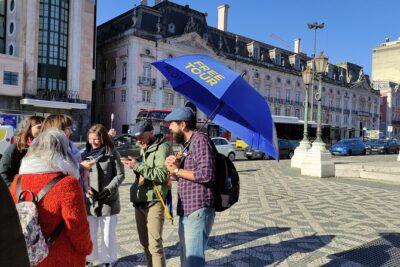 ★ 5.0Lisbon City Center Tour – The Unmissable LisbonTickets from $322,234 traveller reviews
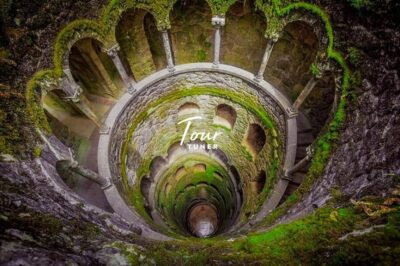 ★ 4.7Sintra, Pena, Regaleira, Cabo da Roca & CascaisTickets from $2319,656 traveller reviews
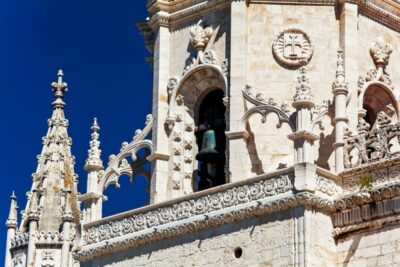 ★ 4.1Jerónimos Monastery Entrance TicketTickets from $2114,164 traveller reviews
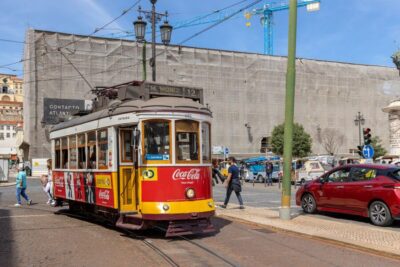 ★ 4.8History, Stories and Lifestyle Walking TourTickets from $2910,902 traveller reviews
 ★ 4.5Sunset Boat Party Cruise with DJ and Open BarTickets from $2710,378 traveller reviews
 ★ 4.7Pena Palace, Sintra, Cabo da Roca, & Cascais DaytripTickets from $919,981 traveller reviews
 ★ 4.6Oceanário de Lisboa Entrance TicketTickets from $299,943 traveller reviews
 ★ 5.0True 4Hour Private Tuk Tuk Tour: Discover Lisbon with a Local!Tickets from $1088,008 traveller reviews