
Review · WINE TOURS
Boat Cruise with Champagne
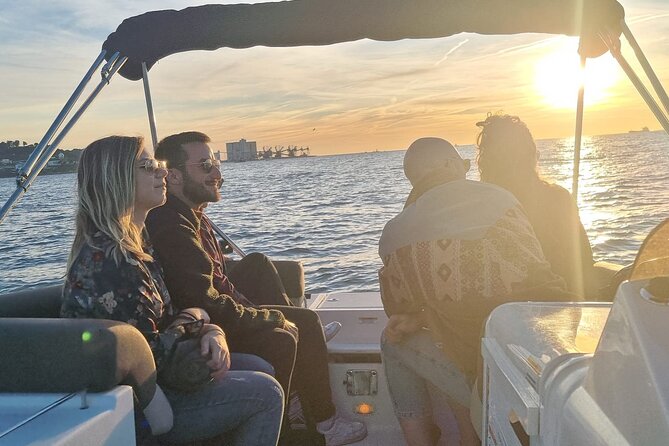
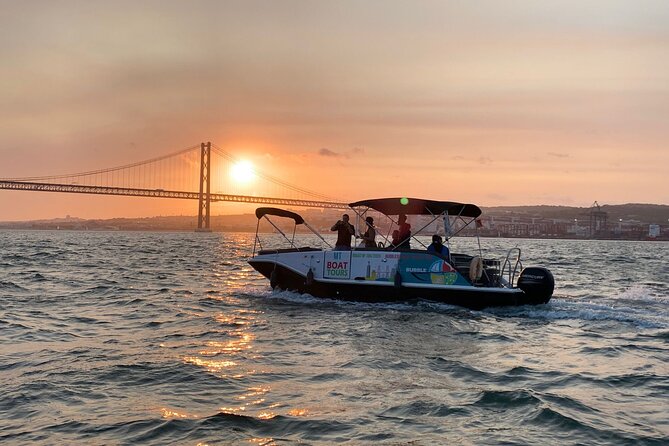
Watching sunset from the water is a treat. This 2-hour Lisbon boat cruise with Champagne and regular photo stops lets you see famous landmarks from a fresh angle, from Belém all the way toward Almada and back. I also love how the crew keeps things calm and safe, and how the pacing is short enough to stay fun, but long enough to grab great photos.
One thing to consider: this ride really depends on conditions on the river. If the sea state is rough or weather turns ugly, you may get cancellations and rescheduling, so plan some flexibility.
Key highlights to know before you go
- Champagne and water are served on board, so the cruise feels like a real occasion, not just transportation.
- Max 12 travelers means you are not stuck in a huge crowd when the best photo moments hit.
- A guided, landmark-focused route covers both sides of the Tagus, from Belem monuments to Almada viewpoints.
- Photo stops are built in so you are not just staring out a window.
- Wheelchair and reduced mobility access is supported, plus service animals are allowed.
- This is designed for good river weather, so you get more from the experience when conditions cooperate.
Champagne on the Tagus: what you’re buying in 2 hours
This is one of those Lisbon experiences that feels simple on paper, then becomes special once you are actually moving on the Tagus. The core idea is short and sweet: a guided boat cruise with Champagne and water, aimed at showing you Lisbon’s major landmarks from the river, with frequent photo time.
For me, the value sits in the combination. You get classic sights that are spread out across different neighborhoods, but you do not have to hop on and off buses all day. And because you are on the water, angles change fast, especially around the bridges and the Belém waterfront.
The second value is pacing. It runs about 2 hours, so you are not committing to a half-day chunk. That matters in Lisbon, where a lot of people pack in castles, viewpoints, museums, and hills. This cruise can slot in as a “reset” between walking days, or as a gentle highlight that still feels like you did something big.
You can also read our reviews of more boat tours in Lisbon


Start at Marina Belém, where the river story begins
You meet at Av. Brasília 1400-038, and the tour starts at Marina Belém, right by the Padrão dos Descobrimentos. That’s a smart starting point because it puts you close to Lisbon’s Age of Discovery theme from the very beginning. You are already in the right mental mood, ships and exploration in the air, before the boat even gets going.
From there, you’re set up to see the city as a riverside capital rather than a set of separated neighborhoods. Lisbon’s magic is partly about the hills and lanes, but the Tagus is the connective tissue. On a cruise like this, you feel that connection, especially when landmarks appear in layers, near and far, across the water.
Also, the tour uses a mobile ticket, which is handy. You are not wasting time figuring out paperwork, and you can focus on getting to the marina and settling in.
The south bank loop: 25 de Abril Bridge and Cristo Rei views
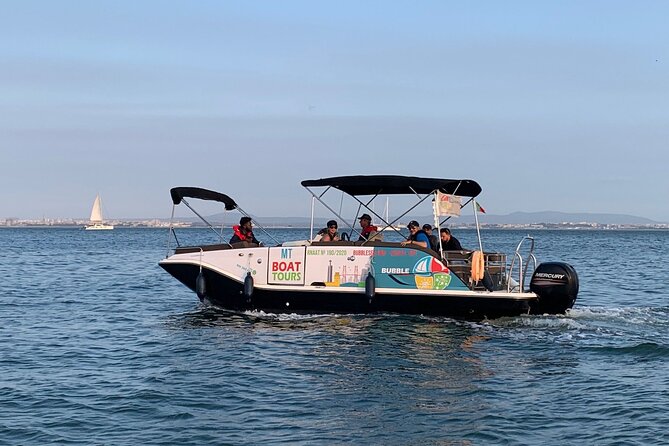
The cruise heads toward iconic Almada scenery, and two stops early on do heavy lifting: the Ponte 25 de Abril and the Santuario Nacional de Cristo Rei.
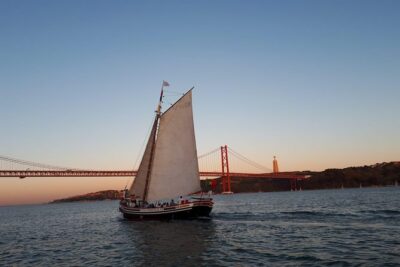
First up, the 25 de Abril Bridge. It is a suspension bridge linking Lisbon to Almada, with a total length of 2,277 meters. Even if you know it from photos, seeing it from the river gives you scale. You also get a clear sense of how the river channels traffic and movement, turning bridges into visual anchors.
Then comes Cristo Rei, the Sanctuary of Christ the King, overlooking Lisbon from Almada. What makes this one more than a look-at-a-statue moment is the backstory you pick up along the way: it was inspired by Rio’s Christ the Redeemer after a Portuguese cardinal visited. The project was inaugurated on 17 May 1959, and the giant statue is tied to gratitude that Portugal was spared direct destructive effects of World War II.
Practical tip: if you like skyline photos, this is a great area to spend your attention. The angle from the water tends to soften the “straight-on postcard” look and gives you depth across the river.
Almada waterfront moments: fisheries ruins, Jardim do Rio, and Cacilhas
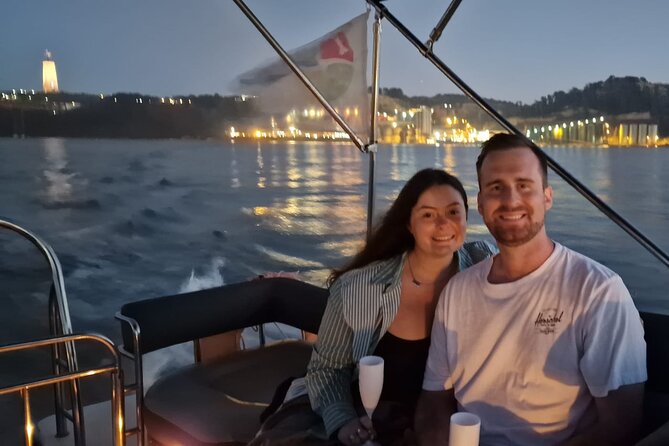
After Cristo Rei, you get more Almada flavor, including places that feel less like “checklist monuments” and more like real river life.
One stop is the Portuguese Fisheries Company Ruins. The story here is about infrastructure. Vessels for coastal fishing originally operated from the Santos pier on the Lisbon side, but support needed to expand across the river. Olho de Boi in Almada became the chosen location, linked to a disused building associated with Companhia de Fiação e Textos Lisbonenses. From there, the building became a mechanics area for the company, and the structures grew around it, with walls built to dock trawlers.
This is the sort of stop that might be quick, but it adds texture. Lisbon from the water can feel glossy. Ruins like this remind you there was industry here, not just tourism.
Next is Jardim do Rio, a green riverside space between the cliff of Almada and the Tagus. You can walk along the Ginjal pier or relax on the grass. The panoramic elevator of Boca do Vento connects visitors to the garden from the viewpoint, with exemplary views across Almada’s riverside. The garden stretches from Fonte da Pipa (built by King João V in 1736) along the escarpment to the houses at Cais do Ginjal.
Then you reach Pontal de Cacilhas. Cacilhas is on the south bank facing Lisbon, and it is part of the modern Almada administrative area. This area works well for a quick photo pause because it gives you a clear, facing view back toward Lisbon across the water.
If you’re the type who likes getting your photos fast, these stops are efficient. If you prefer a long stretch to roam, they can feel brief, but the cruise overall balances sightseeing with movement.
Maritime and military history: Fragata D. Fernando II e Gloria and the Barracuda
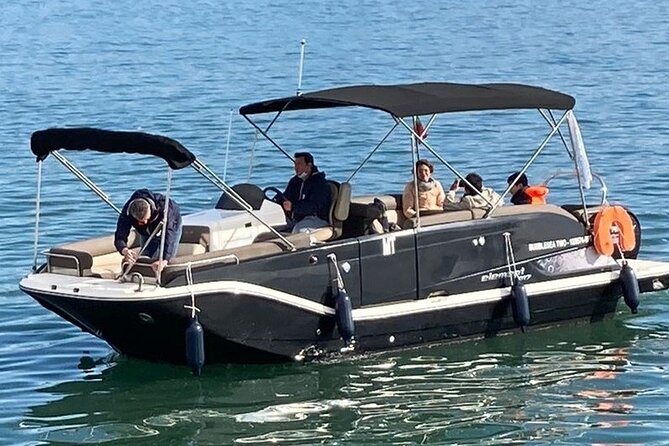
Two of the more fun, “wait, what is that?” moments are maritime relics you can spot around Cacilhas and Almada.
One is Fragata D. Fernando II e Gloria, a wooden-hulled, 50-gun Portuguese Navy frigate. She was launched in 1843, with her maiden voyage in 1845, and she was built at the shipyard of Daman in Portuguese India. It is described as Portugal’s last sailing warship built and the last ship to undertake the Carreira da Índia, the regular military line connecting Portugal to its colonies in India since the early 1500s.
The dramatic part: she was nearly destroyed by a fire in 1963. The burned wooden hull stayed beached on the mud-flats of the Tagus for 29 years, until restoration started again in 1990 to return her appearance.
Next, you can see Barracuda Submarine. It is across the river from Lisbon, near Cacilhas. The submarine served the Portuguese Navy for 40 years, with more than 52,000 hours navigated. It’s a short stop, but it’s a memorable one because it adds a layer of naval technology, not just old stone and towers.
I like including these stops because they prevent the cruise from turning into only architecture spotting. You also learn that Lisbon’s river is tied to shipping, defense, and industry.
You can also read our reviews of more wine tours in Lisbon






Back to Lisbon: Praça do Comércio and Castle hill from the river
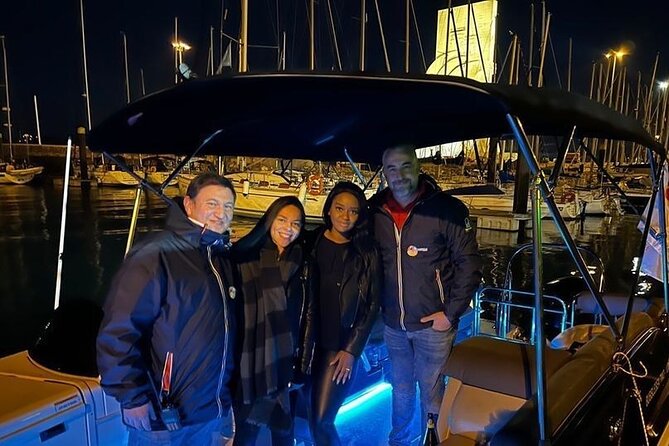
Now you start moving back toward the Lisbon side, and the vibe shifts from Almada riverfront to Lisbon’s historic center.
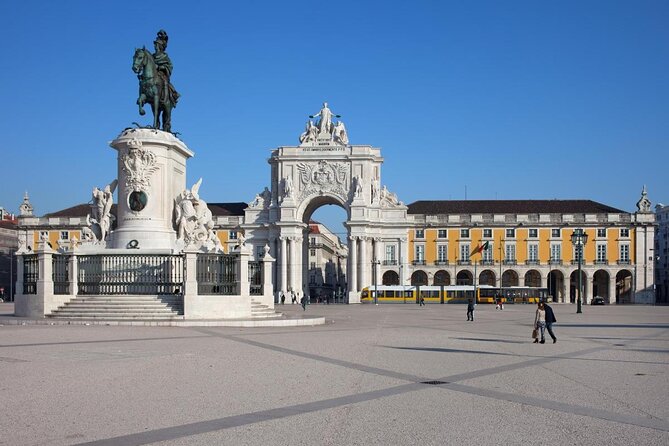
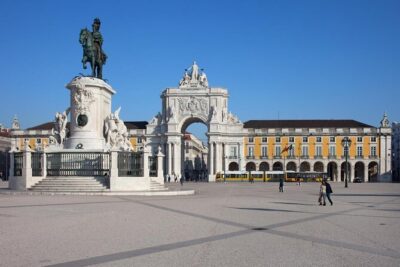
The cruise route includes Praca do Comercio (also commonly called Terreiro do Paço). This is Lisbon’s large harbour-facing plaza, facing south toward the Tagus. It hosted the old Paço da Ribeira until it was destroyed by the 1755 Lisbon earthquake. After the quake, the plaza was remodeled as part of the rebuilding of Pombaline Downtown (Baixa), ordered by Sebastião José de Carvalho e Melo, the 1st Marquis of Pombal.
From there, you get a visual lead toward Castelo de Sao Jorge. Saint George’s Castle sits on a hill with occupation that stretches back to at least the 8th century BC, and fortifications go through Phoenicians, Carthaginians, Romans, and Moors before the Portuguese conquest in 1147. Over centuries it served different roles, including royal palace and military barracks, and it now houses the Torre do Tombo National Archive and museum functions.
Even if you do not step inside the castle during this cruise, you’ll feel why it matters. From the water, the hill and walls read like a map. You can match that view with what you might later explore on foot.
Alfama angles and Lisbon night-life edges: Santa Engrácia, Cais do Sodré, and Santos
The route also touches Lisbon’s emotional neighborhoods, not just major monuments.
You pass the Church of Santa Engrácia, a 17th-century building that became the National Pantheon, where important Portuguese personalities are buried. It is located in Alfama, close to the Monastery of São Vicente de Fora (mentioned as a nearby landmark). This sort of stop helps you understand Lisbon’s layers, religious buildings mixed into neighborhoods that still feel lived-in.
Then you see Cais do Sodré and Santos as a contrast story. These areas were historically rough and tough, with Cais do Sodré known as the capital’s red light area. Today, they are transformed into Lisbon’s more nightlife-focused zones, where you are more likely to find bistros than brothels. Santos’ docks, warehouses, and factories are now designers’ studios and fashionable cafés, shops, and galleries.
On a boat, this works well because you are not trapped inside the neighborhood. Instead, you see the edges and the riverfront structures that shaped the old areas, then you notice the modern shift in how buildings and spaces are used.
MAAT and Central Tejo: modern Lisbon seen from across the water
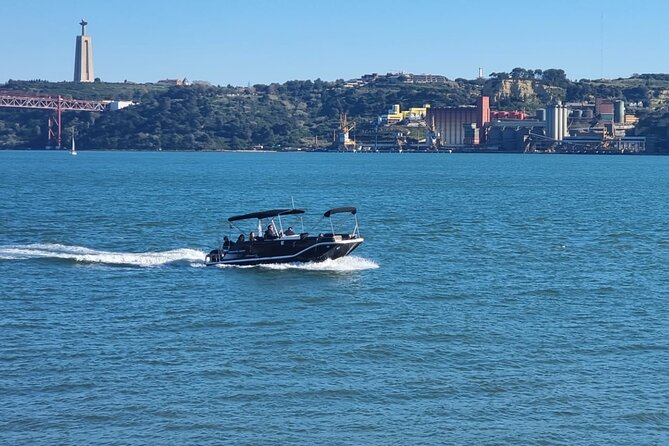
One of my favorite parts of this cruise is how it mixes old and new. MAAT (Museum of Art, Architecture and Technology) sits on the River Tagus west of the city center. It is a cultural project focused on art, architecture, and technology, built as a museum designed by Amanda Levete Architects. It aims to host exhibitions by contemporary artists, architects, and thinkers, with MAAT also designed to connect the building’s modern form to the nearby Tejo Power Station, an example of industrial architecture from the first half of the 20th century.
Also on the route is the Electricity Museum, now integrated into MAAT under the name Circuito Central Elétrica. This part matters if you like science and infrastructure. It presents the past, present, and future of energies, with thematic and experimental exhibits, plus cultural and business events. It is located in Belém, in old Central Tejo spaces.
From the water, these buildings can look like sculpture, not just museum boxes. It is an easy way to add a modern Lisbon highlight without making you commit to a ticketed museum visit.
Belém finale: Padrão dos Descobrimentos and Torre de Belém
The cruise returns toward Belém with its big icon landmarks.
First, the Padrão dos Descobrimentos. This monument sits on the northern bank of the Tagus River estuary in Santa Maria de Belém. It celebrates the Portuguese Age of Discovery in the 15th and 16th centuries, connected to the river where ships departed to explore and trade with India and the Orient. If you’re curious about why Lisbon leans so hard into exploration themes, this is a clear starting point.
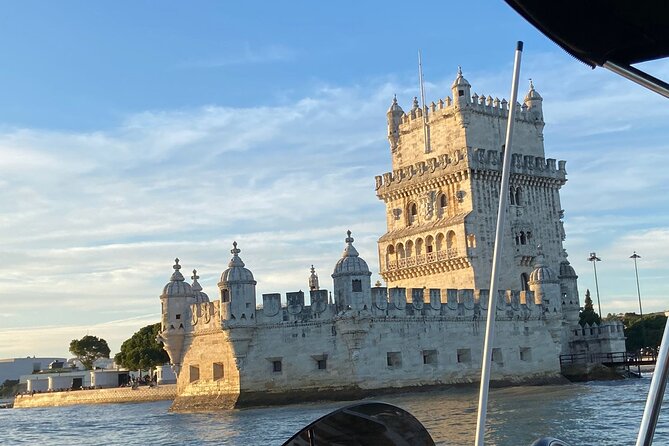
Then you get Torre de Belem, the Tower of Saint Vincent. It is a 16th-century fortification built as an embarkation and disembarkation point for explorers and as a ceremonial gateway to Lisbon. The tower is famous for Manueline style details, built from lioz limestone, with a 30-meter four-storey tower. It has UNESCO recognition since 1983, along with the Jerónimos Monastery.
If you only have one river cruise and want maximum Belém impact, this ending stretch delivers.
One more extra marker appears near the end: a monument in the Jardim da Torre de Belém that reproduces in life size the Lusitânia seaplane used by Gago Coutinho and Sacadura Cabral during the first crossing of the South Atlantic to Brazil in 1922. It was inaugurated on 15 October 1991. It’s a neat reminder that Portuguese exploration was not only ships and maps, but also aviation.
Price, timing, and group size: does $40.64 feel fair?
At $40.64 per person for about 2 hours, this cruise sits in a sensible middle zone for Lisbon. It is not cheap in the way of a simple hop-on boat taxi, but it includes things that make it feel like a real experience: Champagne and water, plus a guide-led route with regular photo pauses.
The average booking timing is about 8 days in advance, so you’re likely not stuck trying to book last minute. That also helps you plan your day, especially if you want to pair the cruise with nearby Belém walking sights.
The maximum of 12 travelers is a practical detail you feel immediately. You spend less time squeezing around, and you can usually get to the right side for photos when landmarks line up. For a sunset-style cruise, that matters.
About food and drinks: Champagne and water are included on board. One review also suggested having a non-alcoholic option like sparkling fruit juice for children and non-drinkers, so if that matters to your group, it’s smart to ask ahead.
Finally, there’s the weather reality. This experience requires good weather. If conditions are not comfortable on the river, it can be canceled and you’ll need a workable plan B. In other words, bring your best optimism, but leave space in your schedule.
Who this cruise is for, and who might want a different plan
This cruise makes sense if you want iconic Lisbon views without doing hours of uphill walking. It is also a solid pick if you like photography with guidance, because the route is built around specific landmark stops where you can take pictures, then move on.
It is also easy for mixed ages. People of all ages are welcome, and the vessel supports wheelchairs and reduced mobility. Service animals are allowed too.
It might not be the best fit if you want long museum time at each sight. Most of what you’re doing is viewing and photo stops, not full ticketed visits at each location. If your travel style is sit-in-the-air-conditioning and read every plaque for an hour, you might want a different format.
And if you hate being on the water when it gets choppy, have a Plan B mindset. One cancellation example involved rain and sea state, with short notice, so your comfort level matters.
Should you book this boat cruise with Champagne?
Yes, I’d book it if you want a high-value Lisbon highlight that combines sunset energy with real sightseeing. The big reasons are simple: Champagne included, great landmark coverage from the Tagus, and a small group size that keeps the experience comfortable and photo-friendly.
I’d also book it if you’re doing Belém anyway, because starting near the Padrão dos Descobrimentos and finishing with Torre de Belém is a clean story arc. Just make sure you keep one part of your day flexible for weather, and if you need non-alcoholic drinks, ask ahead so everyone is looked after.
FAQ
How long is the Boat Cruise with Champagne in Lisbon?
The cruise lasts about 2 hours.
Where does the tour start and where do I end?
It starts at the meeting point at Av. Brasília 1400-038, Lisbon, and it ends back at the same meeting point.
Is there a mobile ticket?
Yes. The tour uses a mobile ticket.
What is included on board?
Champagne and water are offered on board.
Do I need tickets for the stops?
The provided stop notes list admission ticket free for each listed stop.
How many people are on the boat?
The experience has a maximum of 12 travelers.
Is this cruise suitable for wheelchairs or reduced mobility?
Yes. The vessel allows the ride of people in wheelchairs and with reduced mobility.
Are service animals allowed?
Yes. Service animals are allowed.
What is the cost per person?
The price is $40.64 per person.
What happens if weather is bad?
This experience requires good weather. If it’s canceled due to poor weather, you’ll be offered a different date or a full refund.
More Wine Tours in Lisbon


More Boat Tours & Cruises in Lisbon


More Tour Reviews in Lisbon


Not for you? Here's more nearby things to do in Lisbon we have reviewed








Wine Tours, side by side.
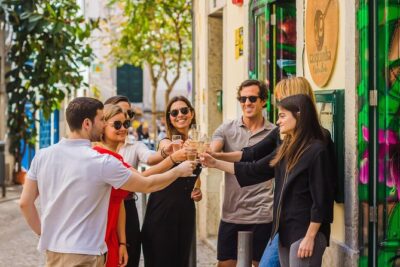 ★ 5.0Winner 2025 Undiscovered Lisbon Food & Wine Tour by Eating EuropeTickets from $1256,390 traveller reviews
 ★ 4.7Live Fado Show with Port Wine in Historic CenterTickets from $174,166 traveller reviews
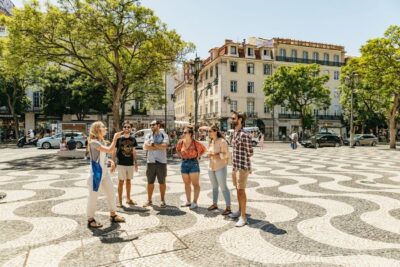 ★ 4.9Food and Wine Small Group Walking TourTickets from $724,082 traveller reviews
 ★ 5.02 Hour Lisbon Sunset and Wine Sailing TourTickets from $662,680 traveller reviews
 ★ 4.52-Hour Lisbon Traditional Boats Sunset Cruise with White WineTickets from $422,091 traveller reviews
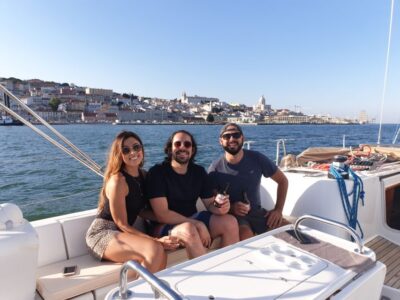 ★ 4.9Champagne Sailing ToursTickets from $581,366 traveller reviews
 ★ 5.0Lisbon Food Tour with 10+ Tastings of Local Delicacies & WinesTickets from $971,339 traveller reviews
 ★ 4.8Fado Show with Wine in a Historic VenueTickets from $191,294 traveller reviews
More useful lists for this tour