

Review · LISBON CITY TOURS
Tuk Tuk Lisbon: Lisbon Iconic Highlights 1.5-Hour
Lisbon shifts gears when you watch it roll by in a 100% electric tuk-tuk. I love the guide-led storytelling that turns big landmarks into human-scale scenes, and I love how the route stacks viewpoints without making you walk every cobblestone hill. One heads-up: the tuk-tuk is not wheelchair or walker accessible, so it may not work for everyone.
In 1.5 hours, you ride from Restauradores Square to Rossio Square, then thread through Baixa, Alfama, and Graça. You also get practical perks like a clear waterproof cover for rainy days, a speaker so you can actually hear your guide, and a taste of ginjinha. If you want a quick, high-impact first pass at Lisbon that still feels personal, this one makes sense.
Key highlights worth your attention

- Electric tuk-tuk with clear, waterproof covers so rainy weather is less of a problem
- Restauradores to Rossio routing that hits the city’s main stage in one loop
- Multiple photo-stop miradouros (Portas do Sol, Santa Luzia, Senhora do Monte) for skyline views
- Storytelling guide + speaker designed for hearing clearly on the move
- Ginjinha included so you get one local taste without hunting for it
- Private group format capped at up to 6 people (max weight 400 kg)
Why this Lisbon tuk-tuk tour feels efficient
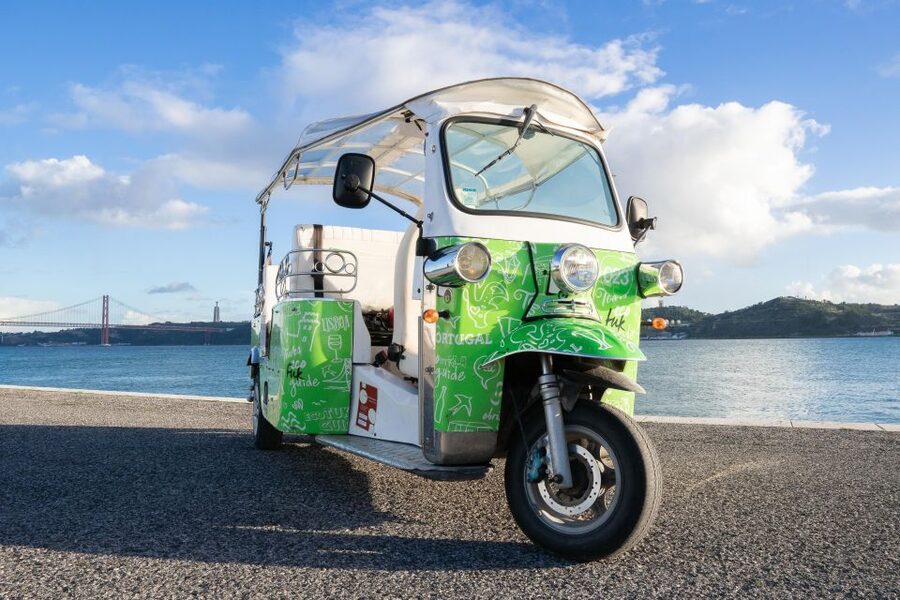
Lisbon has a talent for making you forget time. One minute you are admiring tiles and arches, the next minute you are climbing another hill just to see the next viewpoint. This 1.5-hour Tuk Tuk Lisbon tour is built to reduce that stress. You get a guided loop that prioritizes orientation. You finish knowing where key neighborhoods sit relative to each other.
The electric part is more than a feel-good detail. It helps keep the ride pleasant and quiet enough that the guide’s narration stays usable, especially with the built-in speaker. And because the vehicle has transparent and waterproof covers, weather does not automatically shut down your plan.
You also get a true private-group vibe. That matters because your guide can pace your stops. If a viewpoint needs a few extra minutes for photos, you are not stuck in a giant herd. The tradeoff is that you are still limited by the 1.5-hour window, so you will not linger everywhere like you would on a full day.
You can also read our reviews of more tours and experiences in Lisbon.



Price and value: what $56 gets you in Lisbon time
At $56 per person for about 1.5 hours, this tour is not a “cheap and cheerful” sprint. It is priced like a guided, transport-included orientation tour. The value comes from three things you would otherwise pay for or spend time figuring out:
First, hotel pickup and drop-off. Lisbon logistics can be a headache, especially in areas with tight streets. Being collected and returned saves your energy for the views.
Second, the tour includes a speaker so you do not keep asking to repeat yourself. That sounds small until you are bouncing along streets and wind is chewing up conversation.
Third, you get a bin of practical extras: blankets for colder days, rain covers for wet weather, and a taste of local ginjinha. Most short sightseeing products charge extra for at least one or two of those conveniences.
The one thing not included is entry tickets and food beyond the included ginjinha. If you plan to go inside major sites for paid entry, budget extra. If you just want the best look, best photo angle, and clear context, this price is usually a fair match.
The route you get: Restauradores to Rossio plus the neighborhoods in between
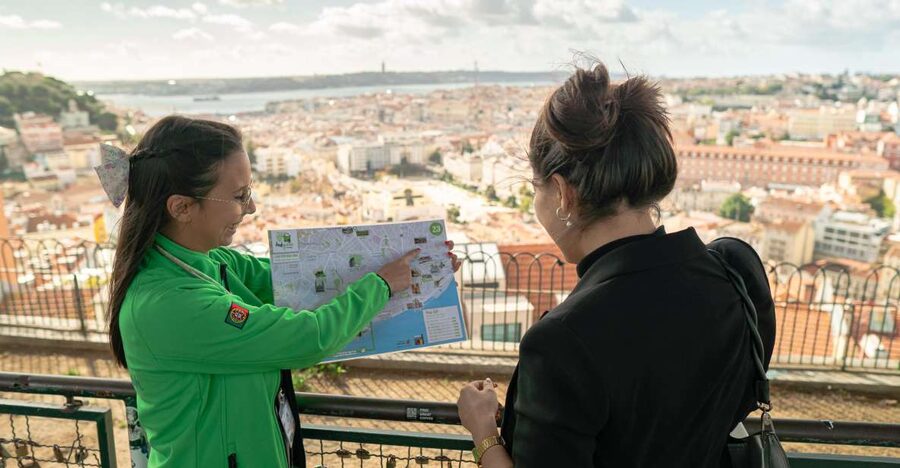
This tour’s structure is simple: it starts at Restauradores, works its way through Lisbon’s center, then climbs into view-heavy districts before returning you to Rossio.
You begin at one of two pickup options listed at checkout (the options are shown as 1400-200 and 1200-200). The drop-off options are the same two ranges. Once seated, your guide uses the ride time to place major monuments in context, so the stops feel connected rather than random.
The big idea is orientation. By the time you arrive back near Rossio, you will have a mental map of where Baixa sits, how Graça overlooks the Tagus, and how Alfama wraps around the cathedral area.
Stop-by-stop: what each moment is really for
Below is how I would think about the stops, what they add, and what to watch for so you get the most from your 1.5 hours.
1) Restauradores Square, where the story begins
Restauradores Square is a natural start point because it is close to Avenida da Liberdade’s energy while still acting like a hinge into the historic core. You start by admiring the monument tied to Portugal’s independence restoration. Even if you only skim the symbolism, the guide’s explanation helps you see why Lisbon celebrates this phase of its identity.
Practical tip: this is often where you orient to your direction of travel. Stand where you can see the avenue and the monument details without blocking others.


2) Avenida da Liberdade, the elegant stretch
You ride down Avenida da Liberdade, Lisbon’s grand boulevard lined with trees and architecture that feels formal compared to the older streets. I like this segment because it is a breather. It gives you a sense of “modern Lisbon” before the route tightens into older quarters.
If you are the type who likes photo angles, look out for architectural repetition along the avenue. It makes your pictures look crisp even when the street is crowded.
3) Rossio Square, Lisbon’s classic meeting point
Rossio Square is one of Lisbon’s most recognizable public rooms. You arrive amid historic buildings, including the train station facade. You get a sense of why Rossio is still a hub for locals. It is the kind of place where Lisbon’s past and present share the same sidewalk.
If your timing hits peak periods, expect people. Take quick photos, then let your guide move you on so the next viewpoint is not swallowed by lines.
4) Baixa, Elevador de Santa Justa, and Rua Augusta Arch areas
In Baixa, you pass through Lisbon’s downtown grid and see the Santa Justa area from the road. The tour does not promise a full elevator ride, but you catch the sightline of the wrought-iron structure, which is often the visual “aha” moment for first-time visitors.
Rua Augusta Arch is another key landmark. It frames Lisbon’s pedestrian core like a signature. Even at a glance, it helps you understand how Baixa was designed for movement and gatherings.
5) Lisbon Cathedral (Sé), the big symbol of Alfama’s center
Sé is the kind of stop that changes how you see Alfama. Cathedral exteriors make more sense when someone tells you what you are looking for: age, role, and why it anchored the surrounding district.
Do not rush this. Even if you do not enter, the cathedral facade gives you a “Lisbon anchor point” that you can later find on your own.
6) Portas do Sol Terrace, Santa Luzia, and Miradouro photo stops
This is where the tour earns its keep. You get photo stops at Portas do Sol Terrace and Miradouro de Santa Luzia, with short guided context and a few minutes to shoot.
What to look for:
- the way the rooftops stack in layers
- how the Tagus River shows up between buildings
- how Alfama’s maze starts to make sense from above
A quick note: because these are photo stops, time is tight. Bring your phone ready and decide where you want to stand before the guide starts talking. You get better pictures when you are not scrambling for position.
7) Convento da Graça and the Graça district feel
The itinerary includes Convento da Graça with a guided stop, plus time in the Graça Historic District. Graça is a favorite for its hilltop vibe, street life, and visible creative energy. If you like street art and neighborhood atmosphere, this section tends to be the one people remember afterward.
The convent stop works because it connects the views with older structures. You see that these viewpoints were not just for beauty, they were strategic and cultural too.
8) Miradouro Senhora do Monte, the skyline payoff
You get another viewpoint at Miradouro Senhora do Monte, with a longer photo stop window (10 minutes). This is your chance to slow down. Use it to grab a panorama and compare it to the earlier terraces. From here, Lisbon looks like it is built for layers, not flat maps.
If you plan to capture skyline photos, wait a minute. Light can shift fast, and even clouds can change contrast.
9) São Vicente de Fora Monastery, architecture and cloisters vibe
The monastery stop is guided, which is helpful because cloisters and church architecture can feel overwhelming if you only skim. The guide’s narration helps you notice what matters: scale, layout, and the reason this site is part of Lisbon’s identity.
Even a short visit can add depth if you use the guide time well. Ask a question if something feels confusing. This kind of tour works best when you talk back to it.
10) Campo de Santa Clara and the quieter in-between moments
Campo de Santa Clara is included as a guided stop. It is not the same kind of headline monument as the cathedral or Rossio. That is exactly why it matters. It helps you experience a real slice of the city beyond the “big photo” stops.
11) National Pantheon of Santa Engrácia
You also stop at the National Pantheon of Santa Engrácia. The headline here is the scale of the monument and the famous dome look. Even if you do not go inside, seeing it from the right angle helps you understand why it is such a landmark.
12) Fado Museum stop, then into Alfama
The itinerary includes the Fado Museum as a guided sightseeing stop. You are not promised a full museum visit in the data provided, but the guide can frame how fado connects to Lisbon’s streets and emotions. Then you roll into Alfama for guided sightseeing.
Alfama is the district you feel in your legs and in your eyes. Even from the vehicle, you get the street rhythm that makes this neighborhood famous.
13) Rua da Madalena, Mouraria, and the street-life weave
As part of the general route, you pass Rua da Madalena, plus Mouraria, which is known for multicultural atmosphere and narrow streets. These sections are less about one single monument and more about textures: shop fronts, cafes, and the way neighborhoods mix everyday life.
If you are hoping for a lot of long walking segments, this is not that style. Instead, it gives you context so you can return later if something calls you.
14) Praça do Comércio, Lisbon’s waterfront stage
You finish the scenic sequence at Praça do Comércio, a grand square on the water. This stop tends to land well because it feels like the city opens up. It also sets you up for a natural return flow toward Rossio.
15) Back to Rossio Square to end
The tour concludes at Rossio Square. By then, you should feel more confident navigating on foot. Rossio is a good base afterward because it is central and easy to connect from.
Weather and comfort: small details that matter on a hill-city tour
Lisbon can go from sunny to misty without much warning. This tour is designed for that reality.
- The vehicle has transparent and waterproof covers so you can keep your sightlines.
- There are blankets for the coldest days.
- Your guide uses a speaker so you hear narration without leaning in or missing directions.
- The tuk-tuk is electric, so the ride stays comfortable and smooth.
The practical downside is the seating and access. The tuk-tuk is not wheelchair or walker accessible, and it is not suitable for pregnant women per the tour notes. Also, children under 7 are not recommended.
What makes the guide experience feel different
This tour is led by a driver and storyteller, and the guide’s job is to make the landmarks connect. One review highlights a guide named FILIPE, described as simpatico, available, and clear when explaining the history of key monuments. That matches what you want on a short tour: crisp stories, not a long lecture.
I also like that the narration is paced around viewpoints and walking-light stops. You are not stuck hearing the longest explanation while the vehicle is stuck in a slow street. The speaker and the stop structure are built for understanding, not just passing time.
Who should book this Tuk Tuk Lisbon tour
This is a good fit if:
- You have limited time and want a guided “best of” loop.
- You want views without worrying about where to park your feet next.
- You like structure, but you still want time for photos at miradouros.
- You prefer hotel pickup and a private group feel.
It may not be the right choice if:
- You want a full deep museum day with long indoor times.
- You need wheelchair or walker access.
- You are traveling with children under 7, or you are pregnant and need accommodations beyond what the notes provide.
- You want to spend most of the experience walking through neighborhoods instead of riding between them.
Should you book this 1.5-hour electric tuk-tuk highlights tour?

Yes, I would book it if you are visiting Lisbon for the first time or you want a high-quality orientation tour that still includes the skyline moments.
The strongest reasons: the route makes sense from a geography point of view, the viewpoints are timed for photos, and the comfort extras (rain covers, blankets, speaker) protect you from the two biggest Lisbon tour killers, weather and noise.
Book it especially if you plan to return later for longer walks. This tour acts like a map you can feel, so your next day feels smarter.
If you already know Lisbon well and you only want one perfect viewpoint, you might feel this is a lot of stops in a short time. But for most people, $56 for a guided electric loop with hotel pickup is a solid way to get bearings fast.
FAQ
What is the duration of the Tuk Tuk Lisbon Iconic Highlights tour?
The tour lasts 1.5 hours.
Where does the tour start and end?
It starts at one of two pickup location options and ends at one of two drop-off location options, with the same options listed for both.
Is the tour private?
Yes, it’s listed as a private group.
What is included in the price?
Hotel pickup and drop-off, a speaker to hear the guide clearly, blankets for cold days, a vehicle with transparent and waterproof covers, a driver and storyteller, liability and personal insurance, and taste of ginjinha.
What is not included?
Monument entry tickets and food and drinks.
What languages are the guides available in?
The tour is available in English, French, Italian, Spanish, and Portuguese.
Is it suitable for people with mobility needs?
No. The tuk-tuk is not wheelchair or walker accessible.
What should I bring and who is it not suitable for?
Bring your passport or ID card. It is not suitable for children under 7 and not suitable for pregnant women.
More Tour Reviews in Lisbon

Not for you? Here's more nearby things to do in Lisbon we have reviewed










Lisbon City Tours, side by side.
 ★ 5.0Lisbon City Center Tour – The Unmissable LisbonTickets from $322,234 traveller reviews
 ★ 4.7Sintra, Pena, Regaleira, Cabo da Roca & CascaisTickets from $2319,656 traveller reviews
 ★ 4.1Jerónimos Monastery Entrance TicketTickets from $2114,164 traveller reviews
 ★ 4.8History, Stories and Lifestyle Walking TourTickets from $2910,902 traveller reviews
 ★ 4.5Sunset Boat Party Cruise with DJ and Open BarTickets from $2710,378 traveller reviews
 ★ 4.7Pena Palace, Sintra, Cabo da Roca, & Cascais DaytripTickets from $919,981 traveller reviews
 ★ 4.6Oceanário de Lisboa Entrance TicketTickets from $299,943 traveller reviews
 ★ 5.0True 4Hour Private Tuk Tuk Tour: Discover Lisbon with a Local!Tickets from $1088,008 traveller reviews
More useful lists for this tour