
Horse work with court-level grace.
This experience is interesting because you get to watch Portuguese equestrian art as it’s built, not just as a finished show. I especially love the behind-the-scenes warm-up, handlers, and agility work, and the elegant rhythms of the Lusitano horses in period-style training. One consideration: it’s only a short morning window, and if you want a long, high-volume performance, the training itself may feel brief for the price.
You’ll visit the Portuguese School of Equestrian Art in the Queluz area, then follow an interpretative route at Nora Pateo before heading to the Henrique Calado Arena. The schedule is built around a calm, focused hour, with activities running between 11am and 1pm. It also skips the ticket line, and it’s wheelchair accessible, but access to the cabin and south stall is limited by stairs.
At around $9 per person and with a rating of 4.4 out of 5 from 20 bookings, it’s strong value if you care about how horses and riders work together. If you are more in it for big sightseeing stops, you might prefer to pair this with the nearby palace and gardens on a separate ticket.
Key highlights at a glance
- Nora Pateo interpretative route running 11am to 12pm, to understand techniques and tradition before you watch training
- Henrique Calado Arena session from 12pm to 1pm (Wednesday is exhibitions instead of training)
- Warm-up and agility exercises that show horse training at work, not only the final routines
- Stables access time, with the chance to walk among horses, riders, and work areas
- Stage lighting and music during the arena routines, adding that court atmosphere
Getting there: how the 11am to 1pm window works
This is a morning-focused visit, with activities running between 11am and 1pm. The venue schedule is split into two main chunks: Nora Pateo in the late morning, then the Henrique Calado Arena session after that.
Your meeting point is CALÇADA DA AJUDA (near number 23). The practical point here is timing. You do not want to show up late and miss the start of the Nora Pateo visit window (11am to 12pm). If you’re building your day around it, treat this as your main commitment for the early hours.
Also note the rhythm of the schedule:
- Nora Pateo visits: 11am to 12pm
- Henrique Calado Arena training: 12pm to 1pm, except Wednesday
- Wednesday: 12pm to 1pm is exhibitions instead of training
More Lisbon tours and experiences for the shortlist

Queluz area setting and why it matters for the experience
The Portuguese School of Equestrian Art is tied to the 18th-century Portuguese court tradition, and the feel of the place supports that idea. Your visit happens in the Queluz gardens area, linked to the National Palace of Queluz.
This setting matters because the equestrian art here is not presented as random horse tricks. You’re watching a system of training built to create controlled movement, balance, and communication between rider and horse. When the arena routines happen after you’ve already seen the horses being prepared, the whole visit makes more sense.
One detail that affects planning: your ticket covers entry to the Portuguese School of Equestrian Art itself, and arena access, but it does not include entry tickets for the Queluz National Palace or the Queluz National Gardens. If you want more time outdoors or inside the palace, budget for those separately.
Nora Pateo route (11am to 12pm): context before the arena
The Nora Pateo portion is your interpretative route, designed to put the training in context. It’s the part that helps you stop watching only the spectacle and start noticing the craft.
During the Nora Pateo visit window (11am to 12pm), you’ll get insights into the history and techniques behind Portuguese equestrian art. Even if you are not an equestrian expert, this is useful because it turns simple observations into informed ones.
For example, when you later see warm-ups and agility work, you’ll know to pay attention to details like:
- how the work is organized
- how riders prepare their mounts
- how movement patterns relate to training goals
This interpretative time is also a good pace-break. Some people go to equestrian shows expecting just a routine. This gives you enough background to understand why the training portion is the main event.
Henrique Calado Arena from 12pm to 1pm: training, exhibitions, and the court mood
The highlight for most people is the session at the Henrique Calado Arena. It runs 12pm to 1pm (except Wednesday, when it becomes exhibitions rather than training).
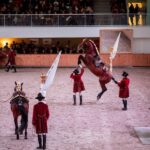
What to expect here is a choreographed training or performance setting. Riders and horses do routines with musical accompaniment, and the arena lighting helps create that classic court ambiance.
This is where you’ll notice the Lusitano horses most clearly. The Lusitano breed is famous for the expressive, controlled movement style used in Portuguese equestrian art, and in this format you see that style in action as part of serious training.
You’ll also see riders in authentic period costumes. That is not just for looks. It reinforces that what you’re watching is meant to echo the 18th-century tradition the school preserves.
Wednesday note
If your day in Lisbon lands on Wednesday, plan mentally for exhibitions from 12pm to 1pm. The time is the same, but the emphasis may feel more performance-focused than training-focused.




Stables time: watching the work close-up
One of the best parts of this experience is that you don’t only watch from afar. There’s time to see the stable environment in a more direct way.
Based on visit experiences shared by guests, I’d put it this way: you may be allowed to walk among the horses, riders, and stable areas, and you can often view the stalls and work spaces more on your own. Some people also mention using an audioguide option, which can be helpful if you want to move at your own pace and still understand what you’re seeing.
Practical advice if you want the best stable time:
- Wear comfortable shoes. You’ll likely stand and walk more than you expect.
- Keep your attention on horse behavior. Slow, calm movements are part of the story here.
- Take a few minutes before the arena session to watch how handlers and horses prepare. That warm-up routine is a big part of why this visit works.
Important accessibility note: the experience is wheelchair accessible, but there are restrictions. Access to the cabin and the south stall has stairs, so if those areas matter to you, plan around that.
Price and value: why $9 can be a bargain or a disappointment
At $9 per person, this is priced like a focused, short experience. That’s the good news. The not-so-good news is that the visit length is limited, and some people may feel the training segment does not justify the cost if they were expecting a longer, fuller performance.
Here’s how I think about value for this kind of activity:
- You get entry to the Portuguese School of Equestrian Art
- You get access to the Henrique Calado Arena
- You get the Nora Pateo interpretative route
- You skip the ticket line
So your money is buying both interpretation and access. That’s different from paying only for an arena show. If you enjoy understanding the technique and process, you’ll likely feel it was a fair price.
The most common mismatch comes from expectations. If you want a longer production, you might leave wanting more time in the arena. On the other hand, if you like training and craftsmanship, the short window can actually be a plus because it keeps things concentrated.
Also remember what’s not included. Food and drinks are not included, and the palace and gardens tickets are not included. If you plan to hang around after the training, you’ll want to factor those costs into your day.
Practical tips for a smoother visit (and better photos)
This is one of those experiences where small choices make a difference.
First, plan around the schedule blocks. Show up early enough to catch Nora Pateo (11am to 12pm). If you arrive late, you risk missing the interpretative context that helps the arena training click.
Second, bring what you need for a morning out. Food and drinks are not included, so have water and a light snack plan. Even if the session is only about an hour, time before and after adds up.
Third, if you booked through an online channel, double-check your voucher or ticket details before you go. A few people reported having to purchase a ticket again at the desk because they did not receive the application or voucher they expected. It’s rare, but it’s an easy fix if you verify everything the night before.
Finally, for watching horses well: keep a respectful distance, and don’t block sightlines. If you’re planning photos, prioritize steady framing over rushing to get everything in one shot.
Who should book this morning training experience?
This is a great match if you:
- like seeing training methods, not only final routines
- enjoy equestrian culture and traditional Portuguese art
- want a structured morning plan that connects interpretation to what you see in the arena
- prefer a smaller, more focused experience rather than a full-day tour
It may be less satisfying if you:
- expect a long show or a full entertainment program
- mainly want to treat it as a quick photo stop
- want the Queluz palace and gardens included in the same ticket (you’ll need separate tickets)
Should you book Portuguese School of Equestrian Art morning training?
If your goal is to understand Portuguese equestrian art through real training moments, I think it’s worth booking. The pairing of the Nora Pateo interpretative route with the Henrique Calado Arena session gives you context, then immediate payoff in what you watch. And at $9, the value is hard to ignore if you’re genuinely interested in horses, riders, and technique.
I’d skip it only if you are set on a longer performance length or you need the whole day to be packed with sightseeing. Otherwise, plan a calm morning, arrive on time for Nora Pateo, and treat the stable and warm-up observations as part of the main event.
FAQ
How long is Lisbon Portuguese School of Equestrian Art morning training?
It lasts 1 day, and the activity schedule is between 11am and 1pm, with Nora Pateo from 11am to 12pm and the Henrique Calado Arena session from 12pm to 1pm.
What is the meeting point?
The meeting point is CALÇADA DA AJUDA (near number 23).
What happens at Nora Pateo during the visit?
Nora Pateo is an interpretative route that runs from 11am to 12pm, where you learn about the history and techniques of Portuguese equestrian art.
When is the Henrique Calado Arena session?
It runs from 12pm to 1pm, except on Wednesday. On Wednesday, the scheduled slot from 12pm to 1pm is exhibitions instead of training.
What is included in the ticket?
Included are Portuguese School of Equestrian Art entry, access to the Henrique Calado Arena, and the interpretative route at Nora Pateo.
What is not included?
Not included are hotel pickup and drop-off, food and drinks, entry tickets for Queluz National Palace, and entry tickets for Queluz National Gardens.
Is it wheelchair accessible?
It is wheelchair accessible, but there are accessibility restrictions to access the cabin and the south stall because stairs are involved.
Can I get a refund if I cancel?
No. The activity is non-refundable.
Does this tour skip the ticket line?
Yes, it includes skipping the ticket line.
More Morning in Lisbon


More Tour Reviews in Lisbon
Not for you? Here's more nearby things to do in Lisbon we have reviewed








Lisbon City Tours, side by side.
 ★ 5.0Lisbon City Center Tour – The Unmissable LisbonTickets from $322,234 traveller reviews
 ★ 4.7Sintra, Pena, Regaleira, Cabo da Roca & CascaisTickets from $2319,656 traveller reviews
 ★ 4.1Jerónimos Monastery Entrance TicketTickets from $2114,164 traveller reviews
 ★ 4.8History, Stories and Lifestyle Walking TourTickets from $2910,902 traveller reviews
 ★ 4.5Sunset Boat Party Cruise with DJ and Open BarTickets from $2710,378 traveller reviews
 ★ 4.7Pena Palace, Sintra, Cabo da Roca, & Cascais DaytripTickets from $919,981 traveller reviews
 ★ 4.6Oceanário de Lisboa Entrance TicketTickets from $299,943 traveller reviews
 ★ 5.0True 4Hour Private Tuk Tuk Tour: Discover Lisbon with a Local!Tickets from $1088,008 traveller reviews