
Review · LISBON CITY TOURS
Lisbon – Daylight or Sunset on a Vintage Sailboat
Lisbon’s best photos come from the water. This vintage sail gives you the big-city sights like the April 25 Bridge and the Praça do Comércio, without the chaos, plus white and rosé wine with cheese and charcuterie on board. I love the small-group feel and the way the skipper points out landmarks while keeping the tone relaxed, not lecture mode. One thing to consider is that the meeting point at Clube de PadelDoca de Santo Amaro can be a little confusing at first, especially if you are arriving at dusk.
You sail on the Tagus for about 2 hours, and with a maximum of 12 travelers, the boat stays calm. In the better light, you get that classic Lisbon glow across the river, and even a chilly evening feels manageable when the crew provides blankets. Still, if you want constant service like on a bar crawl, note that food and wine are offered as part of the experience, and some people found the wine pours modest for a full two-hour cruise.
If you want a more personal way to see Lisbon’s riverfront and Belem area, this is a smart pick. You will get a front-row pass to major monuments on both sides of the water, guided by skipper Angelo Oliveira and his team, with the whole route designed for viewpoints that make sense for photos and sightseeing.
Key things to know before you go
- Vintage sailboat, not a party barge: you get a quieter ride with room to move around.
- Skipper-led landmarks: the captain explains what you are seeing as you pass it.
- Wine plus cheese and charcuterie onboard: you are not just sightseeing, you are also grazing.
- Prime Lisbon river monuments in one loop: April 25 Bridge, Belem area, and Praça do Comércio.
- Blankets for a cooler sunset: comfort is planned for the breeze on the Tagus.
- A short, manageable 2-hour time window: easy to fit into a day plan.
Why a vintage sailboat on the Tagus feels different
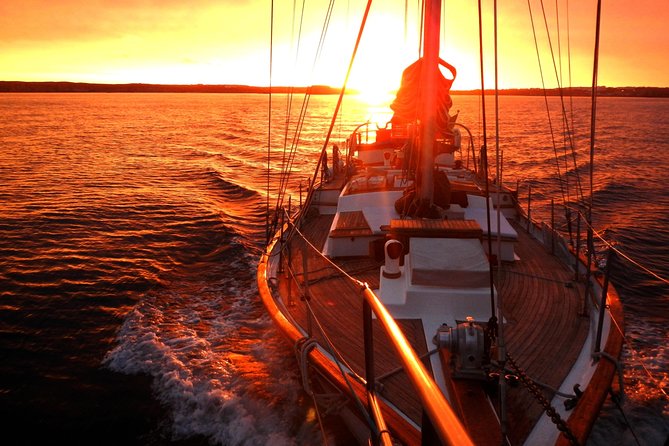
Big boat cruises can be fun, but they can also feel like you are fighting for space and trying to hear over the group. On this vintage sailboat, the atmosphere is more like a relaxed boat evening with a real guide steering the conversation toward the view.
I like that the crew keeps the guidance balanced. You get enough story to connect Lisbon’s landmarks to the river, without being stuck in a long explanation. And because the group is small, you can actually look around when something interesting flashes by, instead of constantly scanning for a chair or a window.
This is also a great choice for first-time river views. Lisbon’s top sights are everywhere on land, but from the Tagus, you see how the city sits, turns, and faces the water. That makes the skyline feel more logical, and it makes your photos look more layered.
You can also read our reviews of more boat tours in Lisbon

Getting to Clube de PadelDoca de Santo Amaro (and not losing time)
The sailing starts at Clube de PadelDoca de Santo Amaro, 1350-353 Lisboa. The good news is that it is near public transportation, so you are not stuck with just one option. If you are coming from central Lisbon, a short Uber ride is often the easiest move, and some visitors also use the local train for a couple of stops.
That said, I do want to flag the one recurring friction point: the exact meeting point can feel hard to spot the first time you are near the docks. If you are going for sunset, give yourself a little extra buffer. You want to arrive, check in, and settle in before the light starts fading.
A practical tip, based on how these small-group boats work: once you find your spot, sit in a position that helps you see the waterline and the city at the same time. On any sail, where you sit changes what you feel. Some people noted that attention from the crew can vary depending on where you are on board.
The route that makes Lisbon click, one landmark at a time
This is a Tagus loop built for classic Lisbon angles. As you sail, the boat passes key sights around Belem and then swings back toward the central waterfront. The best part is that you are not rushing between far-flung neighborhoods. You are moving smoothly along the river while the scenery comes to you.
You will see major riverfront monuments, including the April 25 Bridge at the narrowest point where Lisbon’s geography becomes dramatic. You also get views of the Belem area and the harbor side fortifications, plus the city’s formal river plaza at the end.
Even if you already walked Lisbon’s streets, this route gives you a fresh read on the same places. And because you are on a boat, the distance between monuments feels different. The skyline looks connected, not scattered.
Ponte 25 de Abril: the bridge that frames the whole river story
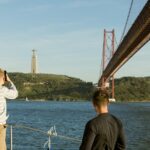
One of the first big visual hits is the suspension bridge that spans the Tagus, Portugal’s April 25 Bridge. It is famous for resembling San Francisco’s Golden Gate Bridge, and it has the kind of clean, bold silhouette that instantly makes photos look cinematic.
There is also a meaning to the structure beyond the looks. The bridge name commemorates the Portuguese Carnation Revolution of 25 April 1974. When you learn that connection from the skipper while you sail, it adds a layer you might miss if you only see it from land.
From the water, the bridge feels closer and taller. The angle helps you see the span and the lines of the deck, and you can often capture it with the river stretching both ways, which is harder to do if you are standing far back on a sidewalk.
Padrão dos Descobrimentos and the Portugal of the 15th and 16th centuries
Next up is the Padrão dos Descobrimentos, the imposing monument on the riverbanks at the Tejo estuary. It celebrates the Portuguese explorers and visionaries from the 15th and 16th centuries, and it is a powerful background to the river route because Portugal’s seafaring identity is literally built into the shoreline view.
On land, this monument can feel like a stop you fit in between other tasks. From the deck of a boat, it turns into part of the motion. You sail alongside it, and it feels like it belongs to the river’s job, which is connecting Lisbon to the world.
A small consideration: monuments like this are impressive, but you need to hold your camera at the right moment. The boat is moving, so you get best results when you are ready before the landmark arrives in full view.
You can also read our reviews of more evening experiences in Lisbon


The 16th-century harbor fortress, seen like a coastal guardian
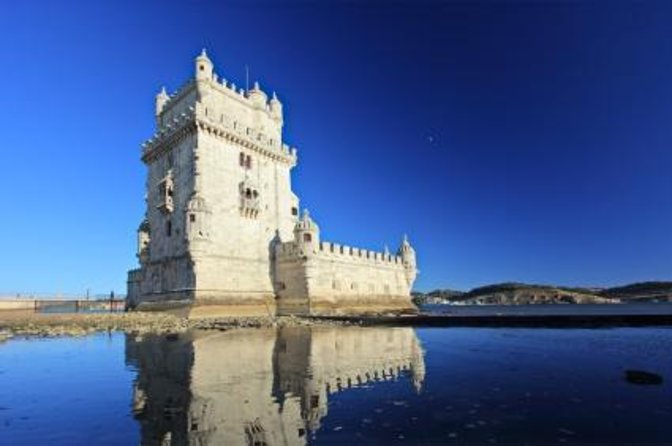
You also pass a fortress built in the 16th century to guard Lisbon’s harbor. This is one of those sights that works especially well from the water because the whole point of a fortress is defense, and the river angle makes that idea clearer.
The fortress is described as symbolizing Portugal’s Age of Discovery, and when you combine that with the explorer monument you just saw, the timeline starts to feel connected. It is not just random architecture. It’s Lisbon telling its own story from the waterfront.
If you like military and maritime architecture, this segment is a real payoff. If not, it is still worth a glance because the shape and stonework provide contrast to the brighter civic buildings elsewhere along the route.
MAAT and Museu da Electricidade: Lisbon’s modern culture across the water
As you continue, the skyline changes from older landmarks to more modern cultural spaces.
You will see MAAT, a current cultural project focused on Art, Architecture, and Technology. It is a bold presence on the waterfront, and from the river it reads as a ship-like shape in the Lisbon scene, which makes it feel more in tune with the maritime setting than you might expect.
Then there is the old Electricity Museum, the Museu da Electricidade. It is presented as a cultural center with a Museum of Science and Industrial Archaeology concept, mixing themed exhibits with experimental ones and cultural events. From the boat, it is an interesting contrast to the centuries-old monuments earlier in the ride. It shows Lisbon evolving, not just preserving.
A practical note for photos: modern buildings can reflect light off glass and surfaces. Sunset is dramatic, but it can also create glare. If you are photographing, shade your lens a little and be ready to adjust.
Cristo Rei: the landmark that watches the Tagus
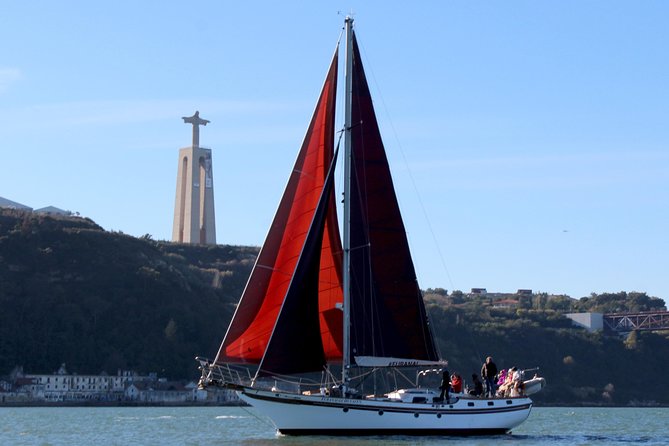
Crossing the river sights toward the southern bank, you get a view of the statue of Christ, Cristo Rei. It stands high above the Tejo Estuary and depicts Christ with arms raised, blessing the city.
Cristo Rei was inaugurated in 1959 as a way for the Portuguese episcopate to thank God for sparing Lisbon during World War II. From the water, it becomes more than a statue. It feels like a watchtower for the river, visible and steady as the boat keeps moving.
This is also one of the moments where the river itself becomes part of the composition. You can frame the statue with the waterline and Lisbon’s riverfront, and the distance helps the image feel depthy without needing heavy editing.
Almada and the marisqueiras: where the locals eat
The itinerary includes the riverfront area of Almada, a small city across the Tagus that you can reach by ferry from Lisbon’s Cais do Sodré. Right by the Almada boat station, you find traditional seafood houses called marisqueiras, where you can get a glimpse of a sweeping view of much of Lisbon across the water.
I like this stop because it adds a daily-life angle. Lisbon’s monuments are dramatic, but food neighborhoods are what keep a place alive. Even if you do not go ashore, the view from the boat gives you context for where people gather and eat.
If you are a foodie, this is a gentle nudge to plan one meal across the river on a different day. If you are not, the visuals still work, because Almada’s waterfront perspective makes Lisbon’s layout easier to understand.
Praça do Comércio: the grand finale on the Tejo
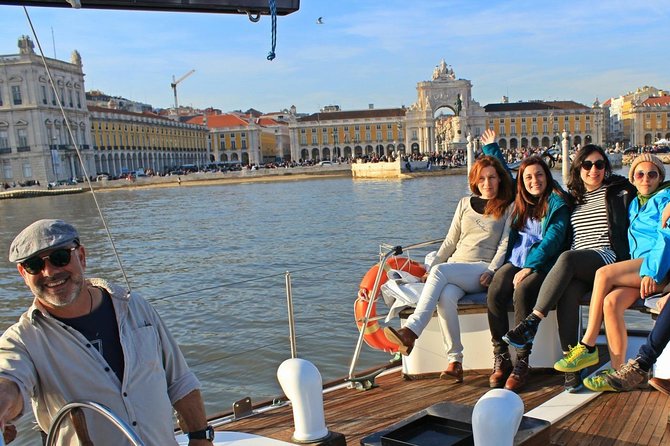
Toward the end, the boat brings you alongside the Praça do Comércio, Lisbon’s grandest plaza opening to the Tejo Estuary. The area is famous for its decorative yellow Pombaline architecture around three sides, and the Arco da Rua Augusta is the focal point in the plaza.
From the water, Praça do Comércio looks formal and open at the same time. The river acts like a wide stage, and the buildings frame it like a theater set. It is the kind of finish that makes the earlier monuments feel purposeful, not random.
This is also a great time to slow down your photo routine. Watch the light hit the buildings. Notice how the reflections sit on the river surface. If you are doing this as an evening event, the plaza and surrounding facades often look best when you let your eyes adjust rather than constantly zooming in.
Wine, cheese, charcuterie, and why the food matters on a sail
The onboard experience includes white and rosé wine along with cheese and charcuterie. Water is also provided, and in cooler moments, blankets show up to keep you comfortable.
I like that the food is simple enough to fit the setting. On a sail, you want light bites, not a heavy meal that makes everyone sleepy. The cheese and cured meats also pair well with the river breeze and the slow rhythm of the boat.
That said, there are a couple of considerations to keep it real. Some people noted that wine pours can feel modest for a full two-hour cruise, with only a couple of glasses served, and a small board after a while. If your priority is a high-volume drink experience, you might want to temper expectations.
Still, the overall theme is clear: people love the combination of good views plus small-group comfort plus an onboard grazing moment, not a formal dining setup.
Daylight or sunset: picking the right timing for your style
This experience can be booked for daylight or sunset. If you are traveling with limited time, daylight can be a smart choice because you get crisp views and more forgiving visibility for photos. You also miss some of the chill factor that the Tagus breeze can bring.
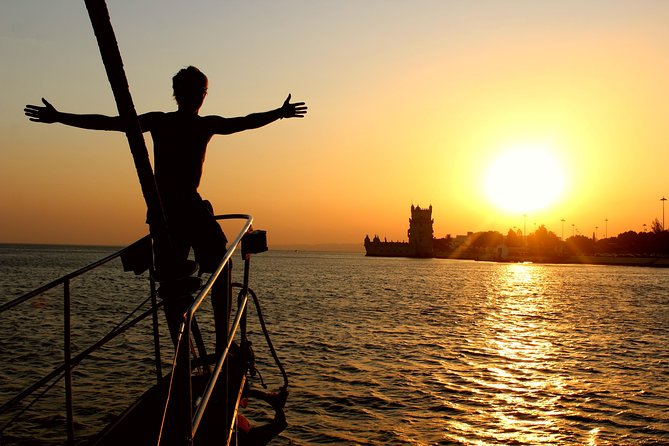
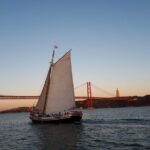
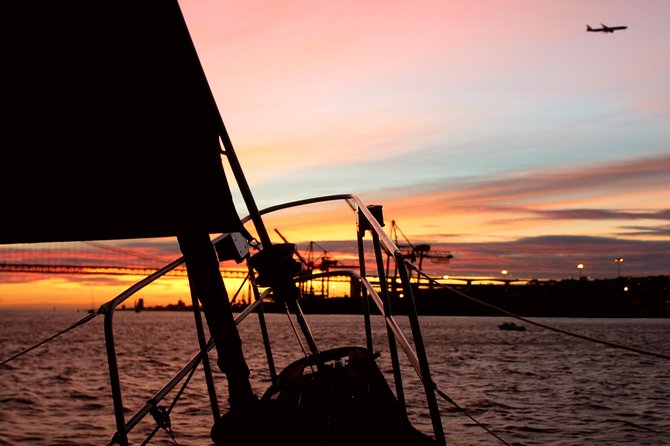
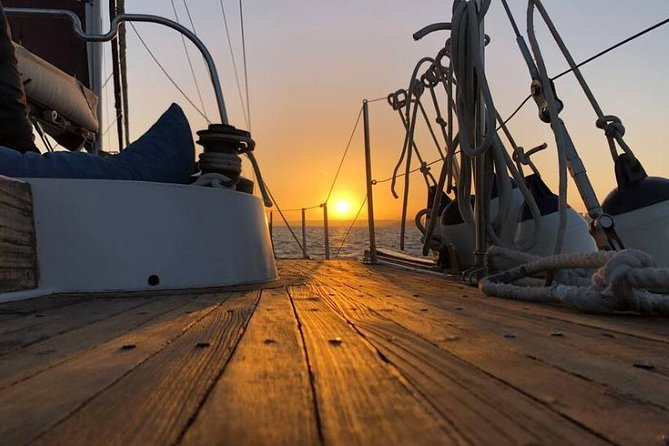
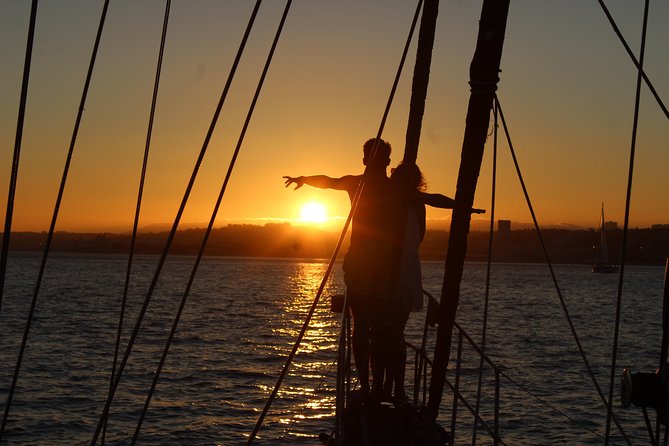
For sunset, the payoff is obvious, the sky changes color and the monuments look softer. A vintage sailboat makes that especially pretty because the motion and the light feel connected. Plus, if you time it right, you can catch the shift as the city transitions from day brightness to evening glow.
My advice: choose sunset if your goal is mood and memory. Choose daylight if your goal is maximum detail and fewer lighting surprises.
Small-group comfort: what 12 travelers changes on a boat
The boat caps at 12 travelers, which is a big deal in practice. On this kind of route, spacing matters. You want room to sit comfortably, move when the landmark is on your side, and not feel boxed in.
The reviews also point to comfort details that matter on the Tagus breeze, bean bags or chairs and some lay-down beds depending on setup. That kind of seating turns the cruise into something you actually relax on, instead of constantly perching.
And since this is a sailing-focused experience, the crew tends to keep things easy, polite, and responsive. People repeatedly describe the skipper and his partner team as attentive without being overbearing, which makes the whole ride feel personal.
Who should book this Lisbon sail (and who might skip it)
This is ideal if you want a calm, scenic Lisbon evening without the party-boat atmosphere. It is especially good for couples and small groups who want to talk, look, and take photos without loud interruptions.
It also works well if you are a first-timer to the river. Seeing the Tagus landmarks in one coherent loop makes your Lisbon map clearer fast.
You might skip it if you expect a nonstop bar experience, or if you need super-structured, museum-style narration the whole time. It is more relaxed than that by design.
Should you book this Lisbon vintage sailboat?
Yes, if you want a two-hour Lisbon experience that feels personal and scenic, not chaotic. The combination of a vintage sailing boat, landmark spotting from skipper Angelo Oliveira and team, and wine plus cheese and charcuterie onboard makes the value feel sensible. And the small group size is the difference maker, it keeps the vibe calm and the views easier to enjoy.
Book it if your evenings are open and you care about sunset mood, or if you want daylight views with a slower pace. If you are worried about finding the dock, arrive early and take your time getting oriented.
Bottom line: this is a thoughtful way to see Lisbon from the river, with just enough guidance to make the scenery meaningful and just enough comfort to make the time fly.
FAQ
How long is the sail?
The cruise runs about 2 hours.
What is the group size?
This activity has a maximum of 12 travelers.
What language is offered?
The experience is offered in English.
What food and drinks are included?
You are served white and rosé wine, plus cheese and charcuterie, and water.
Where does the tour start?
It starts at Clube de PadelDoca de Santo Amaro, 1350-353 Lisboa, Portugal, and it ends back at the meeting point.
What is the cancellation policy?
You can cancel for a full refund up to 24 hours in advance. If it is canceled due to poor weather, you will be offered a different date or a full refund.
More Evening Experiences in Lisbon
More Boat Tours & Cruises in Lisbon

More Tour Reviews in Lisbon



Not for you? Here's more nearby things to do in Lisbon we have reviewed








Lisbon City Tours, side by side.
 ★ 5.0Lisbon City Center Tour – The Unmissable LisbonTickets from $322,234 traveller reviews
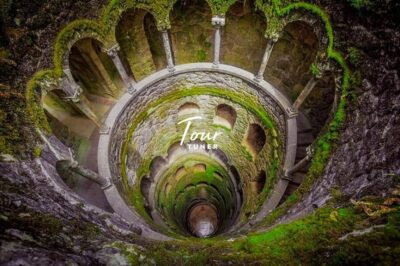 ★ 4.7Sintra, Pena, Regaleira, Cabo da Roca & CascaisTickets from $2319,656 traveller reviews
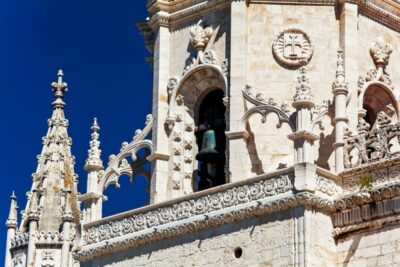 ★ 4.1Jerónimos Monastery Entrance TicketTickets from $2114,164 traveller reviews
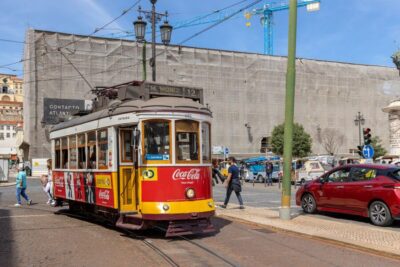 ★ 4.8History, Stories and Lifestyle Walking TourTickets from $2910,902 traveller reviews
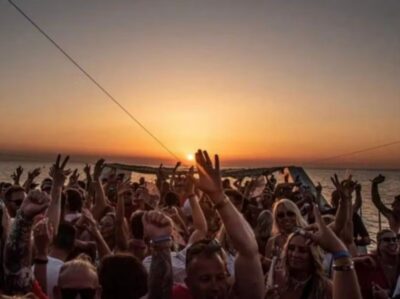 ★ 4.5Sunset Boat Party Cruise with DJ and Open BarTickets from $2710,378 traveller reviews
 ★ 4.7Pena Palace, Sintra, Cabo da Roca, & Cascais DaytripTickets from $919,981 traveller reviews
 ★ 4.6Oceanário de Lisboa Entrance TicketTickets from $299,943 traveller reviews
 ★ 5.0True 4Hour Private Tuk Tuk Tour: Discover Lisbon with a Local!Tickets from $1088,008 traveller reviews
More useful lists for this tour